2 Corinthians 5:14-21; Luke 10:29-37
Of all of life’s difficult questions, perhaps the most challenging concerns suffering. It can be put very simply: Why do good people suffer? Of all the saints whose life most clearly poses that question it is the young girl known as St. Germaine.
She was born Germaine Cousin in 1579 in Pibrac, a small village in south central France. When Germaine was just a baby her mother died. Laurent, her father, soon married a woman named Hortense who for some reason intensely disliked Germaine. It may have been because Germaine was born with a deformed arm, prone to illness, and suffered from a disease that caused unsightly, discharging lesions on her neck.
Under the pretense that she might infect others, Hortense insisted that the little girl live outside, either in the unheated barn or under the stairs. So, Germaine slept on mat, was given only table scraps to eat, and never owned a pair of shoes. By the age of five, Hortense forced her to work every day shepherding sheep or spinning a quota of wool, a difficult task given the deformity of her arm. Regardless, failure meant starvation. As if all this weren’t enough, neighbors saw her stepmother regularly beating the child.
Her one consolation was also the greatest; Germaine loved our Lord and His Mother. Denied a formal education, she taught herself enough about the faith to receive First Communion. She loved adoring and receiving Our Lord in the Holy Eucharist and never missed daily Mass even though this meant leaving the flock, which she innocently and simply entrusted to the Good Shepherd. No harm ever came to it. She loved to pray the rosary and would fall to her knees to recite the Angelus at the sound of the bells, no matter where she was. The other children noticed Germaine’s piety and would gather around her to listen as she taught them about Jesus and Mary.
Adults also noticed but dismissed her as either a lunatic or religious fanatic. Still, no one could deny her charity. Even though all she had to eat was bread, she gave it to the poor whenever she came upon them. When some townspeople witnessed the waters of a local stream part for Germaine on her way to holy Mass, everyone began to realize that God was specially present to this starved, frail, abused young girl.
Once this news reached her family, they began to repent. Her father finally put a stop to his wife’s abusive behavior and offered his daughter a place at home with the other children. In her humility, Germaine begged to be allowed to remain outside and it was there, early in the summer of her 22nd year, that her father found her. She had passed away during the night, lying on her bed made of twigs.
The life of St. Germaine is so compelling, so heartrending that we cannot help but ask again: Why would God allow such suffering to happen? I think that before we focus on God, we should use the story of St. Germaine to take a deeper look inside ourselves.
First, we cannot blame God for the suffering we willfully inflict on each other. Of her own free will, Hortense banished Germaine from the house, starved her, overworked her, and beat her. While few of us have ever gone this far, we have all found ways to hurt others. In anger, pain, or frustration, we’ve banished people from our lives, starved them of affection, demanded too much from them, and even been verbally abusive toward them. Like Hortense, they may be some of the people closest to us.
Then there is the suffering we don’t cause but also don’t do anything about. Laurent stood idly by for years and allowed his wife to abuse his daughter. On top of this, neighbors watched in silence as Hortense physically abused Germaine. They may have thought it was none of their business, but the parable of the Good Samaritan reminds us that the true neighbor is the one who shows mercy (Luke 10:35-37). Again we must ask ourselves how we are Good Samaritans to the hungry, sick, addicted, imprisoned – all the needy of our time.
Finally and most mysteriously, there is suffering that just seems to happen. No one caused Germaine’s birth defect, frailty, or skin disease. We look to God and wonder why He would allow anyone to suffer like this.
 Although we cannot know the answer in this lifetime, the example of this little saint gives us some insight into it. St. Germaine did not endure suffering, she triumphed over it. Suffering was not a test given to her but a means through which she might glorify God and sanctify herself. No one likes to have misfortunes or hardships come their way, but how would virtues such as fortitude, patience, humility, or long-suffering develop without them? Without virtue, the terrible conditions in which Germaine found herself would have been a living hell; with them, they became a sanctifying fire. Thus, it was not anger or revenge but love of Christ that impelled her (2 Corinthians 5:14); for the sake of that love she drew closer to Him and in imitation of it she brought others to Him. Such is the marvelous, inscrutable way of God that Germaine would become the instrument by which Hortense herself, the source of so much of her suffering, would repent and be converted.
Let the example of St. Germaine always remind us that we are not defined by what we’ve been given but by what we give; not by who we are but by who we become; and not by our suffering but by our God-given dignity.
St. Germaine, pray for us.
 No one can give what they do not possess. Father Anthony possessed great faith and great charity, but what transformed him from service in an Augustinian monastery to service as one of the greatest preachers and teachers of the faith was his love of Christ, shown in his constant willingness to discern and pursue the call of Christ in his life as well as his desire to keep Christ at the center of his life. As he once so eloquently said, “If you preach Jesus, he will melt hardened hearts; if you invoke him he will soften harsh temptations; if you think of him he will enlighten your mind; if you read of him he will satisfy your intellect.”
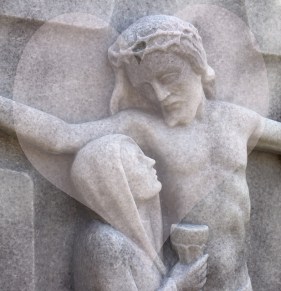 The life of Blessed Diana d’Andalo shows us that to those docile to His promptings the Holy Spirit will show both the greatness and the folly inside ourselves. Diana’s folly lay in the selfishness and will to dominate that has plagued mankind since it first heard the voice that whispers You can be like God (Genesis 3:5). Her greatness lay in her steadfast determination to conquer any enemy, especially herself; to cast aside all fear, remain in God’s love, keep faith in Christ, and abandon herself to the power and working of the Holy Spirit, that her love for God and her neighbor may be made as perfect as possible.
 Norbert did not become a saint because he fell off a horse and heard a Scripture verse; he became a saint because he took a hard look at himself and realized that he had no idea what happiness is. Happiness is beatitude, or eternal union with Christ. As a young man he once aspired to imitate Christ through Holy Orders, but when that life looked difficult and a worldly one much easier, he allowed himself to settle for less. We aren’t so different. In our own spiritual lives, we sometimes try to draw closer to Christ by setting some new and ambitious goal, only to find how hard it is to do in practice. Like Norbert, we end up settling for less and allowing other more worldly things to come between us and a closer union with God.
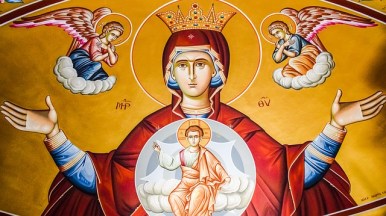 The first reading closes with this exhortation from St. Paul: Rejoice with those who rejoice, weep with those who weep. Have the same regard for one another; do not be haughty but associate with the lowly; do not be wise in your own estimation (Romans 12:15-16). What better or more fitting words are there to describe her whose very soul rejoices in God, her Savior? In the fullness of the grace bestowed on her as a singular gift of God and there visiting Elizabeth and pregnant with the Christ-child, Mary is the very answer to the question Nathanael would ask, “Can anything good come from Nazareth (John 1:46)?” Anything good, indeed! Only she, who by her fiat consented to bring the world Goodness itself; she, not wise in the world’s estimation yet wise enough to leave us with the best advice a mother could tell her children, Do whatever he tells you (John 2:5).
 Leaving Mass, the priest or deacon will say, “Go and announce the gospel of the Lord,” or “Go in peace, glorifying the Lord by your life.” This is our mandate, our call. We have each been given our own unique gifts, not meant only for ourselves. However we do it, our lives are to be a love song to Christ for the world. That our song may be rejected isn’t important. What matters to God is that we sang it for everyone to hear.
 Love is also an act of the will, and to love like Christ requires cooperation with divine grace. This is the love that we are all called to; the love constantly reaches out even to those who push it away; that speaks of healing even to those content only to wound; that speaks of light even to those who love the darkness; that echoes to our neighbor the same words that inspired the artist to paint that famous image of the true Light of the World knocking on the door of our heart: Behold, I stand at the door and knock. If anyone hears my voice and opens the door, then I will enter his house and dine with him, and he with me (Rev 3:20).
 The men and women who we remember today may or may not have had faith in Christ, but in the end what matters is that somehow He spoke to them. In some way known only to Him, Jesus answered their life questions by asking them to be willing to configure themselves to Him; if need be to let go of everything, including their lives, that others may live. Of course, God is never outdone in generosity; we know by the same faith handed on from Peter that each of these fallen soldiers has gone to meet Him face to face and, if so willing, have come to understand the value of the great truth that has confounded mankind throughout the centuries: That only by dying to ourselves do we most truly live; only by letting go of what we want the most do we hold onto what is most truly important: Eternal union with God who is Love itself.
 I remember once talking to my mother as my kids were growing older and leaving home. I questioned whe
 The peace of Augustus won him an altar, the peace of Christ, a cross. Yet look at the result. How many people kneel before an image of Caesar’s Altar of Peace and how many before an image of the cross? The Roman Empire handed Jesus its darkest,
  Mark 10:45