Readings: 2 Corinthians 4:7-15; Matthew 20:20-28
As a young man I attended a classical guitar concert by an internationally recognized master. It was glorious; the music seemed to flow from him as effortlessly as breathing. Inspired, I thought, “I want to play like that,” but when I tried I realized that inspiration is one thing but performance something entirely different.
Masters in any discipline make what they do look easy. Their work is inspiring and tempts us to believe that we can do it, too. We probably can, but to do so we first must realize that inspiration isn’t enough; commitment is what is needed.
Perhaps this is what happened to the Apostle James who we remember today. He, his brother, and all of the Apostles watched Jesus teach, heal, and perform wondrous miracles to the adulation of the crowds. Maybe the glory of it all got to him; maybe he was fooled into thinking that such success comes easy, that whatever Jesus did he could do. This would explain why, when Jesus asked James and John if they could drink the chalice He was going to drink they replied, We can (Matthew 20:22).
 Of course they could; the question was, did they know the cost? As Pope Francis once said, “I distrust a charity that costs nothing and does not hurt.” Jesus is Charity itself; God is love and there is no greater love than to die that others may live. Such a love virtually promises to hurt. Where James may have imagined sweet wine, a crown of leaves, and the cheers of a crowd, Jesus offered bitter gall, a crown of thorns, and a crowd cheering to see Him die.
This kind of love asks much; it may ask everything. Still, remember that the Holy Father also said, “Genuine love is demanding, but its beauty lies precisely in the demands it makes.” If we cannot see beauty in the cross, thorns and rejection, consider St. Paul’s perspective in the first reading. Who was ever more afflicted than Christ? Who more persecuted or struck down? Yet He was not constrained, not abandoned, not destroyed. Nor are we; rather, we are raised to new and eternal life. This is why Paul exhorts us to carry in ourselves what James and the other Apostles carried: the body of the dying Jesus (2 Corinthians 4:10). He knew under the only inspiration that matters – the Holy Spirit – that the one who raised the Lord Jesus will raise us also… and place us with you in his presence (2 Corinthians 4:14).
Although drinking from the chalice is not cheap, the reward is infinite. By so doing we commit ourselves to these life lessons of Christ, the Master: That true freedom is found only in obedience; that the greatest of leaders is the least of the servants; that the conqueror is the one who yields; and that the one who most truly loves life and lives it to the full is the one most willing to empty themselves even to death, that others may live.
St. James, pray for us.
 If the Pharisees had been thinking from this perspective they would have realized that the disciples were not just walking through a field wantonly plucking heads of grain in supposed violation of the sabbath; they were following Christ, giving their lives every day of the week, including the sabbath, to the Lord of the Sabbath.
 Like Dickens’ specters, ignorance and want still haunt us today. Modern culture has forgotten God, and this ignorance moves it to see family, life and love as things that can re-defined. Our scriptures today remind us that no Pharaoh, no judge, no culture can re-define what they could never define to begin with. And where our society wants us to believe that we are lost until we find ourselves, let us remember that Scripture teaches us exactly the opposite; we are found when we lose ourselves for the sake of Christ.
 The abbot reminded the king and he reminds us that the church is not a place we run to that we may lose ourselves; it is the place we come to that we may find ourselves. Over the course of his life and reign Henry spent hours on his knees in front of the Tabernacle. He may have meant to empty himself of his problems but Christ had a different plan; He desired to fill him with the grace that would enable him to face and overcome his problems.
 One night, eight years into a 30-year sentence for the murder of a young girl who had refused his advances, Alessandro Serenelli fell asleep. Suddenly, where his prison cell had been he now saw a beautiful, sunny garden and a girl approaching. As she drew near, he recognized her as Marietta, the girl he had slain. Fearful and wanting to flee but unable to, he watched as she bent down, picked several lilies, and offered them to him. As he took them, they changed into flaming lights. He counted fourteen of them; one for each knife wound he had once inflicted on her. She then smiled at him and said, “Alessandro, as I have promised, your soul shall someday reach me in heaven.”
 This is the freedom that changes not only our own life but the lives of others as well. Consider how Elisha’s freedom to follow Elijah affected the lives of others. What would have become of all the people Elisha touched in his ministry had he refused the call and simply kept on plowing? In our own time, think about how the choices we make affect the lives of others. Where would the moral development of our children be if we chose to ignore what God has taught us? What would our relationships look like if we ignored St. Paul’s exhortation to serve one another through love (Galatians 5:13)? God’s call changes all of us no matter how we choose. If we accept it we grow closer to Him and bring others closer to Him as well; if we refuse or ignore it we distance ourselves and may well keep others from Him. The choice is ours.
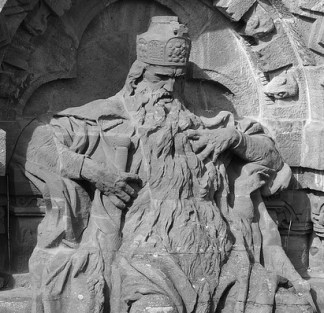 Although he was as willing to follow Jesus as the scribe in the gospel, Cyril did not lose his personality in the process. By all accounts, he was imposing, impetuous, impatient, perhaps even infuriating. He wasn’t always the perfect picture of sanctity or the epitome of virtue. Very few saints are. Sinners and saints fight the same battles, share the same temptations, and struggle with the same demons. They differ only in their response to them. The sinner looks to himself or to the world for strength; the saint looks to Christ alone. This is what Cyril knew and what St. Paul meant when he told the Corinthians:
 This may sound easy but we know it isn’t, for we too are twisted iron. Perhaps we can’t enter religious life to get twisted straight but we can enter into the silence of our thoughts and the privacy of the confessional to learn how to deal with the sins that are holding us back. Whatever they are, the example of St. Aloysius shows us that while change may be difficult or painful, it is possible.
 It took a long time – generations – but the Church in Europe triumphed even over the seemingly invincible Vikings. I say “seemingly” for we who hear the words of Christ in the gospel know that in reality the Vikings never had a chance. All they had were swords, brute strength, and a fierce warrior spirit; what is that against the gentle, persistent, indomitable power of God? Through the ministers of the Church, the Spirit of God flowed over that mighty Norman rock and carved it into a force that would defend and promote the faith they once mocked for yielding so easily.
 Mark 10:45