Tag: Mother of God

  • Feast of the Nativity of the Blessed Virgin Mary

    Feast of the Nativity of the Blessed Virgin Mary

    Micah 5:1-4a; Matthew 1:1-16, 18-23

    It’s tempting on this Feast Day to turn to the 2nd century Protoevangelium of James and consider its many details on the birth and childhood of the Blessed Virgin Mary. After all, Scripture is silent about these things and it’s a good day to set aside some time to contemplate them. There is nothing wrong with that; it’s good, pious reading. However, it is not the mind of the Church to read the Protoevangelium at her sacred liturgies; it is not part of the canon of Sacred Scripture. So the question is, what does Sacred Scripture tell us today with regard to Mary?

    Firstly, Scripture tells us something simply in the silence itself. In its own way, silence speaks volumes. Saints have gone into ecstasy contemplating the hidden years of our Lord; I think the hidden years of the Blessed Mother’s life are also fertile ground for contemplation. Consider one possible fruit: Humility. Christ himself labored for decades in the silence and obscurity of Nazareth; Mary was content to live her entire life that way. How much more can we benefit from laboring for God in quiet imitation of them! Growth in humility is death to our own pride and vainglory; as St. Paul said, Think of what is above, not of what is on earth. For you have died, and your life is hidden with Christ in God (Colossians 3:3). Truly, Mary’s life was the epitome of what it means to be hidden with Christ in God.

    Secondly, sometimes when Scripture speaks in reference to Mary it does so indirectly. A good example is the gospel today, which is one of my very favorites. There are a few remarkable things about it but in reference to the Blessed Mother two things in particular stand out.

    First, God makes clear that women have a crucial role to play; sometimes predictable, sometimes not. We are familiar to some degree with the women prophets of Scripture such as Miriam, Deborah, Huldah, and the mysterious prophetess of Isaiah 8:3, but they don’t appear in the genealogy. Four women (apart from Mary) do: The first, Tamar, is twice-widowed of the sons of Judah and harshly treated by him, but cleverly tricks him into fathering her sons Perez and Zerah to get family support. Next comes Rahab, the Canaanite harlot who lied to help the Israelites conquer Jericho and thus preserved her family’s lives and freedom. Third is Ruth, the Moabite and widow who secured a bright future for herself and her mother-in-law by boldly lying next to the half-drunk Boaz in the fields and suggesting marriage. Finally, there is Bathsheba, wife of Uriah, whom the jealous, lustful King David had put to death that he might marry her. Bathsheba becomes mother of one of the great kings – Solomon.

    But it’s not only the women. The entire genealogy is a wonderful example of how God can, as St. Paul said, make all things work for good for those who love God, who are called according to his purpose (Romans 8:28). Our Lord’s family tree runs the gamut from the famous (Abraham, Isaac, Jacob, David, and Solomon), to the infamous (Manasseh), to the obscure (Achim, Eliud and Matthan). Each one, man or woman, Jew or Gentile, saint or sinner, cooperated with God, defied Him or both; regardless, his purpose was never frustrated but written with straight lines through all the crooked generations directly onto the immaculate heart of a young girl born of Anna, betrothed to Joseph, hailed by the angel as Full of Grace, and asked to be the Mother of the Only Son of God. If God can do all this with them, think what He can do with us.

    We who remember Mary on her birthday do well to remember the lessons from these Scriptures, for they teach not only how God works with us but how He comes to us: Not in the bluster of the mighty or those zealous for the limelight, but in the silence and obscurity of the hidden life; not in the mighty wind, the earthquake, or the fire, but in the still, small voice of a tiny baby born in a village too small to be among the clans of Judah yet big enough to hold the heart of infinite mercy and love. And we do better to ask the intercession of Mary’s Immaculate heart for the grace to say in our own lives what she said to the angel: Behold, I am the handmaid of the Lord. Be it done unto me according to thy word (Luke 1:38).

    Holy Mary, Mother of God, pray for us.
  • A Mother’s Love: Memorial of the Blessed Virgin Mary, Mother of the Church

    Acts 1:12-14; John 19:25-34

    If my mother said one thing to me consistently from the time I can remember, it was that she loved me. She said it all the time. When she felt the need to go beyond that, she’d say, “You will never know how much I love you until you have children of your own.”

    To me, that’s a way of saying that the deepest love cannot be described, it can only be experienced. That may be true, but perhaps science has begun to come close. I came across a recent study that tried to capture the bond between a mother and her children neurologically. In one part, a group of mothers were shown images of people under stress and asked to imagine themselves in that situation. Various brain responses were recorded. Next, they were asked to imagine their children in those same situations and were again measured. The responses of many of these women were nearly identical in both cases; in other words, mothers tended to feel what their child was going through as if they themselves were going through it. As far as they were concerned, they and their child were one.

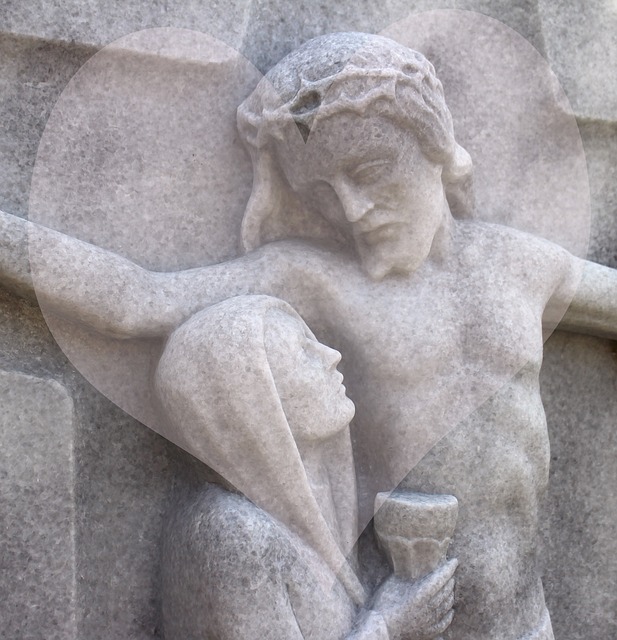
    In light of this, let us pause and reflect on the scene in our gospel reading today. Notice that John, unlike the other evangelists, places Mary right at the cross, not at a distance from it. Our instinctive reaction is to imagine what she felt watching her child suffer so. What mother would not suffer at such a moment, let alone the Blessed Mother? Despite the pain, despite the abandonment of nearly everyone else, Mary remained at his side. Over and above this consider her lifelong, steadfast faithfulness. The gospels make it clear: Mary is the only person to be with Jesus at every pivotal moment of his life from conception to death. She is his mother, but she is his disciple first. Her life is a testament to the advice she herself gave to the wedding stewards at Cana: Do whatever he tells you (John 2:5).

    Knowing that, her Son gives his mother more to do. When Jesus saw his mother and the disciple there whom he loved, he said to his mother, “Woman, behold, your son” Then he said to the disciple, “Behold, your mother.” (John 19:26). Note the high regard Jesus has for Mary. He speaks when he sees her; he speaks first to her; most importantly, he expands her role as mother to now include the ideal or Beloved Disciple. In the words of theologian Fr. Raymond Brown, this is Christ’s last-willed … act of empowerment that both reveals and makes come about a new relationship.”1

    That new relationship is Mary as mother of the Church, for Christ has raised her from being mother of the head to mother also of his Mystical Body. Under the inspiration of the Holy Spirit, the Church proclaims from ancient times that she was born from the wounded side of Christ as he slept the sleep of death upon the cross.2

    jesus-284515_640Mary understood this and, as in all things, obeyed her Lord. That is why in the first reading we find her with the Church – the disciples in the upper room – in prayer. Mary has the most marvelous intercessory role; obedient daughter of the Father, mother of his only Son, and spouse of the Holy Spirit. She is in the perfect position to intercede for the Church.
    Someone once said that the word ‘mother’ isn’t a noun as much as it’s a verb. So today, on the Memorial of the Blessed Virgin Mary, Mother of the Church, consider how Mary’s role from the beginning has been tomother’ people to God by being a model of prayer, discipleship, and unconditional love. And operating on the principle that we will never know how much our Mother loves us until we have children of our own, we must remember that Mary’s model of motherhood is meant to be imitated; we too are called to ‘mother’ people into the Church.

    If we don’t know where to start learning from her, begin with the rosary. From the joyful mysteries alone we learn humility, love of neighbor, poverty of spirit, obedience, and piety. Every major event in her life a mystery, every mystery with its own fruit, every fruit centered on Christ. That is the key; Mary teaches us through the rosary what she teaches through her life; that bringing people to the Church is nothing more or less than bringing them to her Son and allowing him to stir within them the flame of divine love which truly cannot be described but only experienced, and in which we are truly one.

    Mary, Mother of the Church, pray for us.

    Mass, June 1 2020

    1Brown, Fr. R.E., SS (1994). The Death of the Messiah: From Gethsemane to the Grave. New York: Bantam Doubleday Dell Publishing Group, Inc.. p 1021.

  • Mother and Baby: The Solemnity of the Annunciation of the Lord

    Isaiah 7:10-14; 8:10; Psalm 40:7-11; Hebrews 10:4-10; Luke 1:26-38

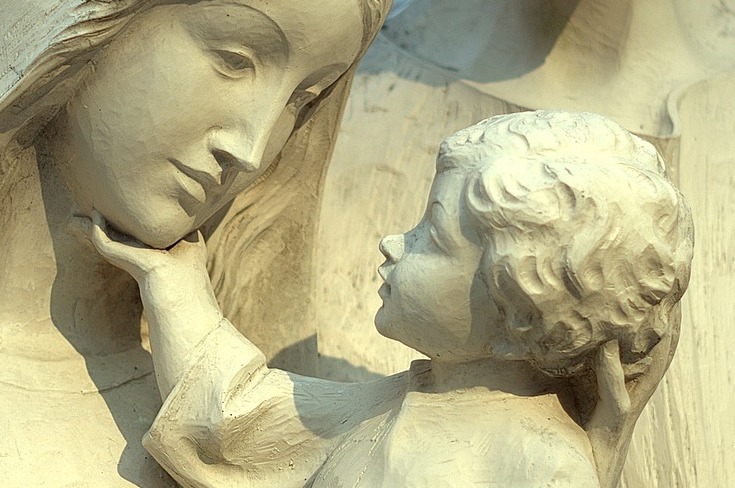
    Everyone knows the bond between a mother and her baby is special and that there is nothing in the world quite like it. But recently I came across some research that taught me things about it I didn’t know and that gave me new perspectives on the Blessed Mother.

    First, there is a physical basis to the phenomenon scientists call the “maternal instinct,” or others know as “Mommy brain.” Others like my older son who as a young child once inspected the back of his mother’s head, searching for the eyes hidden there. He wasn’t far wrong. During pregnancy a woman’s brain actually changes; areas related to the protection and nurturing of her baby develop as never before. This is nature’s way of attuning a mother to the needs and well-being of her children.

    It was no different for the Blessed Mother. From the moment the Holy Spirit came upon her and the power of the Most High overshadowed her (Luke 1:35), Mary began to develop the maternal instinct toward God himself. She alone among all women was to know the singular joy and tremendous responsibility of nurturing the Son of God; of protecting him from and preparing him for the world he came to save; of feeding him who thirsted for souls; and of providing a home for him who sought nowhere to lay his head except upon her breast, first as a helpless babe and then as a lifeless son taken down from the cross.

    It was from the cross that Christ raised Mary’s maternal instinct from the natural to the spiritual. With his words, Woman, behold your son (John 19:26) he gave her motherhood of his disciples, of all those like her who hear the word of God and do it (Luke 11:28). He made the bond complete when he told the Beloved Disciple, Behold, your mother (John 19:27), for in imitation of her Son we too have nowhere else to lay our heads. As her spiritual children we trust her, as he did, to see to our well-being and protection.

    The second thing I learned about the bond between mothers and babies is that children learn to recognize their mother’s voice in the womb and even prefer the language she speaks to any other they hear. By the time he was born, Mary’s voice was already very familiar to Jesus. And of course he prefers her language, for she speaks the language of total and selfless love. This is why we ask the Blessed Mother to speak to Jesus on our behalf; hers is the voice he heard from the time he was old enough to hear anything at all, the voice he could not refuse at Cana. Once again in imitation of him, Mary’s is the voice we too must not refuse, that says to us what it said to the servers at the wedding feast at Cana: Do whatever he tells you (John 2:5).

    Finally, I learned that perhaps the most important aspect of the bond between mother and baby is responsiveness. From the womb, mothers instinctively respond to the needs of their babies, giving from their own bodies whatever they have to give. This continues into childhood. Studies have shown that children thrive when their mothers respond to them in ways that foster growth and security; these especially include support and encouragement in difficult or stressful times. As Scripture makes clear, our Lord was no stranger to difficulty or stress, from his birth in a stable and flight into Egypt to his suffering and death on the cross. But Scripture also makes clear that Mary was with him at each of those times; in fact, she is the only one in all of Scripture to be present from his conception to his ascension. As such, Mary is the epitome of the supporting and encouraging mother.

    mother and baby

    One phrase in the readings perfectly summarizes the bond between Mary and her Son: I come to do your will (Psalm 40:8-9; Hebrews 10:7). For Mary this meant motherhood born of a love for God so deep that she, as Augustine once said, would conceive Christ in her heart before her womb. For Jesus it meant the Incarnation; a love so deep that he would take his own creation’s flesh and offer it back to his Father for the redemption of all who would accept him. Their obedience sets the pattern for us for we too are called to the same kind of obedience; to conceive Christ in our hearts; to offer to the Father the gift of ourselves in total dedication to Him; to love as Jesus and Mary loved. Without grace this is not possible, but this is the great hope of the Solemnity of the Annunciation, when the angel reminds us as he told the Fullness of Grace: nothing will be impossible for God (Luke 1:37).