Exodus 11:10-12:14; Matthew 12:1-8
I remember pulling a priest aside after Mass one Sunday to ask him about a verse in Scripture that I didn’t understand. It appears in today’s gospel but also in various forms in both the Old and New Testaments. As spoken by Jesus, the verse is, If you knew what this meant, ‘I desire mercy, not sacrifice’ (Matthew 12:7).
If you knew what this meant. That was exactly my question; what does it mean for God to say I desire mercy, not sacrifice? It turned out that Father didn’t know. If you don’t know either, then apparently we have lots of company, including the Pharisees – those ostensibly pious laypeople who loved to snipe at Jesus, this time for looking the other way while his disciples plucked heads of grain from a wheat field on the Sabbath.
A better understanding requires us to go to the source, a verse that appears in the book of the prophet Hosea. In the translation approved by the American bishops the verse reads: For it is loyalty that I desire, not sacrifice, and knowledge of God rather than burnt offerings (Hosea 6:6). In place of “loyalty” other translations use “love” or “mercy.” It can be all of these because the original Hebrew word, hesed, defies easy translation. Perhaps it is best to think of hesed as the infinite love, mercy, and faithfulness of God. Thus, Jesus underscores the prophet’s teaching that God desires love, mercy, and faithfulness, not sacrifice.
It’s easy to understand God desiring that we love as He does but doesn’t God also desire sacrifice? It would seem so. Consider the Mass. We call it the holy sacrifice of the Mass; in it we go out of our way to remember the sacrifice of Abraham our father in faith, and the bread and wine offered by the high priest Melchizedek. In confecting the Eucharist we recall the Last Supper, when Christ celebrated the Passover meal with the Twelve. The first reading outlined the ritual in some detail, especially its central event: the sacrifice of a young, unblemished lamb which was a type or foreshadowing of the great memorial sacrifice of Christ, the one true Lamb of God.
However, we also recall at Mass not that our sacrifice be desirable but that it be acceptable. Before the consecration the priest explicitly asks us to pray “that my sacrifice and yours may be acceptable to God, the almighty Father.” Our acceptable sacrifice consists of everything we have laid upon the altar at the Offertory in union with the bread and wine – our entire selves if we so will it – freely offered out of love to the Father, with Christ and through the working of the Holy Spirit.
Our self-offering is not only acceptable to God but also precious to him. As parents we accept every gift our children give us but we reserve a special place in our hearts for the gifts that are hardest to give, for we understand the sacrifice involved. After all, that is what sacrifice is: Something precious completely surrendered out of of love for the person who receives it. If such gifts are precious to us, imagine how much more so they are for our Heavenly Father, who understands better than anyone the meaning and love behind them, especially those that cost us the most. As we also know, nothing is harder to give away than our most prized possession – our very self.
 If the Pharisees had been thinking from this perspective they would have realized that the disciples were not just walking through a field wantonly plucking heads of grain in supposed violation of the sabbath; they were following Christ, giving their lives every day of the week, including the sabbath, to the Lord of the Sabbath.
So then, why does Christ want us to remember that God desires mercy, not sacrifice? To remind us of two important truths: First, no sacrifice is fruitful if done without love, especially those offered to God; and second, love is most fully expressed when we offer to God what is most pleasing, most precious, and most difficult to give: Ourselves as a holy and living sacrifice (Romans 12:1).
As Jesus noted, king David understood this. Despite his many faults, the same king who begged of the high priest the holy bread also had the humility to pray:
… You do not desire sacrifice or I would give it; a burnt offering you would not accept. My sacrifice, O God, is a contrite spirit; a contrite, humbled heart, O God, you will not scorn (Psalm 51:18-19)
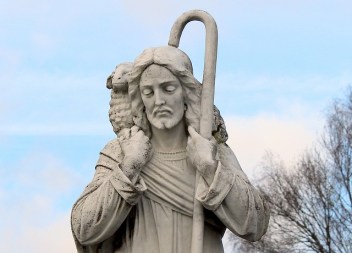 The answer can be read between the lines of our Lord’s question in today’s gospel: He doesn’t want any to be lost. He wants the shepherd to go out and find them. Even one.
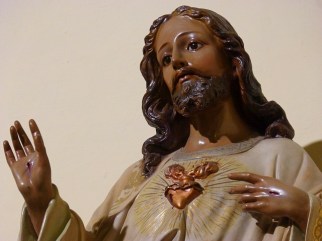 Jesus spent his life and ministry showing us what it means to love as God loves: He made himself vulnerable in the sight of others, exposed his deepest longings, deepest fears, deepest joys, his deepest self. Of course, he risked rejection and it cost him his life, but that is what love does; it was in the nature of his perfect divinity that from the depths of his infinite love and mercy, he glorified what mankind so quickly crucified.
 Jesus could; Jesus did. He “took” the loaves and fish, “looked” to heaven, “said” the blessing, “broke” the loaves, and “gave” them to the disciples. If that sounds a lot like the actions of Jesus instituting the Eucharist, that’s because it is. In feeding the multitudes, Jesus showed that only God could carry the world; only God could unite a house divided. The Eucharist foreshadowed by Christ in the gospel is the sacrament of unity; it is the antidote to the enemy within that seeks to divide.
 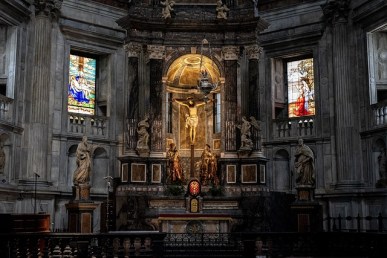 The complication is that our senses can actually keep us from seeing the spiritual reality. We become so preoccupied with what they’re telling us that we miss what lies beyond them. When I walked through St. Mary Major I saw every artistic and architectural wonder she could reveal but missed the revelation that all of it pointed to, the greatest one possible – Christ in the most holy Eucharist. As for the people at Mass, they were also at risk of preoccupation, not with works of art but with their own thoughts or problems. In either case, the task before us is to concentrate on the glory being revealed to us, for it alone is the more lasting and soul-satisfying.
 Today we honor Saints Joachim and Anne, the parents of Mary, for many reasons related to salvation in memory and reality. Most especially we honor them as husband and wife, for it was their marriage, their union that produced the Immaculate Conception, which transformed the dim, distant memory of salvation into a living, breathing, crystal clear reality. We also honor them because, as the last of that long line of generations who patiently waited through the long night for the first rays of salvation’s dawn, doing so honors all the faithful who lived through and, in whatever ways they could, passed on the events of salvation history to those who came after. Finally, we honor them as parents, for they raised their daughter in the faith, taught her the love and goodness of God, and instilled in her the devotion He preferred for the mother of His Only Son.
 Of course they could; the question was, did they know the cost? As Pope Francis once said, “I distrust a charity that costs nothing and does not hurt.” Jesus is Charity itself; God is love and there is no greater love than to die that others may live. Such a love virtually promises to hurt. Where James may have imagined sweet wine, a crown of leaves, and the cheers of a crowd, Jesus offered bitter gall, a crown of thorns, and a crowd cheering to see Him die.
 Like Dickens’ specters, ignorance and want still haunt us today. Modern culture has forgotten God, and this ignorance moves it to see family, life and love as things that can re-defined. Our scriptures today remind us that no Pharaoh, no judge, no culture can re-define what they could never define to begin with. And where our society wants us to believe that we are lost until we find ourselves, let us remember that Scripture teaches us exactly the opposite; we are found when we lose ourselves for the sake of Christ.
 The abbot reminded the king and he reminds us that the church is not a place we run to that we may lose ourselves; it is the place we come to that we may find ourselves. Over the course of his life and reign Henry spent hours on his knees in front of the Tabernacle. He may have meant to empty himself of his problems but Christ had a different plan; He desired to fill him with the grace that would enable him to face and overcome his problems.
 It took a long time – generations – but the Church in Europe triumphed even over the seemingly invincible Vikings. I say “seemingly” for we who hear the words of Christ in the gospel know that in reality the Vikings never had a chance. All they had were swords, brute strength, and a fierce warrior spirit; what is that against the gentle, persistent, indomitable power of God? Through the ministers of the Church, the Spirit of God flowed over that mighty Norman rock and carved it into a force that would defend and promote the faith they once mocked for yielding so easily.
 Mark 10:45