Tag: Matthew

  • God Will Provide… Right?

    God Will Provide… Right?

    Saturday of the 11th Week in Ordinary Time

    Matthew 6:24-34

    At a parish potluck, many people showed up, but few brought food. I heard one of the volunteers say, “We were all asked to bring a dish to pass; so few did! I’m worried that we’re going to run out of food.” The woman serving next to her smiled and said, “Don’t worry, God will provide.” A few minutes later, the first said again, “I’m telling you, this is a problem. The food is running out!” Again, the other said, “God will provide.” A moment later, I heard the first one mutter, “Fine. Don’t listen to me. What do I know?” Sure enough, about ten minutes later, the food ran out. If I had looked, I’ll bet that I could have seen the words, “I told you so!” written all over that woman’s face.

    The truth is that, at the time, if you’d asked me, I would have told you that she was right all along. However, as I read today’s gospel, things look a little more complicated. Now, I think both women were right, and both were wrong.

    The first one was clearly right about the food running out. But at the same time the other was right to tell her not to worry. Our Lord said as much when he asked, Can any of you by worrying add a single moment to your life? Of course not! Worry does nothing but contribute to that all-too-human tendency to focus on ourselves: I’m worried; I’m telling you; listen to me; I know; I told you so. Maybe that’s why Jesus counsels us to look at the birds and learn from the way the wild flowers grow; he wants us to shift our focus outward, to look and see that God is in control, and understand how He provides.

    This is where the second woman had it wrong. When Jesus said that God feeds the birds, He didn’t mean that God delivers the food to the nest. No, the birds have to go out and get it. In the same way, God provides for us, but that doesn’t mean He will do everything we don’t. We have a part to play in our own salvation, and we have to play it. As St. Augustine once said, “God created us without us, but He will not save us without us.”

    So then, what must we do? On the surface, the answer is obvious: We must have faith. The question is, what does it take to have the faith our Lord is asking of us? I think Jesus tells us, if we read between the lines of the gospel reading.

    The first thing it takes is humility; specifically, the humility to abandon ourselves to the dominion and will of God. We all know how hard it can be to let go of our own ideas, our own perspective, our own desire for control, especially when it concerns our own destiny. It takes real humility to recognize our limitations; to acknowledge that we can’t see everything, know everything, or do everything. Only God can. When I find myself in that place, trying to control what only God can control, I find it very helpful to repeat over and over that simple but powerful aspiration, “Let go and let God.”

    Apart from humility, we must pray for the gifts of patience and fortitude. We might think that as we turn our lives over to God, things will get easier, but often that is not the case, as the book of Sirach reminds us: when you come to serve the Lord, prepare yourself for trials… Accept whatever happens to you; in periods of humiliation be patient (2:1,4). Again, we all know how hard it is to accept the painful or difficult things that happen, or to endure suffering or humiliation. At those times more than ever we must look to the cross and pray for the patience and fortitude of Christ, for in his cross we find not only the pain of his suffering and humiliation but also the joy of his victory over them, and his promise that, if we follow him, we too will overcome whatever life puts in our way.

    Joy is the final word, the fruit of the Spirit whose seed lies hidden in our Lord’s words today. For joy is happiness in pursuit of our good, and as he has just told us, nothing is better than complete abandonment to the God who is goodness itself: the Father, who leaves us nothing to worry about; the Son, who is the Food that never runs out, and the Holy Spirit, the Love that is written all over our hearts.

  • Being Who We Were Made to Be

    Being Who We Were Made to Be

    Solemnity of St. Joseph, husband of the Blessed Virgin Mary

    Matthew 1:16, 18-21, 24a

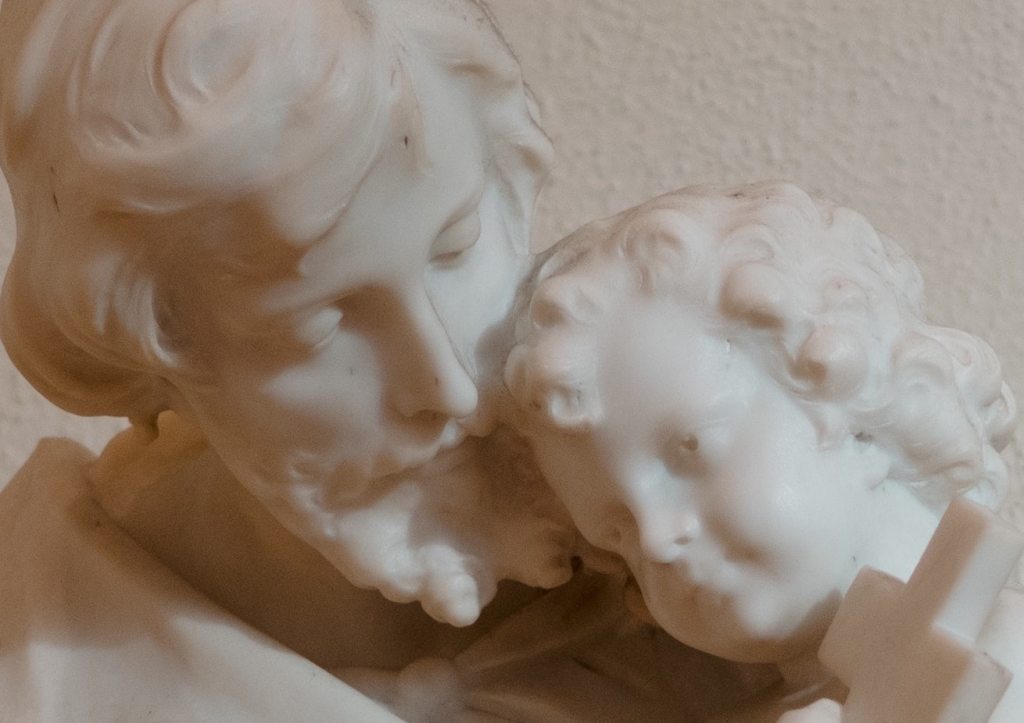
    A theologian once said that “great occasions do not make heroes or cowards; they simply unveil them to our eyes. Silently and imperceptibly, as we wake or sleep, we grow strong or weak; and at last some crisis shows what we have become.”1 When I read that, I wondered if he was thinking of St. Joseph. It fits him so beautifully.

    Joseph was certainly not a man accustomed to great occasions. The ordinary ones were enough: Learn a trade, get married, bring up a family. By the time we meet him in Matthew’s gospel, Joseph had already checked two of those boxes. It was the third that brought about the crisis.

    We know the basic story well: Learning that Mary is pregnant and unwilling to expose her to shame, Joseph intends to divorce her quietly. What we may not know are a couple of details. First, in that time and culture, “expose her to shame” meant the legal right to “make a show” or public mockery of her. That Joseph would not do this speaks of his love for Mary and sensitivity toward her. This brings us to the second point: his intention to divorce her quietly. Where we read “intention,” Matthew’s original word implies a decision made in angst, in the heat of a deep and inner passion. It might even go so far as to mean that Joseph was tempted to feelings of anger, shame, or indignation.

    Who can blame him? How would we feel? Joseph had plans for his life and had worked, maybe even suffered, to achieve them. Now, on the verge of actually realizing them, he found his plans shattered to pieces. Even more, Joseph loved Mary; he knew that divorce meant disgrace for her and the child, not to mention very dim prospects for their future. This was the heart of the crisis. He had to make a decision, to do something, but what could he do? Mary was pregnant, he was not the father, and the law was clear. His decision for a quiet divorce was the best he could think of. Even if it meant pain or distress for the woman he loved so much, the law came from God, who Joseph loved above all.

    This I think is the key. Remember the theologian’s words: “Silently and imperceptibly, as we wake or sleep, we grow strong or weak.” Joseph came to this crisis with a strong moral center; born into the faith of his fathers, he was raised in it, steeped in it, and guided by it. He wasn’t going to abandon it now or ever. No matter the cost to his own or to anyone’s honor, Joseph would honor his heavenly Father first.

    In its section on the 4th commandment, the Catechism lists two qualities of a respectful child: docility and obedience. As they apply to our role as children of God, docility is our readiness to follow God’s will rather than our own, and obedience is our willingness to do whatever God asks of us.

    Joseph had both of these gifts in abundance, and in time God would ask him to use them to their fullest measure. For now, though, what He asked was more than enough: First, that Joseph set aside his plan of being husband of Mary of Nazareth and instead be the husband of Mary, the Mother of God; second, that he set aside any plan he might have of raising his own children and instead raise the Son of God as his own.

    This is a lot to ask, but as we know, God is never outdone in generosity. In return for all Joseph was willing to do, God bestowed many honors on him: Joseph, called ‘son of David’ by God himself, would see the Son of God; Joseph, whose family line had held the God’s promise in their hearts for so long was now chosen to hold His fulfillment in his arms; and he, Joseph, was now the only one ever asked to give that Promise a name: Jesus, or “God Saves.” Ultimately, Joseph would be honored as the greatest saint of all time next to Mary, for as Blessed William Chaminade has reminded us, “To give life to someone is the greatest of all gifts. To save a life is the next. Who gave life to Jesus? It was Mary. Who saved his life? It was Joseph.”

    Let us pray that we become like St. Joseph; that every day, in the silence he modeled so well, we too grow stronger in our love for God, our faith in him, and our willingness to do whatever He asks. Then, like St. Joseph, when our own crises come, as they always do, we too can show God exactly what Joseph showed Him: The person He has called us from all eternity to be.

    St. Joseph, pray for us.

    1 The 19th-century Anglican bishop and theologian, Brooke Foss Westcott.

  • The Paradox of Love: Friday of the 19th Week in Ordinary Time

    Joshua 24:1-13; Psalm 136:1; Matthew 19:3-12

    Today’s readings remind me of that famous scene in the musical Fiddler on the Roof when Tevye asks Golde, his wife of 25 years, do you love me? She replies, “Do I love you? For 25 years I’ve washed your clothes, cooked your meals, cleaned your house, given you children, milked the cow, after 25 years, why talk about love right now?” He repeats, do you love me? “I’m your wife.” I know… But do you love me? She thinks out loud, “Do I love him? For 25 years I’ve lived with him, fought him, starved with him, 25 years my bed is his, if that’s not love, what is?” Then you love me? Finally, she replies, “I suppose I do…”

    Why does this scene remind me of the readings? Because today Scripture focuses on what love is in its essence, and that scene highlights three key aspects of it.

    First, love is a verb. We love not in what we say but in what we do. Through Joshua, God speaks to people who, from the time of Abraham, through the oppression in Egypt, the fleeing, struggling, and starving in the desert, might well have asked, “God, do you love us?” Today we hear God reply: “Do I love you? Remember all the things I’ve done for you, and look what lies before you: You’ve made it to the Promised Land!”

    That reply echoes through the ages to today, to every one of us. We each have our own struggles, physical and spiritual. Through all of them, God isn’t sitting silently in the background; he is in every moment, working in ways beyond our understanding. His work may be unknown to us this moment, this month, or this year, but like the Promised Land, its fruit lies waiting. We must never mistake silence for inaction or indifference; God is eternally vigilant, eternally loving, always acting for our good.

    This brings up the second point: Love is timeless. How fitting that we hear Psalm 136 today, especially the antiphon, His mercy endures forever. The Hebrew word translated as “mercy” is hesed, which includes mercy but implies action, things we do when we are motivated by love and loyalty to someone else. In the scene from Fiddler on the Roof, remember that Golde replied, “After 25 years, why talk about love right now?” To her, the amount of time was not the point; she had committed her life to her marriage.

    Jesus speaks of this kind of commitment in the gospel when he quotes the passage from Genesis that a man is joined to his wife, and the two shall become one flesh (Genesis 2:24). Again to go back to the ancient language, the word for “joined” literally means, “glued.” Imagine gluing two pieces of paper, allowing them to dry, then trying to tear them apart. We know what will happen; the kind of pain and suffering that only such tearing can bring.

    This leads us to a third aspect of love, which in the words of venerable Fulton Sheen is that love is the soul of sacrifice. Recall how Golde replied when Tevye asked if she loved him: all the sacrifices she had made, the things she had endured, for him. But not just for him, for herself as well. Only those willing to make the greatest sacrifice for love’s sake can know the deepest joys that love brings. When it comes to love, joy and sacrifice can never be separated; in married life, in ministry, in whatever kind of service we are called, only those who are most fully open, who risk the greatest vulnerability, can know the deepest, most fulfilling joy: to know and to be known, to accept and be accepted; to love and to be loved.

    As in all things, the best model for all these aspects of love is our Lord, Jesus Christ. Who performed greater works of love than he? Whose love is more timeless? Who is the soul of sacrifice more than he who was willing to empty himself into his own creation to show us that those who risk the ultimate sacrifice of themselves are given the ultimate joy of resurrection to eternal life? Only Christ could most perfectly show us all this, the great paradox of love: that giving is receiving; that most fully knowing means to be most fully known; and that only by dying to ourselves can we reach the promised land of eternal life.

  • Change in His Native Place: Friday of the 17th Week in Ordinary Time

    Matthew 13:54-58

    For me, social media is a mixed blessing. On the one hand, it’s been the best way to find out what my kids are doing; you know, things they hadn’t gotten around to telling me yet, like if they were pregnant or had a new job. Dads really are last to know. But social media can also be problematic. I decided to reconnect with people I knew over 50 years ago at St. Peter’s school. I found one of the kids I hung out with and sent him a note saying, “Hey, it’s me! Do you remember me?” He responded, “Yeah, I remember you. Those poor nuns and priests.” And that was that.

    I wanted to write back and say, “No, no, I’ve changed! I’m not the same kid,” but I let it go. I’ve done the same thing he was doing, maybe we all do – tending to paint people with a broad brush, stereotype them, see them as unchanging. I don’t like it when people do that to me, but I do it to them all the time. Maybe it’s human nature.

    This is similar to what I think happened to Jesus when he went back home. To them, he was just the carpenter’s kid, Mary’s son, who they remembered from the neighborhood. They couldn’t believe that he is or was anything else. And we know the result; Matthew tells us that Jesus did not work many mighty deeds there because of their lack of faith.

    Of course, the irony is that Jesus hadn’t changed. As Scripture says, he is the same yesterday, today, and forever (Hebrews 13:8). We can’t blame the people for not seeing that; his years in Nazareth are called “hidden” for a reason. The problem was not the peoples’ failure to learn about Jesus in the past but their failure to learn from him in the present. They were right to believe he hadn’t changed; they were wrong to believe that their knowledge of him didn’t need to change, either. Like my old classmate, like me, they failed to realize they didn’t know everything they needed to know about him. As Jesus showed them, for the sake of their own salvation they needed to change their minds.

    Change of mind and its relationship to faith is clearly important to Christ. It was among the first words he spoke in Mark’s gospel: Repent, and believe (Mark 1:15). Repent is a translation of a Greek compound word that means “change your mind.” As I’ve said before, it’s one thing to hear Jesus tell tax collectors or prostitutes to change their mind; we expect that. What we don’t expect, whether it’s people in ancient Nazareth or us in the modern day, is for him to tell us to change our mind when we think we’re already doing exactly what God wants!

    But he does say that to every one of us, and I think I know why. Remember the reaction Jesus got after the Sermon on the Mount; Matthew tells us the crowds were astonished at his teaching (Matthew 7:28). In both cases, astonishment. But at the Mount he was the new sensation; here in Nazareth, just the same, familiar Jesus. We must ask ourselves which Jesus we follow. Is his teaching still challenging us, or have his words become too familiar to us? Do we find new ways to apply them, or have they acquired a sameness? Are we continuing to grow in our knowledge and love of God, or do we think we know and love him as well as we need to?

    Regardless how well we think we know him or his message, Jesus challenges us because he’s looking for a reaction. He wants us to challenge him and to challenge ourselves. Although the questions he got in Nazareth were tinged in irony, they lie at the heart of all the gospels and the heart of our faith: Is he not the carpenter’s son? Where did this man get all this? These are just another way of asking the question that also appears in every gospel, Who do you say that I am?

    One final point. Matthew tells us that when Jesus heard these questions, he was in his native place (Matthew 13:54). We could say that the Church is our Lord’s native place, but it is also true that his native place is within each of us, where God has written his image. Certainly as we receive Jesus in Holy Communion he takes up residence in the most special way inside us. That is where he meets us, counsels us, urges us constantly to change our mind, to know him more deeply, and to contemplate that crucial question, Is he not the carpenter’s son? We do well to remember that every one of us, every day of our life, is challenged to answer those questions, and that everything we do from the time we wake up until the time we go to bed is our answer to them. Let us make it our most fervent hope and prayer that Christ is most truly honored there, in his native place.

  • To Seek, To Find, To Give, To Possess: Wednesday of the 17th Week in Ordinary Time

    Exodus 34:29-35; Matthew 13:44-46

    The French mathematician and philosopher Blaise Pascal, a Catholic, once said that he would have written a shorter letter but didn’t have time. Anyone who has tried to say exactly what they want to say in as few words as possible knows how hard that is.

    Our Lord is certainly a master of it. In two sentences he gives us a wonderfully deep insight into the spiritual life. The idea is simple; hidden treasure is found, the finder sells everything and buys the field. But there are really four things: Seeking, finding, giving up, and owning. God does them, we do them, and the result is what Israel saw with Moses in the first reading; when we are touched by God, our very being changes.

    First, seeking. In the parables, a man finds a treasure. Who is the seeker, man or God? Before answering, consider: the treasure had to be hidden first or there would have been nothing to find. The reality is that God is not hidden; he has written his image into us and around us all creation proclaims his glory. Yet as St. Augustine once said, “You were with me and I was not with you; created things kept me far from you.” Sinfulness keeps us from seeing him; we feel the emptiness, the hunger, but look to worldly things to fill it, only to find that everything the world has to offer leaves us as empty and unfulfilled as we were before. Still, God is faithful and always ready; when we turn to him with our whole heart and soul to do what is right before him (Tobit 13:6), he comes and finds us.

    No wonder the man in the parable was filled with joy! I see that kind of emotion often in people who are new to or returning to the faith; they are so happy to have finally found what their hearts had been searching for. There is great joy knowing that God is near, has our good in mind, and loves us. But we should remember too, as Scripture reminds us, of God’s joy, for he first loved us (1 John 4:19) and greatly rejoices when one is found who had gone astray (Zephaniah 3:17; Luke 15:7,10).

    Of course, joy and good feelings aren’t enough. In any relationship built on genuine love more is asked, and when that comes to the greatest of all, our relationship with God, the greatest is asked. Jesus made it a point in the parables to say that the men who found the treasure didn’t give up part of their wealth to obtain it; they gave up everything they had. As with both seeking and finding, God has given up everything first. Anyone who doubts that need only look at a crucifix. But to quote St. Augustine again, God made us without us but will not save us without us. The questions for us today are: What are we willing to give up? What stands between us and complete devotion to doing God’s will?

    Finally, possession of the treasure. For our Heavenly Father, this flows from the greatest sign of his infinite love for us – the passion and death of his only Son. As St. Paul said, you are not your own… you have been purchased at a price (1 Corinthians 6:19-20). As for us, note that the man in the first parable buried the treasure and bought the field. Why do that? In those days, owning the land meant that you owned anything that was found on it or in it; he could not claim the treasure until he claimed the land it was found on. For us, the land is our faith. When we have the faith, we possess the kingdom whole and entire; what our gospel acclamation said: all that the Father has told us (John 15:15).

    In the first reading, Moses became radiant in the presence of God and while proclaiming his word to Israel. This was the same the man who once made excuses to God to avoid being sent by him to do anything, let alone proclaim his word. But then, it wasn’t the same man; he had allowed God to work within him and through him, to “possess” him if you will, to so transform him that he became the man God called him from all eternity to be. When we are touched by God, we too should show it, and that is the other question we have to ask ourselves today: Can anyone tell that we are Christians, not by our being here, not by our rosaries or prayer books, but by the way we live our lives? Can anyone tell that we have sought God, and that he has found us?

  • One of the “Do Nots”: Friday of the 16th Week in Ordinary Time

    Exodus 20:1-17; Matthew 13:18-23

    Even though I’ve gone through it countless times over the last 35 years, each time still amazes me. I look at one of my kids, say, “Do NOT do that,” then find myself standing there incredulous, less than 5 minutes later, saying, “Didn’t I just tell you not to do that? Will you ever grow out of this?” But it was just recently, as I was going through it yet again, that I heard a voice in my head say, “You do the same thing.”

    Now, that could have been an echo of my mother or father, for I definitely did the same thing to them. It could also have been any of a number of nuns or priests, for I did it to them, too. Come to think of it, it could have been any of the adults who had to deal with me as a kid. It could have been, but I had the distinct feeling that it wasn’t. No, this was my conscience speaking, and not about past behavior, either. The voice didn’t say, “You did the same thing,” it said, “You do the same thing.”

    It’s true. Day after day, year after year, God has taught me through his word. It couldn’t be clearer than on a day like this when we literally read the 10 Commandments. Yet time after time, year after year, sometimes not 5 minutes later, I do exactly what God just said not to do. Why? If I understood the gospel today, our Lord has wrapped the reason in a parable which teaches me that I have a hearing problem.

    My ears work fine, that’s not the issue. The problem seems to be an inner, spiritual sort of deafness. When Jesus begins his explanation of the parable by saying, Hear the parable of the sower, he clearly wants his disciples to do more than use their ears; he wants their hearing accompanied by an attitude that says, ‘Lord, I am ready to be taught.’ Ask yourself how many times you’ve heard a gospel begin, thought, ‘Oh, I know this one,’ and then tuned out or paid little attention? This is the seed that falls on rocky ground; we hear but lack the docility, the teachable spirit, needed to help the word take root and endure. The gift of docility inclines us to remember that no matter how familiar a passage may seem, there is always something new to be learned.

    Our Lord also relates our hearing problem to a lack of understanding. We hear the word, but like the seed that falls on the path, let it go because we don’t understand it. In and of itself, lack of understanding is nothing to be ashamed of. Scripture can be hard to understand; it refers to cultures, peoples, and times far removed from our own. The problem comes in when we make no effort to learn more; to ask for help; to set time aside for study and contemplation of God’s word. Those who do this will find their time and effort well rewarded.

    Other times we can’t hear God because, as Jesus implies, his voice is drowned out by our own anxieties. We all know what it’s like to come to Mass or prayer with problems weighing us down. They distract us and before we know it the time has slipped by. It helps to begin preparing for our time with the Lord before leaving home, or if we’re praying at home to sit and recollect ourselves in silence before we begin. I find it helpful to repeat one of the old aspirations of the Church: “Let go and let God.” Not to forget or minimize what is on our mind but to make it part of our prayer, our offering to God, laying it on the altar and offering it as our sacrifice to the only One who can bring good out of it. I can’t think of a better way to quiet the inner voices so we can hear what God is saying.

    In years past, I thought of this parable as referring to different kinds of people: Those who hear the word of God and those who do not. That’s fine as far as it goes, but when God reminded me that I am one of the “do nots,” I looked a little deeper and saw the parable referring not to different kinds of people but different states of the spiritual life. That is great news for all of us, for it reminds us that conversion is possible; we can do something about our hearing problem. It is true that in the deafness of our sloth and arrogance, we are in the path; in our ignorance and shame, the rocky ground; in our anxieties and temptations, the thorny ground. But we don’t have to stay there; these grounds aren’t meant to be passively endured but to be grown out of. Christ ends the parable in the place we all want to be, so let us all today resolve that we will show him the humility, docility, and perseverance it takes to be transplanted into the soil that, truly hearing his word, bears fruit thirty, sixty, and a hundredfold.

  • Ready or Not: Sunday of the 32nd Week in Ordinary Time

    Ready or Not: Sunday of the 32nd Week in Ordinary Time

    Wisdom 6:12-16; Thessalonians 4:13-18; Matthew 25:1-13

    My father died when he was 55 years old. He went out golfing with one of my brothers and had a massive coronary on the golf course. According to the coroner, Dad died from a total blockage of the left anterior descending artery of his heart – known as the “widowmaker.” He died in less than a minute.

    Awhile after his funeral, my Mom told me something I hadn’t known. Over the last year or so Dad had been going to Confession every two weeks like clockwork. That wasn’t typical of my Dad; he was a practicing Catholic and no stranger to Confession, but when I was a kid he didn’t go every two weeks. Now he was. It got me to wondering whether he had a sense that he going to die soon.

    It also got me wondering about my own life. For example, if I knew that today was my last day on Earth, what would I change? What would I do? I think, like the foolish virgins, I would be calling out, “Lord, Lord!”

    But even more to the point, I wondered what Christ would say in reply. Today and the next two Sundays are the time the Church gives us to contemplate that question and we must ask it now because Jesus makes it clear that there comes a time when it’s too late.

    As we saw in the parable, that is the fate of the foolish. Desperate, they seek help from those around them: Give us some of your oil (Matthew 25:8). It seems like a reasonable request. Why can’t the others share? Isn’t their refusal cruel or selfish? No; not when we understand what the oil represents. The oil in the parable is everything we have done to build up the Kingdom of Heaven. So even if they wanted to, the wise couldn’t give away their good works to someone else; each person has to go out and earn their own.

    That’s why it’s so important to seek wisdom like the first reading recommends, for when we seek wisdom it will be given to us. In fact, the reading says, she will make herself known in anticipation of our desire; will wait for us, will seek us, will graciously appear to us. It sounds simple. So then, why isn’t everyone wise? Because wisdom tends to come slowly, through trial and error; those who are wise most often got that way by learning from their mistakes, suffering some loss, making some real sacrifices.

    It’s human nature to avoid that but ask yourself, when I’ve wanted something in life, really wanted it, haven’t I been willing to sacrifice time, money, comfort, or whatever I needed to, to get it? As Venerable Fulton Sheen once said, love is the soul of sacrifice. In the parable our Lord isn’t really talking about young women and a wedding; he’s talking about loving him and being his disciple. Well, what are we willing to sacrifice to get that oil of service in our lamps? Are we willing to give up even the sins that are dearest to us?

    As we know, this takes work. It’s far easier to put it off, to let ourselves drift into that deadly sin of sloth, the spiritual laziness that rationalizes sin away. The problem is that sins don’t just go away; they build silently within us like a blockage to our heart that, if we let it go long enough, becomes our own spiritual widowmaker. By then, it’s too late.

    But again there is the lesson of my father. He didn’t make any drastic, sudden changes in his life; he simply started spending a little more time every month examining his conscience and cleansing himself of sin. One small step, but regularly made. Like the first reading said, taking thought of wisdom is the perfection of prudence, and whoever for her sake keeps vigil shall quickly be free from care (Wisdom 6:15).

    It’s not that we have to be that vigilant in this pursuit. Notice that both the foolish and the wise virgins fell asleep waiting for the bridegroom. In the second reading, St. Paul was dealing with people in Thessalonika whose loved ones had died while waiting for Christ’s return. But our Lord did not emphasize vigilance as much as he emphasized being prepared. When our flask is full of the oil of doing justly, loving mercy, and walking humbly with our God, it won’t matter if we have fallen asleep while waiting for Him to return. All that will matter is that we are ready.

    So then, take the time given to you and ask yourself before it’s too late: “Am I ready?”

  • Feast of the Nativity of the Blessed Virgin Mary

    Feast of the Nativity of the Blessed Virgin Mary

    Micah 5:1-4a; Matthew 1:1-16, 18-23

    It’s tempting on this Feast Day to turn to the 2nd century Protoevangelium of James and consider its many details on the birth and childhood of the Blessed Virgin Mary. After all, Scripture is silent about these things and it’s a good day to set aside some time to contemplate them. There is nothing wrong with that; it’s good, pious reading. However, it is not the mind of the Church to read the Protoevangelium at her sacred liturgies; it is not part of the canon of Sacred Scripture. So the question is, what does Sacred Scripture tell us today with regard to Mary?

    Firstly, Scripture tells us something simply in the silence itself. In its own way, silence speaks volumes. Saints have gone into ecstasy contemplating the hidden years of our Lord; I think the hidden years of the Blessed Mother’s life are also fertile ground for contemplation. Consider one possible fruit: Humility. Christ himself labored for decades in the silence and obscurity of Nazareth; Mary was content to live her entire life that way. How much more can we benefit from laboring for God in quiet imitation of them! Growth in humility is death to our own pride and vainglory; as St. Paul said, Think of what is above, not of what is on earth. For you have died, and your life is hidden with Christ in God (Colossians 3:3). Truly, Mary’s life was the epitome of what it means to be hidden with Christ in God.

    Secondly, sometimes when Scripture speaks in reference to Mary it does so indirectly. A good example is the gospel today, which is one of my very favorites. There are a few remarkable things about it but in reference to the Blessed Mother two things in particular stand out.

    First, God makes clear that women have a crucial role to play; sometimes predictable, sometimes not. We are familiar to some degree with the women prophets of Scripture such as Miriam, Deborah, Huldah, and the mysterious prophetess of Isaiah 8:3, but they don’t appear in the genealogy. Four women (apart from Mary) do: The first, Tamar, is twice-widowed of the sons of Judah and harshly treated by him, but cleverly tricks him into fathering her sons Perez and Zerah to get family support. Next comes Rahab, the Canaanite harlot who lied to help the Israelites conquer Jericho and thus preserved her family’s lives and freedom. Third is Ruth, the Moabite and widow who secured a bright future for herself and her mother-in-law by boldly lying next to the half-drunk Boaz in the fields and suggesting marriage. Finally, there is Bathsheba, wife of Uriah, whom the jealous, lustful King David had put to death that he might marry her. Bathsheba becomes mother of one of the great kings – Solomon.

    But it’s not only the women. The entire genealogy is a wonderful example of how God can, as St. Paul said, make all things work for good for those who love God, who are called according to his purpose (Romans 8:28). Our Lord’s family tree runs the gamut from the famous (Abraham, Isaac, Jacob, David, and Solomon), to the infamous (Manasseh), to the obscure (Achim, Eliud and Matthan). Each one, man or woman, Jew or Gentile, saint or sinner, cooperated with God, defied Him or both; regardless, his purpose was never frustrated but written with straight lines through all the crooked generations directly onto the immaculate heart of a young girl born of Anna, betrothed to Joseph, hailed by the angel as Full of Grace, and asked to be the Mother of the Only Son of God. If God can do all this with them, think what He can do with us.

    We who remember Mary on her birthday do well to remember the lessons from these Scriptures, for they teach not only how God works with us but how He comes to us: Not in the bluster of the mighty or those zealous for the limelight, but in the silence and obscurity of the hidden life; not in the mighty wind, the earthquake, or the fire, but in the still, small voice of a tiny baby born in a village too small to be among the clans of Judah yet big enough to hold the heart of infinite mercy and love. And we do better to ask the intercession of Mary’s Immaculate heart for the grace to say in our own lives what she said to the angel: Behold, I am the handmaid of the Lord. Be it done unto me according to thy word (Luke 1:38).

    Holy Mary, Mother of God, pray for us.

  • Happy Shall You Be, and Favored: Wednesday of the 21st Week in Ordinary Time

    Happy Shall You Be, and Favored: Wednesday of the 21st Week in Ordinary Time

    2 Thessalonians 3:6-10,16-18; Psalm 128:1-2; Matthew 23:27-32

    When I was a child, learning came quickly and easily to me. I was the type of student who excelled without much effort. I expected that to continue when I got to graduate school but it didn’t; I quickly found myself struggling. Although the other students seemed to have no trouble, the nebulous concepts and abstract theories baffled me. I was lost.

    All that changed one semester when I took a class from a professor who had turned to teaching after a long career in the business world. He taught concepts and theories too but not as vague abstractions; he applied them to real-life situations that he had actually experienced. Under that kind of teaching I again excelled and this taught me something about myself: I did much better when concepts were modeled for me than when I was left to figure them out on my own.

    Perhaps that’s why the first reading resonates with me. It is taken from St. Paul’s second letter to the Thessalonians. His first letter years earlier talked at some length about the end times and it may be that over time these people had focused on that and not on the gospel. In any event St. Paul and his companions visited them, as he says, to present ourselves as a model for you, so that you might imitate us (2 Thessalonians 3:9). In so doing, he must have thought that modeling would serve as a concrete, practical example of how to more fully live out the gospel as Christ intended.

    Of course, no matter how well the Thessalonians learned about the Christian life, their imitation of it had to come from a sincere and genuine faith. Otherwise it was merely an act, an outward show, and they were no more than hypocrites, the name Jesus called the scribes and Pharisees in the gospel. In those days the Greek word “hypocrite” referred to actors on stage who hid behind large masks and in exaggerated motions pretended to be who they were not.

    Although we have long since lost that particular meaning, we all know that hypocrisy is hardly limited to the ancient world and that the words of Christ indict us as well. In our own ways each of us knows what it means to hide behind a mask, pretend to be who we are not, and speaks from a divided heart. We may have many reasons – the pain of rejection, reluctance to stand out from the crowd, etc. – nevertheless we know deep down that these are rationalizations based on fear.

    But like the Thessalonians we have spent too much time on the wrong thing. We should not be focused on servile fear – a fear of punishment – but on holy fear, the fear of the Lord as in today’s psalm. Pope Francis has reminded us that holy fear is “the joyful awareness of God’s grandeur and a grateful realization that only in him do our hearts find true peace.”1

    That is the peace prayed for by St. Paul at all times and in every way (2 Thessalonians 3:16) who knew that true peace only comes when we have conquered our servile fear and live in imitation of Christ as the people we were created to be. We can only do this by the Spirit’s gift of holy fear which, again to quote Pope Francis, “allows us to imitate the Lord in humility and obedience, not with a resigned and passive attitude, but with courage and joy.”2

    Therefore, let us pray for the virtues that help us overcome hypocrisy: humility, obedience and fortitude, and especially for an outpouring of the Holy Spirit’s gift of fear of the Lord, that we may taste the wonderful fruits of his handiwork: Love, joy, and peace. As the psalmist has so beautifully sung, Happy shall you be, and favored (Psalm 128:2).

    1https://www.catholicnewsagency.com/news/pope-fear-of-the-lord-an-alarm-reminding-us-of-whats-right-48609

    2 Ibid.

  • Love Worthy of Suffering: Friday of the 18th Week of Ordinary Time

    Love Worthy of Suffering: Friday of the 18th Week of Ordinary Time

    Matthew 16:24-28

    I recently came across a profoundly moving book entitled Man’s Search for Meaning by the Austrian psychiatrist and Holocaust survivor Dr. Viktor Frankl. In it he recounts many of the horrors of his internment in the Nazi death camps. What sets this book apart from other such accounts is that his perspective as a physician and psychiatrist imbues that experience with some remarkable insights that everyone can profit from.

    His greatest insight, hinted at in the title of the book stems from his observation that the prison camps held two distinct types of prisoner. The first and by far the majority were those who competed and struggled against each other to gain even the smallest amount of power, control, or possessions. They did so regardless of the cost to others or to their own dignity because they saw it as the way alleviate as much of their own suffering as they could. The second group was different; these prisoners befriended and looked out for others, comforted or consoled them, gave them hope. These people, Frankl realized, did so because they were searching for meaning in their suffering; they recognized in themselves and in others a freedom and dignity that no Nazi could beat, starve, or gas out of them. He went on to write: “The way in which a man accepts his fate and all the suffering it entails, the way in which he takes up his cross, gives him ample opportunity – even under the most difficult circumstances – to add a deeper meaning to his life.”

    This is exactly why Christ so challenged his disciples with the difficult words in today’s gospel; why he said, Whoever wishes to come after me must deny himself, take up his cross, and follow me (Matthew 16:24). Denying ourselves, bearing the weight of suffering, and following Christ can hurt physically, emotionally, and spiritually. But it hurts more not to, for then we become like the first group of prisoners: Grasping and fighting to reserve power, control, and comfort to ourselves. So often Frankl found that their strategy backfired; prisoners worked hard to preserve their lives but lost them anyway.

    When Christ said whoever wishes to save his life will lose it, but whoever loses his life for my sake will find it (Matthew 16:25) we rightly wonder how we can lose our life by saving it or save our life by losing it. However, the translation of “save our life” in this context is “protect” or “keep safe.” Thus, Jesus is counseling us not to keep safe but to risk being hurt, for only when we do that can we enjoy eternal life with God in heaven.

    Although that might help us understand his words, it doesn’t make living it out any easier. It seems as if Jesus is teaching that the way to avoid suffering in the afterlife is to endure suffering in this life. That seems cruel! Does Jesus really want us to suffer? What does suffering gain us?

    If we take the attitude of the first group of prisoners, the answer is “nothing.” Suffering exists only to be eliminated; it is not something to endure – for its own sake or anyone else’s.

    That is the attitude of love turned inward and as Frankl saw, the result was little gain and much futility. Love turned outward is in the image of God who is Love itself, and no one modeled that image better than Jesus, who is the image of the invisible God (Colossians 1:15). By his Incarnation Jesus taught that true love seeks neither isolation nor safety but entanglement and risk. God could have chosen to save fallen humanity from the safety of pure divinity. He didn’t; he chose to dwell among us, to take on the nature he created and raise it from within; to bind himself to the human condition beyond any untying and restore it to its original capacity for the deepest love possible: Eternal union with him. Jesus spent his life and ministry showing us what it means to love as God loves: He made himself vulnerable in the sight of others, exposed his deepest longings, deepest fears, deepest joys, his deepest self. Of course, he risked rejection and it cost him his life, but that is what love does; it was in the nature of his perfect divinity that from the depths of his infinite love and mercy, he glorified what mankind so quickly crucified.

    This tells us that Jesus doesn’t want us to suffer, he wants us to love; by its very nature, love risks suffering and when perfected will endure any amount of suffering for the sake of the beloved. Like the prisoners in the death camp we are perfectly free to refuse, but refusing to love means that we give nothing, share nothing, resist the promptings of the Holy Spirit, and remain isolated even from God himself. Some may call that safety but Christ calls it loss, for he knows that the only thing we bring to heaven is the love that we have given away.