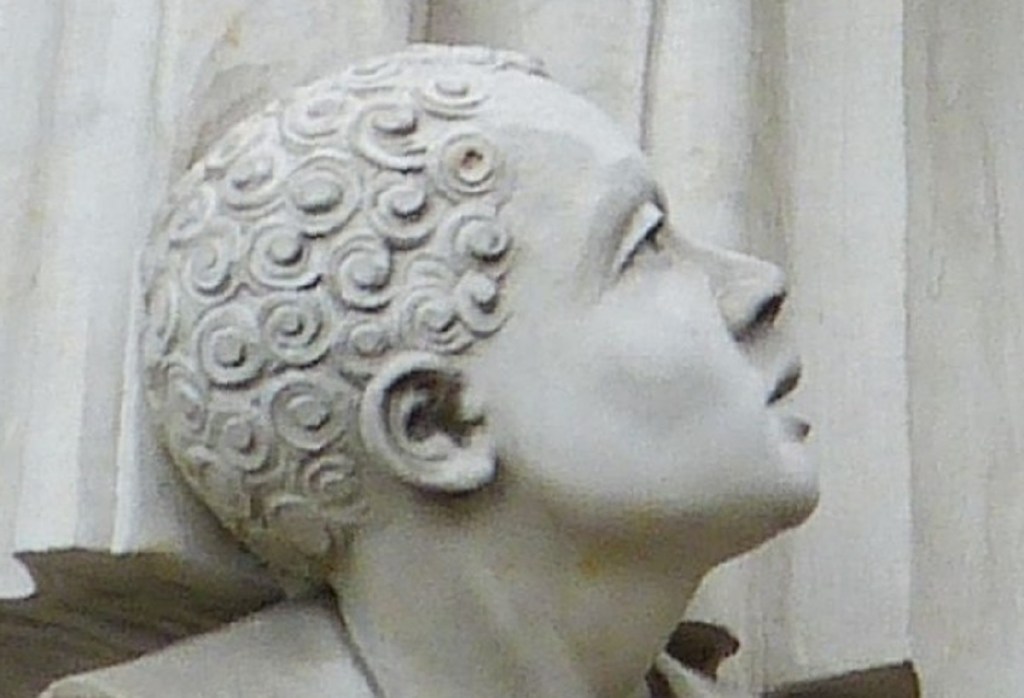
Feast of St. Charles Lwanga and Companions (June 3rd)
Sirach 51:12cd-20; Mark 11:27-53
If we were there in 1886, at the place Charles Lwanga and his companions were being martyred for the faith, we probably would have called the outlook bleak. The young king, a pedophile furious because the young Christian men in his court refused his advances, saw to it that they were rounded up, marched out of the capital city, and killed. In all this, Charles was exemplary; he was baptized, instructed the others, had them baptized, and, when he spoke, it was to pray, encourage the others, or even urge his executioners to accept Christ. When he and the others died, all that remained was a tiny group of Christians, their king against them, very little outside support, and Muslims and pagans all around. To all the world, it must have looked like the Church in Uganda was finished.
Yet, look what happened: Today, and for many June Thirds past, Mass has taken place on that very spot, in a great basilica, with a shrine, and grounds dedicated to those men. The place the king chose to wipe out the Church has instead become the place where hundreds of thousands gather every year to celebrate and ask the intercession of twenty-two martyrs whose faith bore so great a harvest. Indeed, from that small band they inspired, Christianity in Africa has grown to include 400 million people.
These and all the martyrs are perfect examples of what the world has had such a hard time understanding: When it comes to the Church and how things between her and the world will unfold, human beings are simply not in control; God is. For centuries, civil authorities have gone out of their way to change, curtail, or outright destroy the Catholic Church. Nevertheless, every time, she has not only survived but flourished, while they have all come and gone.
It would be nice if we could confine that problem to the outside world, but, as the gospel shows, religious people also tend to forget who is in control. We can single out the chief priests, scribes, and elders in today’s gospel for assuming that God would never work through John or Jesus, but what about us? We should stop for a moment and ask if we ever set ourselves up as authorities over God. Do we expect God to act at certain times or certain ways, give us certain answers, or work through certain people? I’m sure that if we reflect long enough, all of us can think of times when God has surprised us – worked in places, people, and ways we never expected. And the results, while they may not have been what we wanted, were exactly what God intended, for that is his Providence.
The author of the first reading urges us to take a much more prudent course: Rather than assume wisdom is something we already have, assume it’s something we must be given. He counsels us to pray for it openly, seek it persistently, and learn from our experiences. This is what St. Charles Lwanga and all the martyrs did, and, since martyr means witness, it is what we must do as well. Let us resolve, then, to see God in all people and places, accept what he is pleased to give us, and see his hand at work in the events and experiences of our lives. Only by so doing can we become more and more like Christ, who is Wisdom and King of martyrs.
St. Charles Lwanga and Companions, pray for us.



 Like the mysterious sacrifice of the wren, this may leave us curious. Why does the Church take the first day after Christmas to remember the first martyr? The answer lies precisely in the similarity of Stephen’s passion and death to Christ’s. Christmas is the celebration of the birth of Jesus; the same Jesus who came not to be served
  Eventually, Father was caught, imprisoned on a false charge and on the morning of November 23
 The example of the Korean Church and her martyrs teaches us that every heart open to God and acting on his word becomes a mother, sister, and brother to Christ. Even though we may not have the power of Orders, we do have Christ in the Scriptures and the power of the Holy Spirit through our baptism. We too can evangelize. If you don’t know where to begin, consider: Religious education programs can always use help teaching children the faith; there is a bible study nearby that would teach you more about Christ; there are many ministries that reach out to the hungry, the poor, and the mourning. Be docile to the promptings of the Holy Spirit; He will show you ways to bring Christ to someone in need.
 Thus, the encounter with Christ is the key to evangelization. As Cardinal Francis George once said, evangelization consists of introducing people to Christ and allowing him to take over from there. No matter how eloquent, forceful or dramatic we are, the human word pales in comparison with the Eternal Word. Like Nathanael, every person has their own “fig tree” moments; at one time or another, everyone quietly contemplates the eternal, the divine, the transcendent. This is a mystical silence into which we dare not intrude; it is the stillness in which God speaks. The God who sees what we cannot – the heart and soul – speaks to whole person as we cannot. Again like Nathanael, the effect is all-encompassing and all-surpassing.
 Christians are martyrs, not kamikazes. The word martyr means “witness,” for that’s what a martyr does; they witness the faith in whatever circumstances they find themselves. What St. Paul Miki knew, and what the emperor could not understand, is that there is only one true kamikaze, one Divine Wind. The Holy Spirit graces each martyr with the gifts they need to witness the gospel according to their inclinations; always for the building up of the kingdom.
 Mark 10:45