Tag: Love

  • Not Larger than God’s Love

    Wednesday of the 26th Week in Ordinary Time (Memorial of St. Jerome)

    Luke 9:57–62

    There are people we meet – or we may be a person – who others might describe as “larger than life,” or a “force to be reckoned with.” They have a presence, a way about them, that seems to always compel a response, good or bad.

    The saint we remember today, Jerome, strikes me as such a person. Like everyone, he had strengths and weaknesses. But like those who live larger than life, his good could seem very good, and his bad,very bad.

    On the good side, Jerome was brilliant; one of the greatest minds the Church has ever known. What’s more, he loved Scripture with all his heart, and spent his life studying and writing about it. Above all, Jerome loved God, and wanted more than anything to live a life pleasing to Him.

    But then there were weaknesses. First, pride. Like many intellectuals, Jerome didn’t like to be wrong and didn’t want anyone having the last word but him. Worse, he had such a fiery temper and was so hard to get along with that his most loyal supporter and patroness, Paula, and her daughter, became saints just dealing with him. On top of all that, Jerome was strongly attracted to women and was constantly tempted to impure thoughts.

    This last temptation was so bad that Jerome left Rome to live as a hermit in the Holy Land. Although that helped, the temptations persisted. In desperation, he vowed to study Hebrew – a language he found hard to learn – every time lewd thoughts came back. Thanks to that vow, Jerome became an expert in Hebrew.

    That was a stroke of the Holy Spirit. When Jerome’s friend, Pope St. Damasus I, assigned him the task of producing a new version of the Bible based on the ancient languages, he poured himself into it. Despite some disagreements with the Church in the process, Jerome sacrificed his pride, submitted himself to her authority, and gave the world the Bible we still know as Jerome’s Vulgate.

    St. Jerome’s victory in the struggle against himself gives us great insight on the gospel today. People want to follow Jesus, but they want to do so on their own terms. Can we set conditions on discipleship? The life of St. Jerome underscores our Lord’s point: Following Christ means submitting ourselves entirely – mind, body, passions, strengths, and weaknesses — to his authority and his alone.

    That doesn’t mean that we are to somehow become people without strong desires, without opinions, personalities, or weaknesses. No, God made us; He knows who we are. We may, in our own ways, be larger than life, but St. Jerome reminds us that we’re never larger than God’s love. And, like him, we may be a force to be reckoned with, but let us pray that we, too, can – by God’s grace – be a force for good, submitting ourselves to God’s authority, and praying, as all the saints have prayed, “Lord God, all of me is yours. Tell me what to do with it and help me do it. Your will be done.”

    St. Jerome, pray for us.

    —
  • What Do They Say?

    What Do They Say?

    Thursday of the 24th Week in Ordinary Time

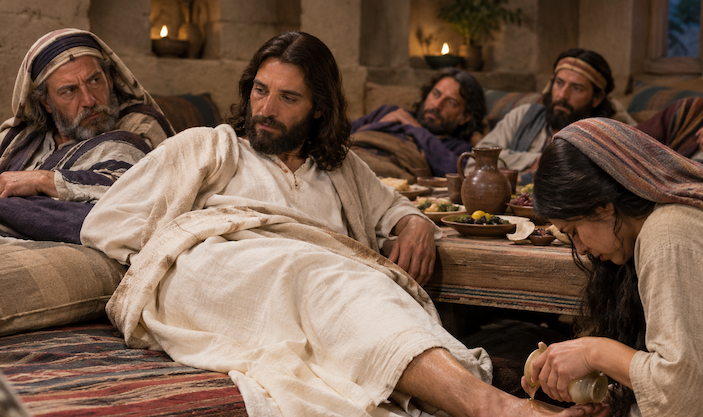
    1 Corinthians 15:1-11; Luke 7:36-50

    In the first reading, St. Paul tells the Corinthians to hold fast to the gospel he has preached to them. But he isn’t talking about just remembering it. He’s saying that the gospel must shape their lives, especially their relationships with others.

    Their words will teach people about Christ, but so will their actions.

    The Gospel gives us two striking examples of how our actions reveal the unspoken thoughts of our heart.

    First, consider Simon the Pharisee. Clearly a man of learning, no doubt well-spoken, and in a respectable religious position. But his actions on bringing Christ into his home… what do they say? He doesn’t give Jesus even the ordinary courtesies, things easy for him to provide; no water for his feet, no kiss of greeting, no oil.

    The woman, on the other hand, says nothing. No words about how sorry she is, or how much she loves Jesus. But her actions pour out the thoughts of her heart; washing his feet with her tears, drying them with her hair, kissing them repeatedly, and finally anointing them.

    And we know our Lord’s reaction to that. And to Simon.

    The question is, what will his reaction will be to us? 

    We use words to speak our love for God. We say our prayers, give all the proper responses at Mass. We might even use them to teach the faith to others. 

    But my actions – what do they say?

    • When someone hurts me, what do they say about whether I believe in forgiveness?
    • When someone needs my time, what do they say about whether I believe in charity?
    • When I’m inconvenienced, what do they say about whether I believe that my life belongs to God?
    • When no one is watching, what do they say about my character?

    The readings today are clear: Holding on to God’s word doesn’t mean merely remembering it, or even repeating it. Holding onto it means allowing it to become visible in our lives – despite the cost.

    As St. Anthony of Padua once said, “Let your words teach and your actions speak.”

    When all is said and done, people may well forget what we said. But let’s make sure they always remember what our lives told them about Christ.

  • Finally Found It

    Sunday of the 22nd Week in Ordinary Time

    Jeremiah 20:7-9; Romans 12:1-2; Matthew 16:21-27

    One ice-cold Michigan morning, my elderly mother realized she left her cellphone in her car. Not waking my little brother to help, Mom ran out in her pajamas to get it. The car doors were frozen shut. She ran back inside, got a cup of hot water, went out, and poured it on the door lock. It opened. When she finally found the phone and tried to get out, the door had frozen shut again. Irritated and freezing, Mom threw herself against the door, which did nothing but hurt her shoulder. “I know,” she thought. Lying down on the front seat, Mom kicked her legs as hard as she could against the door. Hurt her ankle. Car door 2, Mom zero. Only then realizing, “Oh, I have a phone,” she tried calling my brother. Dead battery. By the grace of God, some college kids on their way to school saw Mom in her car, and helped her out.

    This adventure of my mother and her cellphone is true, but also a parable about the spiritual life. We can focus so much on what we want that everything else fades into the background.

    For Mom, it was a cellphone she absolutely had to have. But there are many other things people think they must have: more money, more power, more possessions, more recognition. And it works the other way, too; there are many things people think they absolutely must avoid. For Jeremiah in the first reading, it was the ridicule and reproach that came with being a prophet.

    In either case, the more we focus on what we want, the more we lose sight of what really matters, and we need to be reminded.

    In Jeremiah’s case, his heart reminded him. Notice how the reading ends; speaking of the drive to prophesy, he says, “… it becomes like fire burning in my heart… I grow weary holding it in, I cannot endure it.” God’s word has taken hold of him. It consumes him. His mind may say, “Walk away,” but this is a matter of the heart, and in the end, his love of God is far more important than any discomfort. 

    Peter has yet to learn that. He, who just called Jesus the Messiah moments before this, wants something, too – he wants Christ without the cross. If going to Jerusalem means suffering and dying, then DON’T GO. But then comes the reply, “You are thinking not as God does, but as human beings do.”

    This is a reminder for all of us who want to be disciples of Christ: True discipleship means focusing not on what I want, but on what God wants of me. And what is that? Jesus is pretty clear: “Whoever wishes to come after me must deny himself, take up his cross, and follow me.” So there will be a cost: self-denial, bearing hardships, and going where I may not want to go.

    In other words, sacrifice.

    I hear the word “sacrifice” and might think “give up something,” but remember, a sacrifice is fundamentally a self-giving. A matter of the heart. For example, when a parent sacrifices for their child, is the parents’ focus on what they’ve lost or what the child has gained? The gain, of course. Why? Because it’s all about love.

    That’s the point we can so easily miss when we hear Jesus speak about denying ourselves and taking up our cross. Our faith isn’t about suffering for the sake of suffering, or God asking us to give things up because He wants to make our lives miserable.

    It’s all about love.

    Jesus gave himself for us out of love. And when he asks us to take up our cross and follow him, he’s inviting us to love in the same way: not making ourselves the center of everything, not asking only, “What do I want?” or “What can I avoid?” but asking, “What does love require of me?”

    It will require something. There’s always a cost. But there is a promise hidden in our Lord’s words: “Whoever loses his life for my sake will find it.”

    The readings today urge us to keep a proper perspective in life. If our primary focus is where it should be – on Christ, who gave everything for us – then the only question that matters is, “What is God asking me to give, and am I willing to give it for love of Him?”

    Those who are, are those who discover that in so doing, they haven’t lost their life at all.

    They have finally found it.

    —

  • A Whitewashed Tomb

    Wednesday of the 21st Week in Ordinary Time

    2 Thessalonians 3:6-10, 16-18; Matthew 23:27-32

    A while ago, I visited a parish where I spent many years as a child. Sitting in a pew, I began reminiscing about my days as an altar boy there.

    I remembered some of the boys I went to school and served with. Good kids, pious in the best possible sense: quiet, attentive, prayerful. They seemed genuinely holy; not only at Mass, but outside it, too.

    Me? Not so much. Although we did the same things, for me it was more like “going through the motions” of holiness. Maybe I looked the part, but few would have called me quiet, attentive, or prayerful. To the contrary, too often I behaved as if I’d never gone to Mass at all.

    And it was then that this gospel hit home. I saw my face in our Lord’s dictionary, right there under the term, “whitewashed tomb.” Looks fine on the outside, but inside? “Dead men’s bones.”

    At first, my heart sank. I imagined Jesus disappointed in me. But then I realized that Jesus took the scribes and Pharisees to task, not out of hatred, but love. Yes, his words were sharp, but that was to awaken them, make them understand that the way to God’s heart wasn’t by acting holy, but by allowing God to make them holy.

    Acting holy. That’s what I’d been doing. I don’t know why. Maybe I thought the holiness of the other boys would rub off on me or that going through the motions would somehow change me inside.

    It won’t. External actions on their own won’t produce holiness. Why? Because holiness isn’t just what we do, it’s who we are becoming by the grace of God. It’s God’s grace that changes the heart, and it’s the changed heart that expresses itself in virtuous behavior like piety, patience, prayer, and love.

    That’s why St. Paul reminded the Thessalonians that faith must be visible in the way we live. Our relationship with Christ cannot be an appearance only; it must shape our responsibilities, our work, our relationships, and our daily choices.

    So the question isn’t simply, “Do I look religious,” but “Is Christ making me truthful within?” How do we know? We must look at our behavior: Do I pray only when others can see me, or because I desire communion with God? Do I serve because I want recognition, or because I love? Do I speak about holiness while remaining impatient, resentful, or unforgiving? Do my actions at Mass radiate to the rest of my life?

    Like me sitting in the pew that day, we may not like some of the answers. We may sense that, to some degree, we too are the scribe or Pharisee who Jesus is calling out.

    But that’s good. Christ loves us and never wants us hiding from him in shame. Far from it; he wants us to bring our true self to him, for that is who he created. His words may be strong, but they’re meant to call us home.

    So today and every day, let us ask God for the grace we need: one act of patience, one honest prayer, one admission of fault, and one hidden choice of love at a time.

    For Christ doesn’t want us to look holy. He wants to make us holy.

    —

  • Saying Sorry and Being Sorry

    Saying Sorry and Being Sorry

    Monday of the 16th Week in Ordinary Time

    Micah 6:1-4, 6-8

    Heather, a woman who worked a couple of desks away, was on the phone with her husband, who had apparently bought her flowers as a way of apologizing for something.

    It didn’t work. She said, “I don’t want flowers, Harry. And I don’t want you to just SAY you’re sorry. I want you to BE sorry.”

    Today’s selection from Micah reminded me of that. In a way, Harry was on trial, just like Israel is in this reading. 

    The defendant? Israel.

    The plaintiff? God.

    The prosecutor? Micah.

    The witnesses? The mountains and hills. 

    The evidence? Everything God had done for Israel over the centuries.

    The people know they have failed. They’ve strayed from God time and again. They want to make good, but here they make their worst mistake: “What do you want, Lord – more animals, more oil, our first-born children?”

    They completely misunderstand. God certainly doesn’t want child sacrifice, and He doesn’t want more empty ritual. He wants a change in their behavior, as He says through the prophet to close this reading: Do justice, love goodness, and walk humbly with the Lord your God.

    Those beautiful words echo down the centuries to our own day.

    Do justice. Give to God and to others what you owe them. What do we owe God? Everything! Without God, where would we be? What do we owe others? The dignity that belongs to them, for they too are made in the image and likeness of God.

    Love goodness. There is no single word in our language for what is meant here. Imagine the person you love the most: How do you treat them, and what are you willing to do for them? This is that level of merciful, loving kindness; the kind of faithful love that keeps showing up, no matter how costly.

    Walk humbly. We do this by recognizing our own God-given dignity while at the same time acknowledging our weaknesses. Without doing so, we can neither do justice nor love goodness.

    Our perfect model for all of this is Christ. Who did justice more than he, who gave God the total gift of himself, and us the way to eternal life? Who loved more than he, who gave his life even for those who despised him? And who walked more humbly than he, who, though King of kings, lived and died as servant of all?

    Like Heather, God isn’t looking for ‘flowers.’ He isn’t looking for bigger sacrifices or more impressive religious gestures but for converted hearts. And He doesn’t want us to just SAY we’re sorry. He wants a change of heart that leads to a change in behavior.

    That’s exactly what Jesus came to make possible.

    —

  • Everything

    Wednesday of the 10th Week in Ordinary Time

    1 Kings 18:20-39; Matthew 5:17-19

    Today, the Church gives us two powerful images:

    • In 1 Kings, Elijah prays “Answer me, LORD,” and everything is consumed. Not just the burnt offering, but the wood, the stones, the dust… even the water in the surrounding trench.
    • In the gospel, Jesus speaks of the Law and the prophets, saying that in him “not the smallest letter” or even “part of a letter” would go unfulfilled.

    What do these images have in common? They reveal the love of God, who gives completely and fulfills completely.

    First, we see how God gives completely. Elijah asked only for an answer. Just send fire; accept the sacrificial offering. But the Lord didn’t stop there; He answered with such abundance that everything was consumed. Being infinite Love, God can only give everything. We ask for acceptance at Baptism, He makes us His children; for forgiveness of sins in Confession, He removes them entirely; to satisfy our hunger at Communion, He gives us His only Son – Body, Blood, Soul, and Divinity.

    And God fulfills completely. Imagine receiving a note from someone you love most in the world. You’d save it for years, read it over and over, maybe even remember the exact words. You certainly wouldn’t ignore even the smallest part of it. Why? Because every stroke represents the person and the love behind it. The Scriptures are God’s love letter to us. Every book, every story, every word points to the Eternal Word – Jesus Christ – who in his perfect love for the Father and for us is the fulfillment of the Law and the prophets.

    Of course, these images of love are given to us not just to reflect on but to imitate. We know from experience how hard this is. Do I allow God’s love to totally consume me, or do I keep part of myself for myself? Elijah placed everything on the altar, and God’s fire consumed everything. We’re called to do the same; to hold nothing back. The question is whether we’re willing to place our whole lives on the altar – not just the convenient parts or what costs us little, but everything. Because the God who gives everything asks us, in return, to love with everything we are, and to teach that love to the world in everything we do.


  • When Words Fail

    The Solemnity of the Most Holy Trinity, Cycle A

    Exodus 34:4b–6, 8–9; 2 Corinthians 13:11-13; John 3:16-18

    When in your life have you ever been left speechless – when words just wouldn’t come? I don’t mean sports teams letting you down or movies that were so bad you couldn’t find words. I mean profoundly important moments when words were simply inadequate.

    In my own life, words have escaped me most often at times centered around love: As a child, feeling my mother’s embrace; as a husband, my wife sitting by my hospital bed; as a father, seeing our newborn children; as a son, burying my parents. I think it’s true for all of us that there are times when love renders words useless.

    That is exactly where the Trinity is encountered, and the readings help us see it.

    In the first reading, God descends in a cloud and stands with Moses. To understand the real power of the moment, remember when this occurs. Moses has already seen the burning bush, led Israel out of Egypt, crossed the sea, and received the Law. After all those mighty acts, God finally reveals His Name — and Moses falls silent before love.

    From this we learn that while God’s relationship with His people includes powerful deeds, rituals, laws, and covenants – and those are important – that is what God does. Far more important than that is who God is: faithful, merciful love. All encapsulated in one Name: Lord.

    That reminds me of something St. John of the Cross once said: “In giving us his Son… [God] spoke everything to us at once… and he has no more to say.” Jesus isn’t one of God’s communications to the world, he is the communication; the highest revelation of Almighty God to the world.

    And once again, it’s all about love. “God so loved the world that He gave His only Son.” Jesus, the Father’s one Word, handed over. Not spoken into the air, like “Lord,” but placed into history; made flesh, laid in a manger, nailed to a cross. Jesus – the Father’s love made visible – is the name made speakable whose love still defies all speech.

    The Holy Spirit is a little more difficult to understand, but Church Tradition helps. From it, we learn that the Holy Spirit is the living love between the Father and the Son — a love so real, so perfect, that He is not merely a feeling or force, but a Divine Person.

    If you don’t understand that, you’re in good company. The relationship of the Trinity is a supernatural mystery. But we don’t have to understand it. St. Paul didn’t. Notice, though, what he did do: pray it: “the grace of the Son, the love of the Father, and the fellowship of the Spirit.”

    Grace. Love. Fellowship. Those we can understand. And those are the essentials of the Trinity, the very pattern of divine love into which we are baptized and called to live.

    And I do understand this much: the love we feel in those speechless moments — the embrace, the newborn, the grave — is an icon, a symbol, of the love that has been happening within God from all eternity.

    If we take nothing else away on Trinity Sunday, let’s take these two things:

    First, the Trinity isn’t some abstract, theological formula. It is the original and greatest love story, of which every true human love is a participation and a reflection.

    Second, every time we trace the Sign of the Cross on our body, we are doing what Moses did on Sinai — falling prostrate before the greatest Love of all time. Not explaining it. Not debating it. Just receiving it.

    So let it be a moment of silence. Let words fail. That is exactly where the Trinity is.

    —

  • All For the Sake of Love

    Wednesday of the 2nd Week of Easter

    John 3:16

    The Taj Mahal. The Hope diamond. Romeo and Juliet. Each in its own way a priceless masterpiece – built, gifted, or written all for the sake of love.

    Imagine being given any one of these. How special we would feel! Unique in all the world. To be the subject of that force of emotion.

    Fortunately, we don’t have to imagine such a gift. We have one infinitely more precious. As Jesus says to Nicodemus:

    God so loved the world that he gave his only-begotten Son, so that everyone who believes in him might not perish but might have eternal life (John 3:16).

    This is the verse that stopped Church Fathers in their tracks. We too know its power, not least by its enormous popularity. That’s good, but it’s also a problem; we hear it so often, see it so many places – from bumper stickers to end-zone signs – that we risk looking right past it.

    Don’t let that happen.

    Today, take a good, long, hard look at a crucifix. For there is the love that built not a building, but the Church; that isn’t the gift of a stone, but the Cornerstone; that isn’t written with ink but with the Precious Blood of Christ.

    And remember: We know the price of that love story – the death of Jesus Christ. But we also know the ending – the tomb is empty.

    So, rejoice and be glad! You really are loved that much.

  • Love and Fear

    Love and Fear

    Wednesday after Epiphany

    1 John 4:11-18; Mark 6:45-52

    Many things John says get my attention, but today, one thing in particular stands out: perfect love drives out fear (1 John 4:18). He doesn’t say that love reduces or manages fear; it drives it out. When love becomes primary, it takes over. There is no room for fear.

    It sounds wonderful, but how does that happen? Let me give you an example.

    Laying by a pool one day, I noticed a commotion in the water. It was my son. Not only was he in trouble, he was drowning! Immediately, I jumped in. I saved him, but in doing so almost drowned myself. While I was then and still am terrified of drowning, in that moment love completely dominated. There was no time, no room, for fear. All that mattered was love.

    That’s what John means. Perfect love doesn’t wait for fear to calm down or try to reason or compromise with it. No, it totally overrides it.

    But then Mark adds an important dimension. Sometimes, fear becomes crippling or disabling. For example, the disciples in the boat were terrified, not just because of the storm, but also because of the “ghost” on the water. Fear blinded them; looking right at Jesus, they do not recognize him. And it’s not only them. Recently, while suffering with cancer, I was afraid many times. Despite my own prayers, the fear was so bad that I was tempted to give up.

    But that’s where St. Mark’s story proves so helpful. It reminds us that love isn’t only what we give, it’s what we receive when we can no longer carry ourselves. For the disciples in the boat, it was the presence and the voice of Jesus saying, Take courage, it is I; do not be afraid. At that moment, fear lost hold; Christ, Love Himself, had arrived. For me, it was Christ working in ways known only to him and in one way he allowed me to feel: The prayers, the concern, the quiet fidelity of others. Their love was like a “shared” courage that cast out my fear. Together, the love of Christ and the love shared by others in imitation of him are more than enough to stand watch when our own strength falters.

    Whether it’s the barque of the Church or the small, fragile boats of our own lives, there will always be dark nights and sudden storms, times when fear threatens to take over. At those moments — at every moment — we must remember that Christ is always here, always personally present to us in Word and Sacrament. He speaks into the storms of every human life, “Take courage, it is I; do not be afraid.” And he empowers us to stand watch for one another, to lend strength when strength is failing, and to share the courage that only the grace of God can give.

    Fear is real. But as Christ has shown so perfectly, love — his love — is sovereign.

    —

    You might also enjoy

  • Vulnerability: The Path to True Love

    Vulnerability: The Path to True Love

    Saturday of the 4th Week in Ordinary Time

    Hebrews 13:15-17, 20-21; Psalm 23:1-6; Mark 6:30-34

    When I was a kid, my cousin and I debated many important things, like whose comic book superhero was better. I said Spiderman, he said Superman. When I asked him why Superman was better, he said, “Simple. He’s invulnerable. Spiderman isn’t.” I had to look up ‘invulnerable.’ Turns out it means Superman is immune or highly resistant to physical damage, injury or disease and illness. In other words, he’s almost impossible to hurt.

    Of course, in real life things are different. We all know, especially as we age, that the human body is quite vulnerable. So is the human heart; certainly parents, children, and spouses feel in their lives that connection between love and suffering. Indeed, some people are afraid to love others for just that reason; they don’t want to be hurt.

    But I don’t think it can be any other way. Why? Because, to be genuine, love requires vulnerability. We see that even with the first step: trust. Psalm 23 reminds us that God is our Shepherd and calls us to trust Him. With what? Our entire self! Placing ourselves wholly in His care requires total openness and surrender – in other words, being vulnerable. The psalmist beautifully expresses this trust when he says, Even though I walk in the dark valley I fear no evil; for you are at my side (Psalm 23:4). Such trust isn’t about relying on our own strength, but surrendering to the guidance of the Good Shepherd.

    Then in Mark 6:30-34, Jesus shows us the payoff for that. When he saw the people’s hunger – not just for food, but for guidance and meaning – their vulnerability moved Him with pity. This is love in its purest form, empathetic and totally self-giving. Christ can only love totally, so he doesn’t shy away from their neediness, but embraces and fills it. This is what happens when we let go of control and allow ourselves to show Him that we are in need.

    We see this in the life of St. Josephine Bakhita. Torn from her home as a child, subjected to cruelty, and stripped of control, she had no choice but to be vulnerable. However, when she encountered Christ, she found that vulnerability isn’t just a condition of suffering, but also the gateway to love. She learned to trust in God’s love, not to hide her wounds, physical or emotional, but to give them to him, and allow him lead her to peace and healing. Her decision to forgive those who hurt her was an act of profound love, requiring the courage to let go of resentment and trust in God’s justice.

    Just as in human relationships, where love requires the risk of being hurt, our relationship with God requires us to move beyond fear and trust in His guidance. When we let down our guard and allow Him to be our Shepherd, we experience a love that is not only protective but also transformative. In so doing, we mirror Christ Himself, who made Himself vulnerable for our sake; taking on human suffering, loving to the death, and ultimately revealing that true love is not about self-preservation, but about self-giving. That is the irony of love: Only by giving ourselves away do we ever really find ourselves.

    —