Tag: Last Supper

  • The True Cornerstone: Memorial of St. Patrick, Bishop

    August 15th, the Feast of the Assumption, fell on a Sunday in the year 1858; that afternoon, a 22 year-old Irish immigrant named Cormack McCall1 may well have watched as a stone that he had cut with his own hands was blessed as the cornerstone of the new St. Patrick’s Cathedral by New York City’s Archbishop John Hughes. Around Hughes stood seven bishops, 130 priests, and 100 choirboys. The crowd was estimated at 100,000 people or more; New York’s entire fleet of streetcars had been diverted to the area just to accommodate them.

    It is an oddity in keeping with St. Patrick that to this day no one knows exactly where the cathedral’s cornerstone is or when it went missing.2 It has sunk into obscurity like the details of the life of the great saint himself. Nevertheless, St. Patrick’s impact on the faith is every bit as real and foundational as the cathedral’s mysterious cornerstone.

    Patrick was similar in a few ways to Israel’s son Joseph, whose life story closes the book of Genesis. Both became slaves in their youth, both were bright and resourceful men of dreams, and both used their gifts not just to endure their captivity but to be victorious over it.

    Of course, there were differences. Unlike Joseph, Patrick was not raised by parents with a strong and vibrant faith; nevertheless, during his captivity he found that his faith was strengthened. Moreover, although both were men of dreams, Patrick focused on one particular vision from his youth and was determined to see it come to fruition. While a slave he had a vision of Irish children reaching out for him and resolved that should he escape he would return and convert the pagan Irish to Christianity. In fact, he did escape and reunite with his family in Britain for awhile; however, Patrick never lost sight of that vision from his youth. Around the year 431, after being ordained in France, Patrick was sent to Ireland as its bishop by Pope Celestine I.

    At first, Bishop Patrick began by supporting the small band of Christians already on the island but was soon evangelizing far and wide, preaching, writing and baptizing countless people. It is ironic that Patrick was so self-conscious of his lack of formal education for as an evangelizer he was brilliant. He understood that the truth of Christ transcends culture, that certain symbols or practices of the pagan people could be imbued with Christian meaning. For example, an ancient pagan image of two crossed lines and a circle was reinterpreted by Patrick as the Cross of Christ with the circle symbolizing the eternity of God. We know it as the Celtic Cross to this day.

    Over the course his years a missionary bishop to Ireland, Patrick truly was a cornerstone of the Irish Church. He installed and supported church officials, created councils, founded monasteries and organized Ireland into dioceses. He died around the year 461 and was buried in the land that he first came to as a slave and to which he returned, faithful to his promise to the end.
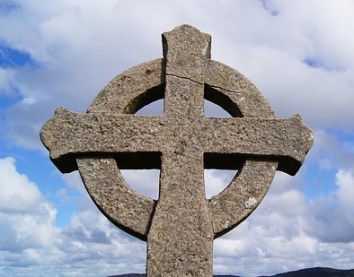
    ireland-2184916_640The psalmist must have had Joseph in mind as he sang, they had weighed him down with fetters, and he was bound with chains till his prediction came to pass and the word of the LORD proved him true (Psalm 105:18-19) but it applies to St. Patrick as well. In a larger sense it applies to all of us, for to one degree or another we are all weighed down with the fetters of sin. Many are bound with the additional chains of addiction or illness, either our own or someone we love. Perhaps we have not been given visions or dreams like Joseph or Patrick, but we have been given the vision of Christ, the Eternal Word who proved himself true to the greatest promise ever given mankind: That every fetter would be lifted, every chain broken, every tear wiped away for all those who cling to him as their salvation. As much as they did, as faithful as they were, both Joseph and Patrick humbly bend their knee and fade into the background like an old cathedral cornerstone before the Stone rejected by the builders, the one true Cornerstone who is Christ.

    St. Patrick, pray for us.

  • Love and Sacrifice: Friday of the Fifteenth Week in Ordinary Time

    Exodus 11:10-12:14; Matthew 12:1-8

    I remember pulling a priest aside after Mass one Sunday to ask him about a verse in Scripture that I didn’t understand. It appears in today’s gospel but also in various forms in both the Old and New Testaments. As spoken by Jesus, the verse is, If you knew what this meant, ‘I desire mercy, not sacrifice’ (Matthew 12:7).

    If you knew what this meant. That was exactly my question; what does it mean for God to say I desire mercy, not sacrifice? It turned out that Father didn’t know. If you don’t know either, then apparently we have lots of company, including the Pharisees – those ostensibly pious laypeople who loved to snipe at Jesus, this time for looking the other way while his disciples plucked heads of grain from a wheat field on the Sabbath.

    A better understanding requires us to go to the source, a verse that appears in the book of the prophet Hosea. In the translation approved by the American bishops the verse reads: For it is loyalty that I desire, not sacrifice, and knowledge of God rather than burnt offerings (Hosea 6:6). In place of “loyalty” other translations use “love” or “mercy.” It can be all of these because the original Hebrew word, hesed, defies easy translation. Perhaps it is best to think of hesed as the infinite love, mercy, and faithfulness of God. Thus, Jesus underscores the prophet’s teaching that God desires love, mercy, and faithfulness, not sacrifice.

    It’s easy to understand God desiring that we love as He does but doesn’t God also desire sacrifice? It would seem so. Consider the Mass. We call it the holy sacrifice of the Mass; in it we go out of our way to remember the sacrifice of Abraham our father in faith, and the bread and wine offered by the high priest Melchizedek. In confecting the Eucharist we recall the Last Supper, when Christ celebrated the Passover meal with the Twelve. The first reading outlined the ritual in some detail, especially its central event: the sacrifice of a young, unblemished lamb which was a type or foreshadowing of the great memorial sacrifice of Christ, the one true Lamb of God.

    However, we also recall at Mass not that our sacrifice be desirable but that it be acceptable. Before the consecration the priest explicitly asks us to pray “that my sacrifice and yours may be acceptable to God, the almighty Father.” Our acceptable sacrifice consists of everything we have laid upon the altar at the Offertory in union with the bread and wine – our entire selves if we so will it – freely offered out of love to the Father, with Christ and through the working of the Holy Spirit.

    Our self-offering is not only acceptable to God but also precious to him. As parents we accept every gift our children give us but we reserve a special place in our hearts for the gifts that are hardest to give, for we understand the sacrifice involved. After all, that is what sacrifice is: Something precious completely surrendered out of of love for the person who receives it. If such gifts are precious to us, imagine how much more so they are for our Heavenly Father, who understands better than anyone the meaning and love behind them, especially those that cost us the most. As we also know, nothing is harder to give away than our most prized possession – our very self.

    wheat-field-640960_640If the Pharisees had been thinking from this perspective they would have realized that the disciples were not just walking through a field wantonly plucking heads of grain in supposed violation of the sabbath; they were following Christ, giving their lives every day of the week, including the sabbath, to the Lord of the Sabbath.

    So then, why does Christ want us to remember that God desires mercy, not sacrifice? To remind us of two important truths: First, no sacrifice is fruitful if done without love, especially those offered to God; and second, love is most fully expressed when we offer to God what is most pleasing, most precious, and most difficult to give: Ourselves as a holy and living sacrifice (Romans 12:1).

    As Jesus noted, king David understood this. Despite his many faults, the same king who begged of the high priest the holy bread also had the humility to pray:

    You do not desire sacrifice or I would give it; a burnt offering you would not accept. My sacrifice, O God, is a contrite spirit; a contrite, humbled heart, O God, you will not scorn (Psalm 51:18-19)

  • The Primacy of Service: Holy Thursday

    Today we read from John’s account of the last evening that Jesus spent with his disciples before his Passion and death. The other evangelists take this opportunity to provide us with the Institution Narrative, or the words spoken by Christ that to this day are repeated by the priest during the Consecration at holy Mass.

    John does not do this; rather, he uses the occasion of the Last Supper to depict Jesus washing the feet of his disciples and commanding them to do likewise. We don’t know why, but it’s possible that by the time the evangelist composed this gospel account the Breaking of the Bread had become an occasion for people to segregate into groups and eat and drink their fill, rather than to unite and commemorate the Passion, Death, and Resurrection of our Lord as one body.

    passion-3807312_640
    By showing Jesus washing the feet of his disciples, the evangelist re-emphasizes the primacy of service. Those who would be greatest must become the least. This is the humility and love behind the gift of his life poured out for our sake, by which he becomes one with us and we become one with each other.

    As we approach the Eucharist this evening let us take his words and his actions to heart, for together they show that love leads naturally to service. Christ has shown us the greatest love through the gift of his Body and Blood broken and poured out for our sake and at the same time that this is the love that allows us to see others not as things to be used but as people to be served.

  • The Power of the Passion: Palm Sunday, Cycle C

    Reading: Luke 22:14-23:56

    Today we hear Luke’s version of the passion and death of our Lord Jesus Christ. Like all great dramas it is most effective when we place ourselves in it; see it through the eyes of those on the inside. As we do so we find such a rich array of characters that we cannot help but ask ourselves which ones we most resemble.

    There are those who fall: the Apostles, who argue at the Last Supper about which of them is the greatest; Judas, the follower turned betrayer; Peter, the follower who denies even knowing Jesus; Herod, anxious only to see Him perform a sign; Pilate, whose resolve over Our Lord’s innocence weakens under pressure; the crowd, who stand by and watch silently as others abuse Him; the thief who reviles and bullies Him.

    But there is also virtue: Simon the Cyrenian, who carries the cross on behalf of the struggling Christ; the women of Jerusalem who weep in mourning; the thief who recognizes that Jesus has done nothing wrong and begs to be with Him in eternity; the crowd who regret their actions; the centurion who proclaims His innocence; and Joseph of Arimathea, who provides for Him to the end and beyond.

    passion-3807331_640

    What makes the Passion of Our Lord so powerful is not only that it is the story of our Redeemer, although it certainly is that; it is also the story of us, the redeemed. We don’t have to imagine ourselves as characters in the drama; we already are those people. As flesh and spirit, virtue and vice, it is we who in one breath swear to follow Christ, to bear the cross, to proclaim His innocence, and to beg Him for salvation, only in the next breath to deny even knowing Him, shout to crucify Him, and bully Him into doing things our way.

    We might think that the struggle between virtue and vice is what makes us human; yet throughout the Passion, Jesus shows us what being fully human really means. As Pope St. John Paul said in his encyclical Redemptor Hominis, Jesus Christ the Redeemer “fully reveals man to himself.” Consider His words to the arguing Apostles, let the greatest among you be as the youngest, and the leader as the servant (Luke 22:26); to Peter, once you have turned back, you must strengthen your brothers (Luke 22:32); to the jeering crowd, Father, forgive them, they know not what they do (Luke 23:34); and to the repentant thief, today you will be with me in Paradise (Luke 23:43). In Christ do we find our proper point of reflection. Being most fully human is not measured by how much we are like the people around Jesus, but how much we are like Jesus to the people around us.

    Today we leave the story unfinished, with Jesus buried in the tomb. This is fitting; it reminds us that if we are truly like Christ, we were indeed buried with him through baptism into death, so that, just as Christ was raised from the dead by the glory of the Father, we too might live in newness of life (Romans 6:4).