Tag: John

  • Perfect Love: Memorial of Blessed Diana d’Andalo (June 9)

    1 John 4: 11-21; Matthew 19:16-26

    The readings today speak in different ways of love and fear. First, John reminds us that because God is love (1 John 4:16), we who desire to know Him and share in His life must love God and each other as God loves: perfectly. We remain in His love through faith in Christ and the working of the Spirit and, as love comes to perfection, fear subsides; for perfect love casts out all fear (1 John 4:18). This sounds wonderful, and it is, but it isn’t easy. We see that in the gospel. The rich young man loved God but he didn’t know Him; lacking the eyes of faith he looked at Jesus and saw not the Lord but a teacher who asked of him what he most feared to give: his wealth. No wonder he went away sad; he allowed fear keep him from the perfect love Christ offered.

    Today’s saint, Blessed Diana d’Andalo, probably understood that man as well as anyone. Born around the year 1201 in northern Italy, Diana was the 5th child of Octavia and Andalo de Lovella. Andalo means “Little Andrew,” but even if her father was small in stature, he was larger than life. Mayor of a mountainous district of Bologna, Andrew was a powerful, wealthy, and influential man, both warrior and statesman.

    Diana emerges in the annals of history at the age of seventeen. She is described as good, intelligent, brave, sympathetic, and resourceful but also spoiled, vain, worldly, obstinate, and not overly pious. Like her father, Diana preferred to give orders, not take them. Finally, like most wealthy young socialites, she loved the finer things in life – dresses and jewelry – and enjoyed the pursuit of pleasure.

    While she pursued pleasure the Holy Spirit pursued her. He made His first inroads into her heart through the missionaries visiting Bologna from the newly-formed Order of Preachers, the Dominicans. She loved listening to them for they intrigued her, but what interested her most was their results. They were converting people in great number.

    At the right moment the Spirit made His move in the person of Blessed Reginald of Orleans, a French Dominican sent to Bologna to preach. He had a way about him, a charism for preaching that attracted people. He captivated Diana. As he spoke about the pride, vanity, and worldliness infecting society she felt his words, like Christ’s to the rich young man, bringing her face to face with her own sinfulness.

    The fire of enlightenment is one thing, the fire of purgation another. Like the man in the gospel Diana had a choice to make: Draw near to the Light of the World and endure His cleansing fire or retreat into the darkness of her old, familiar ways. The rich young man had made his choice; Diana, hers. She resolved to give her life to Christ as His bride.

    Although this was certainly the right choice, she soon learned that it was no guarantee of easy times ahead. As was the custom, Diana asked her father’s permission to leave home and take the habit of the Dominicans. Having a husband in mind for her, he said no. Greatly disappointed but undeterred, she left home to do it anyway. Her brothers rode to the convent and, when she resisted, dragged her away with such force that they broke one of her ribs. Back at home and in physical and spiritual pain, she spent a year begging her father’s permission, then once more eloped to the convent. This time her father relented and Diana was received into the order by St. Dominic himself.

    She could overcome her father’s will; could she overcome her own? Recall that Diana liked being in charge and giving orders. She was comfortable when appointed prioress of the convent but when it became clear to her advisor that leadership was not among her gifts, obedience was a bitter pill to swallow. What she thought or felt about this we cannot know; she left no record and died at the age of 36. But from contemporaries we learn that Diana used this time to pray tirelessly, accept direction enthusiastically, and become a model of humility. An ancient biographer wrote:

    Profoundly humble, she thought herself the least of all and saw to it that she wore the poorest habit. She loved to keep in the background [and was] possessed by the spirit of poverty, completely detached from the goods of this world…1

    How far she had come from that spoiled teenager in love with the finer things of life!

    jesus-284515_640The life of Blessed Diana d’Andalo shows us that to those docile to His promptings the Holy Spirit will show both the greatness and the folly inside ourselves. Diana’s folly lay in the selfishness and will to dominate that has plagued mankind since it first heard the voice that whispers You can be like God (Genesis 3:5). Her greatness lay in her steadfast determination to conquer any enemy, especially herself; to cast aside all fear, remain in God’s love, keep faith in Christ, and abandon herself to the power and working of the Holy Spirit, that her love for God and her neighbor may be made as perfect as possible.

    Blessed Diana d’Andalo, pray for us.

    1From Georges, N., OP, STL. Blessed Diana and Blessed Jordan of the Order of Preachers. Available online at http://opcentral.org/resources/wp-content/uploads/2012/09/dijolives.pdf, p 87.

  • I Stand at the Door and Knock: Monday the 6th Week of Easter

    Acts 16:11-15; John 15:26-16:4a

    There is a very popular painting called The Light of the World by the artist William Holman Hunt. You’ve probably seen it, you may even have a copy. It is an image of Christ holding a lantern and knocking on the door of a house.

    In the gospel reading, Jesus told the Apostles that the synagogue doors would soon be closed to them. This did much more than just cut off their means of worship. For Jews, the synagogue was the center not only of religious life but social life as well. The Apostles, their families, friends, neighbors, and co-workers spent their entire lives within the confines of Judaism and the synagogue. Expulsion meant a total separation from the only way of life they had ever known.

    Yet God never closes one door without opening another; if the doors of Jewish society were closing, the doors of Europe were about to open. In Chapter 16 of Acts, we read that (d)uring the night Paul had a vision. A Macedonian stood before him and implored him with these words, “Come over to Macedonia and help us” (Acts 16:9). So it was that Paul and his companions arrived at Philippi. They would find very few Jews; Philippi’s residents were mostly descended from Roman soldiers settled there in retirement by Augustus Caesar about 80 years earlier. That is why Paul went to a local river; lacking a synagogue, the Jews and God-fearers would gather for prayer there because they needed water for ritual washing.

    As Paul spoke on the river bank in Philippi, a Gentile woman named Lydia listened, and the Lord opened her heart to pay attention to what Paul was saying (Acts 16:14). After she and her household welcomed Christ into their hearts through the waters of baptism, they welcomed Paul and the others into their house. We take church buildings for granted, but in those early days Christians had nowhere to meet for worship, instruction, and fellowship. Thanks to Lydia and her family’s generosity, the Christians at Philippi now had a house of worship.

    Earlier, I referred to the painting of Christ knocking on the door of a house. Some people miss the fact that the door in the painting has no handle on the outside. The door to the human heart opens only from the inside. God could deliver Paul and his companions to Philippi, he could put the words in their mouths, even put them in her ears, but Lydia’s heart could only be opened by an act of her own free will in cooperation with grace.

    glass-door-861007_1280Love is also an act of the will, and to love like Christ requires cooperation with divine grace. This is the love that we are all called to; the love constantly reaches out even to those who push it away; that speaks of healing even to those content only to wound; that speaks of light even to those who love the darkness; that echoes to our neighbor the same words that inspired the artist to paint that famous image of the true Light of the World knocking on the door of our heart: Behold, I stand at the door and knock. If anyone hears my voice and opens the door, then I will enter his house and dine with him, and he with me (Rev 3:20).

  • Roots and Wings: Friday of the 5th Week of Easter

    Acts 15:22-31; John 15:12-17

    bird-3371912_640I remember once talking to my mother as my kids were growing older and leaving home. I questioned where the time had gone and was worried about how they would get along in life. I don’t remember everything that Mom said in reply but I do recall that she quoted the old saying, “There are only two things a parent can give their children; one is roots and the other, wings.”

    Today’s readings show us that our Heavenly Father has given his Church roots and wings: Her roots are the love of Christ, her wings the inspiration of Holy Spirit.

    In today’s gospel Jesus told his Apostles, You are my friends if you do what I command you; I no longer call you slaves. This is a great honor; few people were ever called friends of God. Even Moses, Joshua, and David were known as “slaves” or “servants of God.” Abraham was called God’s friend (Isaiah 41:8; James 2:23). This is not to exalt one over the others, for God loves all with an everlasting love; it is simply to acknowledge that God relates to people in ways of his own choosing.

    Related to this, Christ told his Apostles that it was not you who chose me, but I who chose you and appointed you to go and bear fruit that will remain. He knew that they would encounter situations they weren’t entirely prepared for; that is why he told them that he would send the Holy Spirit to guide them into all truth.

    It is in today’s reading from Acts that we witness the Apostles’ first flight on the wings of the Spirit. With false teaching threatening to divide the early Church, the Apostles gathered in Jerusalem for the first Council ever held. Since the earliest times the Church has gathered when facing a crisis. This is a hopeful sign. Where the love of God is active the many will gather, for true love seeks unity and diversity assumes many voices in times of trouble. So it was that after debate and discussion, the united voice of the Council was best expressed in a letter whose key sentence begins, ‘It is the decision of the Holy Spirit and of us not to place on you any burden beyond these necessities…’

    The phrase – the decision of the Holy Spirit and of us – is as important for what it does not say as for what it says. We commonly hear the question, “What would Jesus do?” Yet this chapter of Acts says nothing at all about what Jesus would do; he is never mentioned. Does that mean that Jesus had no influence on them or had been forgotten? Of course not; it means that the Apostles had listened to Jesus, had learned from him, and were now listening to the internal promptings of the same Holy Spirit whom he had promised to send.

    grapes-2180685_640

    As it was in the beginning is now and ever shall be. We in the Church today have the same roots and the same wings. Christ is the vine and we the branches; our roots bind us to him beyond any undoing. His is the infinite love that sustains and gives us life; ours the obedience to love one another as he commands. The same Holy Spirit who united the Apostles still inspires us to proclaim with one voice that Jesus is Lord and keeps us together despite the dissensions that threaten to tear us apart.

    Come Holy Spirit, fill the hearts of your faithful and kindle in them the fire of your love. Send forth your Spirit and they shall be created. And You shall renew the face of the earth.

    O, God, who by the light of the Holy Spirit, did instruct the hearts of the faithful, grant that by the same Holy Spirit we may be truly wise and ever enjoy His consolations, Through Christ Our Lord, Amen.

  • Apostle by Destiny: Feast of St. Matthias

    Acts 1:15-17, 20-26; John 15:9-17

    The list of the Apostles given in Matthew, Mark, and Luke do not agree in every detail; one or two of the less familiar names differ by evangelist and, just to complicate matters, Matthew’s list differs depending on which ancient manuscript of Matthew you’re looking at. Naturally these differences have led to confusion and disagreement about exactly who was who. Regardless, everyone agrees about one thing – the name Matthias does not appear in any gospel list of the Twelve.

    However, Peter makes two things clear in today’s reading from Acts. First, he recognizes that Christ chose twelve as a structural number; that is, it was the office that mattered, not the name of the man who filled it. This is why he says in reference to Judas, May another take his office (Psalm 109:8). Second, Peter understands that while men may not have foreseen the need for apostolic succession to that office, God did. By Peter’s reckoning two men, Justus and Matthias, were prepared; as he said, they had accompanied the Apostles the whole time the Lord Jesus came and went among us, beginning from the baptism of John until the day on which he was taken up (Acts 1:21-22).

    Therefore, although only one man was needed to fill the vacancy left by Judas, preparation for the call to apostleship for both men had begun long ago. The same is true for everyone called to any vocation that builds up the Kingdom of God. No man suddenly becomes a deacon, priest, or bishop on the day of ordination; no man or woman is instantly transformed into a spouse, whether of another person or of Christ, merely by speaking vows. Graces are given at those moments and at ordination a man’s state is changed and all the privileges of the office accorded; however, the call to follow that vocation and the discipline needed to prepare for it come well before the administration of any Sacrament (or Consecration prayer).

    What’s more, the whole process is initiated by Christ. We may be tempted to think that we choose a particular vocation and to a degree that is true for we have free will. However, remember the words of the prophet Isaiah: Before birth the LORD called me, from my mother’s womb he gave me my name (Isaiah 49:1) as well as those of Jesus in the gospel: It was not you who chose me, but I who chose you (John 15:16a). If we have truly committed ourselves to follow Christ then, although the steps toward our destiny are our own, the path is lighted by Christ, discerned in union with the Holy Spirit, and freely offered out of love for and in union with the will of the Father.

    fishing-164977_640With this in mind, we can say that Matthias freely chose to follow Christ who first chose him, called him from his mother’s womb, and gave him the name, “Apostle.” That Matthias was chosen for that office by lot was nothing more or less than confirmation that the journey begun from shore had now moved out into the deeper water that he had already been called to and prepared for.
    That we never hear about Matthias in Scripture again is neither surprising nor important. It is the same with most of the other Apostles. Remember why Christ chose Apostles to begin with: to go and bear fruit that will remain (John 15:16b). Somewhere, a line of bishops remains to this day that traces its origin to St. Matthias and continues to bear fruit for love of him who first called them to that glorious destiny – our Lord Jesus Christ.

    St. Matthias, pray for us.

  • Against the World: St. Athanasius, Bishop and Doctor of the Church

    John 15:26-16:4a

    In the gospel reading, Jesus said to his disciples, They will expel you from the synagogues; in fact, the hour is coming when everyone who kills you will think he is offering worship to God. They will do this because they have not known either the Father or me (John 16:1-3). While everything that Jesus said is appropriate for all times and seasons, these words have particular resonance for St. Athanasius, whose feast we now remember and celebrate.

    By all accounts, Athanasius was a man of many gifts. Brilliant in both academics and his understanding of people, at ease as pastor of a large patriarchate yet equally comfortable amid the solitary contemplatives in the desert, a gentle man not prone to anger but at the same time a tenacious defender of the faith.

    Athanasius was born around the year 298 into a Christian world on the throes of tearing itself to pieces over a heresy known as Arianism. Named after its progenitor, a priest named Arius, it sent a shock wave through the world by preaching about Christ that “there was a time when he was not.” The Arians believed that only the Father was truly God; as great as he was, Jesus was a creature, not God. The idea spread like wildfire, and by the time Constantine legalized Christianity, the faith was a house divided threatening to collapse upon itself.

    A good general but no theologian, Constantine convened a worldwide Council in 325 to bring the sides together and solve the problem. Athanasius, then deacon and secretary to the Patriarch of Alexandria, quickly saw that biblical arguments were futile; each side interpreted Scripture to suit its own beliefs. He and a small group of defenders outmaneuvered the Arians by moving from exegesis to philosophy. They argued that Jesus must fully share the eternal, divine nature of the Father; to relegate him to the status of a creature, no matter how godly, would be to say that he was subject to error and to change, including from good to evil. Hearing this horrified even many Arians. Their position was overwhelmingly rejected. To this day, we still recite every week the words first written at that Council, perhaps by Athanasius himself: God from God, Light from Light, true God from true God; begotten not made; consubstantial with the Father…

    sword-790815_640Recall Christ’s words: The hour is coming when everyone who kills you will think he is offering worship to God. It is a sad fact that we in the Church are often our own worst enemy. The Arian leadership resolved that what they could not win in Council, they would take by subterfuge. Athanasius, newly elected Patriarch of Alexandria and much loved by his people, was a primary target. The Arians boldly went after him, seeking nothing less than his disgrace and death. They fabricated scandals, perjured themselves and, aided by Arian-leaning or pagan emperors, forced Athanasius into five exiles spanning seventeen years.

    Yet, recall that Jesus also said, And you also testify, because you have been with me from the beginning (John 15:27). If Athanasius did anything, he certainly testified. Instead of spending his years of exile in angst or despair, he took refuge where he could, not least among the desert fathers, and wrote extensively. He taught and encouraged his flock, gave outstanding defenses of the faith, and shaped the Western world’s understanding of monasticism by writing on the life of his friend St. Anthony of the Desert. These works together with treatises on Arianism and theological topics such as the Incarnation earned Athanasius the title Doctor of the Church.

    Some of the histories refer to him as Athanasius contra mundum (Athanasius against the world). He spent his ministry in a world that was increasingly Arian, hostile to the orthodox, and many wanted him silenced. Yet, the bishop kept in mind the words of Jesus: they have not known either the Father or me (John 16:3), and loved the world too much to let it go its own way. Athanasius knew that heresy could only triumph where people were ignorant, where they didn’t know the Father or the Son. God had provided him the office, the education, and the opportunities; it was then up to him to use these gifts to bring the truth to whoever would accept it and leave the consequences to God.

    In a way, little has changed over the centuries. We find ourselves in a world increasingly hostile to Christianity; many would like us silenced as well. This we cannot do. Like Athanasius, we must look with love upon the world, consider the gifts that we have been given, and seize the opportunities that Christ has laid before us.

    St. Athanasius, pray for us.

  • The Primacy of Service: Holy Thursday

    Today we read from John’s account of the last evening that Jesus spent with his disciples before his Passion and death. The other evangelists take this opportunity to provide us with the Institution Narrative, or the words spoken by Christ that to this day are repeated by the priest during the Consecration at holy Mass.

    John does not do this; rather, he uses the occasion of the Last Supper to depict Jesus washing the feet of his disciples and commanding them to do likewise. We don’t know why, but it’s possible that by the time the evangelist composed this gospel account the Breaking of the Bread had become an occasion for people to segregate into groups and eat and drink their fill, rather than to unite and commemorate the Passion, Death, and Resurrection of our Lord as one body.

    passion-3807312_640
    By showing Jesus washing the feet of his disciples, the evangelist re-emphasizes the primacy of service. Those who would be greatest must become the least. This is the humility and love behind the gift of his life poured out for our sake, by which he becomes one with us and we become one with each other.

    As we approach the Eucharist this evening let us take his words and his actions to heart, for together they show that love leads naturally to service. Christ has shown us the greatest love through the gift of his Body and Blood broken and poured out for our sake and at the same time that this is the love that allows us to see others not as things to be used but as people to be served.

  • The Deepest Truth: Friday of the Fifth Week of Lent

    Jeremiah 20:10-13; John 6:63c, 68c; 10:31-42

    In these last few weekdays of Lent, the Church presents us with a series of readings from the gospel of St. John. In each one, Jesus is accused in various ways of making himself equal to God. In today’s reading, Jesus tries a different way of responding to his opponents’ charges.

    First, he quoted Sacred Scripture. On the surface, this seems only fair; after all, his critics used Scripture in their arguments against him frequently. However, Jesus wasn’t trying to get even. He quoted Scripture because he knew that it was his critics’ highest authority. Indeed, its value could not be overestimated then or now. As the Fathers of the Second Vatican Council wrote, Sacred Scripture is the word of God inasmuch as it is consigned to writing under the inspiration of the divine Spirit. That Jesus quotes and interprets Sacred Scripture confirms our belief in its power to reveal God to us; to tell us of his ways, make known his deeds, proclaim his steadfast love, and teach much of what the human mind can understand about God.

    Yet Jesus went deeper; he likened his own works to the actions of God written of in Sacred Scripture. Doing this, he made the point that the revelation of God to the world is really the unity of word and action; in other words, God’s actions in salvation history demonstrate what the words teach, while the words proclaim the deeds and enlighten the mysteries they contain.

    Ultimately, Christ’s deepest point was not merely that he was an interpreter of God’s word; he is God’s word. If God’s actions were displayed in the signs that he performed and the words of Scripture were confirmed in those same actions, then Christ himself is the living embodiment of the unity between Almighty God and Sacred Scripture. The Fathers of the Second Vatican Council understood this when they wrote that the deepest truth about God and the salvation of man shines out for our sake in Christ, who is both the mediator and the fullness of all revelation.

    Thus, the face of Christ is revealed in the many passages of Scripture. We think of Gethsemane, as his betrayer and the guards approach, and can almost hear the foreboding words of today’s reading from Jeremiah: All those who were my friends are on the watch for any misstep of mine; and perhaps his consolation as we read: But the LORD is with me, like a mighty champion: my persecutors will stumble, they will not triumph or the words of Psalm 18: In my distress I called upon the Lord, and he heard my voice.

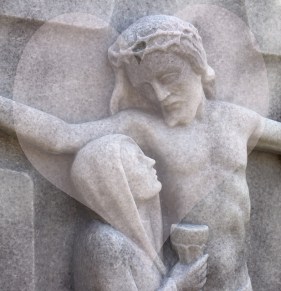
    jesus-1250023_640Jesus Christ, not Sacred Scripture, is the highest and greatest revelation of God to the world. Next is the Church, because Jesus instituted her and gave her the authority to teach in his name. This teaching authority is called the Magisterium; it safeguards the teaching which we call Sacred Tradition and in communion with the Holy Spirit has given us the Bible, which is the third source of revelation. Thus sacred tradition, Sacred Scripture and the teaching authority of the Church … are so linked and joined together that one cannot stand without the others… They all together and each in its own way under the action of the one Holy Spirit contribute effectively to the salvation of souls (Dei Verbum, §10).

    The salvation of souls: the promise of everlasting life won for us by Christ in his passion, death, and resurrection. No wonder that the Gospel Acclamation today proclaimed, Your words, Lord, are spirit and life. You have the words of everlasting life. We can just as well acclaim, “You, the Eternal Word, are spirit and life. You are the word of everlasting life.”

  • Thinking Rightly: Friday of the Fourth Week of Lent

    Thinking Rightly: Friday of the Fourth Week of Lent

    Wisdom 2:1a, 12-22; John 7:1-2, 10, 25-30

    A man once walked by my office while I was talking to someone. After he passed by my visitor said, “Boy, that guy is lazy.” I didn’t know the passerby very well but I heard that he was often absent, got others to cover his duties, and generally avoided taking any extra assignments. I have to admit that from then on I eyed him with a little suspicion. Only much later, when I got to know him well, did I discover that during that time his wife was suffering through a terrible battle with cancer. His manager had very kindly given him consent to work at home as much as possible so he could spend time being with and caring for her as well as for their two young daughters.

    Today’s readings remind us that before we say we know someone we should stop to consider whether we are thinking rightly. In the first reading the people knew the just one well enough to know that he was an annoyance; a reminder of what they did not want to be. Somehow, they had strayed so far from right thinking that even the sight of a good person had become too much for them. In reality, it wasn’t the just man himself who was an annoyance to these people as much as it was the voice of their own consciences.

    The words from this section of the book of Wisdom may sound very familiar. They very effectively prophesy the mocking that Jesus endured on the Cross; Jesus, the epitome of goodness and righteousness. We would never want to be associated with those who mock, taunt, or belittle Him. However, we must ask ourselves if we do that to any of the least of His brothers and sisters; if so, we are doing it to Him. If we have been annoyed or bothered by the piety or spiritual practices of others, then perhaps the voice of our own conscience is calling us to remember that our standard for piety and all the virtues is not other people. It is Jesus. To know virtue, we must know Jesus.

    As today’s selection from the gospel according to John teaches, knowing Jesus means much more than knowing where He was born or raised. Apparently, there was a belief among some Jews of the time that when the Christ appeared, no one would know where he was from. Since they knew where Jesus was from they reasoned that He could not be the one. The evangelist loves irony; it is fitting that these people in fact did not know where Jesus was from. They acknowledged his human origins but were completely blind to his divinity.

    The question for us is, do we know where Jesus is from? That is, although we know him as our Savior, do we really acknowledge him as Lord over all parts of our life? Whenever we refuse to give ourselves totally to Christ, we keep Him at a distance. For example, perhaps in the quiet of some evening the Spirit urges me to turn the television off and spend a few minutes in silence examining my conscience. I could do that now; on the other hand, I could wait. This show isn’t really that bad. Maybe I should say grace even when I’m out with my non-religious friends; on the other hand, that might make them self-conscious. As for that pro-life bumper sticker or rally, maybe I should forget it; others might be offended and I don’t want to start any trouble. Isn’t my Catholic faith a private matter, after all?

    These are the kind of things that keep Christ at a distance for they are at odds with the example he gave us. Jesus devoted his life and death to showing us that faith is not private, it’s public: He called people publicly, healed publicly, taught about His Father publicly, and died publicly. Again, the standard for our profession of faith is not the feelings or self-consciousness of others, it is Christ. If Jesus wasn’t ashamed to profess God as His Father and act in his Name publicly then we shouldn’t be, either.