Tag: John

  • Becoming Who We Are

    Becoming Who We Are

    Memorial of St. Philip Neri, Priest (May 26th)

    Philippians 4:4-9; John 17:20-26

    The readings today speak of two of the greatest gifts we can receive from our heavenly Father – peace and unity. St. Paul reminds us that it is the pursuit of excellence that leads us to God and the peace only he can give. In the gospel, Jesus teaches that perfection is nothing less than unity with the Father; again, a gift that only God can give.

    When I think of excellence and perfection in life, I can’t help but think of the saints, for these are the men and women who went out of their way to achieve both. I’m especially glad that we remember St. Philip Neri today, for his life provides a view of sanctity that is too often missing from the popular imagination.

    I say that because it seems to me that most people in our time see the saints as stained glass stereotypes; living in a perpetual state of sadness and gloom, cloistered from the world and everything in it. It’s as if they really believe the old pop song lyrics, “I’d rather laugh with the sinners than cry with the saints. The sinners are much more fun.”

    That’s why I like St. Philip Neri; he is exactly the opposite. Far from sadness and gloom, St. Philip was noted for his cheerfulness, going so far as to say that “Cheerfulness strengthens the heart and helps us to persevere. A servant of God should always to be in good spirits.” And far from running away from the world, Philip was born to engage it; charismatic, charming, and quick to smile, he was one of those people who lifted the spirits of a room just by walking into it. It says a lot about him that his favorite books were the Bible and his joke book. He was silly enough to walk around Rome with half his beard shaven off, and solemn enough to bring a congregation to tears. He was the scholar who taught the simple, the joker who consoled the sorrowful, the friend who welcomed every stranger, and the priest who reached out to every sinner. We call him the patron saint of laughter not simply because he excelled at making people laugh, but because he did it for the reasons St. Paul spoke of: That they might calm their anxiety, approach the Lord in prayer, and come to know the peace of Christ that surpasses all understanding (Philippians 4:4-7). This was grace at work in him for their sanctification and his own.

    St. Thomas Aquinas taught that grace perfects nature, and like all the saints, this is what St. Philip Neri shows us. The gifts God gave him – a jovial personality, the ability to relate to people, a brilliant mind, everything that made him who he was – were not meant to be replaced or suppressed; on the contrary, they were given to be made more excellent by the working of grace. What’s more, God graces each saint with their own unique gifts. Sanctity is not a matter of becoming more like someone else; it is becoming who we are. God doesn’t want another Philip Neri, He wants us, and he wants us to use the gifts He has given us, that through us people might know the peace of God and draw closer to Him and each other.

    This is the unity Christ had in mind when he said, that they may be brought to perfection as one, that the world may know that you sent me, and that you loved them even as you loved me (John 17:23). No wonder St. Paul said to rejoice! If knowing the infinite love of God is what it means to be saint, then I’m with St. Philip Neri; I’d rather laugh with the saints than cry with the sinners. The saints are much more fun.


  • Both Beggar and Bishop

    Both Beggar and Bishop

    Saturday of the 4th Week of Easter

    Acts 13:44-52; John 14:7-14

    One Sunday in late November, members of a Mormon congregation in suburban Salt Lake City were greeted by a homeless man in the parking lot. As he approached and wished them a Happy Thanksgiving, he got various reactions; most people ignored him, a few gave him money, still others asked him to get off the property. Imagine their surprise when the man not only attended the service with them, but revealed that he was actually a Mormon bishop in disguise.

    In the gospel, our Lord said, “Have I been with you for so long a time and you still do not know me, Philip?” (John 14:9). As usual, that question is meant for us, too, but before answering, keep in mind that the word John uses for “know” means “to know by experience.” So, the question is, have we been with Jesus for so long a time and still not experienced him?

    We certainly have ample opportunity. For one thing, we experience him in each other. As St. Paul taught, we are the Body of Christ. For another, we experience him in the Scriptures, where he has given us plenty to contemplate. Finally, we have the most profound experience of all – the Blessed Sacrament, Jesus Christ himself – Body, Blood, Soul, and Divinity. All these experiences have been given to us that we might come to know and love him more deeply.

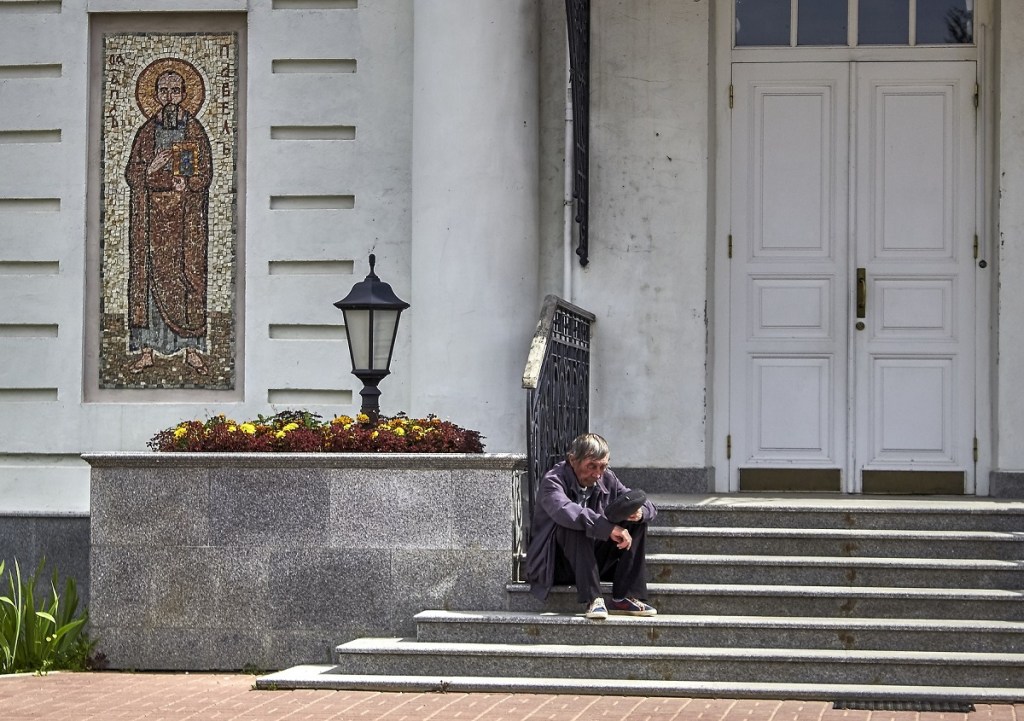
    Still, in the face of all that, we have the deep-seated problem of failing to find Christ when he’s standing right in front of us. I say deep-seated because we’ve been fighting it at least since the time of St. John Chrysostom, who said that if we cannot find Christ in the beggar at the church door, we won’t find Him in the chalice.1 What good is the faith that shows us Christ in the Blessed Sacrament, if in practice we ignore Christ in those around us?

    If only it was as simple as mistaking the bishop for the beggar! Although the example shows that we still struggle with it, we are well-trained (rightly so!), to see Christ in the poor, the marginalized, and the suffering: they, as St. Teresa of Calcutta said, are Jesus in his most distressing disguise.2 But what about our Lord’s more subtle disguise – the people we spend so much time with? That can be harder; for, as so many of us know, when it comes to our families, friends, co-workers, and fellow parishioners, familiarity often breeds contempt.

    Sadly, contempt has blinded religious people for centuries. It isn’t hard to understand. The first reading is a perfect example; Paul and Barnabas preached to the Jews what sounded an awful lot like heresy. Naturally, that’s going to stir up anger, resentment, and ill will. We expect that. What we don’t expect is the persecution that followed; such behavior hardly reflects the true love or knowledge of God. How could it surprise anyone that separation would result, a wound in God’s people that aches to this day.

    But again, the issue is not them, but us. We too disagree, make mistakes, hurt each other, and stir up feelings of resentment, disappointment, or even anger, that threaten to divide us. Constantly, we must go back to the question of Jesus, have you been with me so long and still do not know me? To know Christ is to know the love that unites us one to the other; that forgives as we have been forgiven, and that looks at both beggar and bishop and sees the only thing that matters – the image and likeness of Almighty God.

    1This seems a paraphrase of section 4 of Homily 50 on Matthew: https://www.newadvent.org/fathers/200150.htm

    2https://brandonvogt.com/his-most-distressing-disguise/


    And now, a word from our sponsor…

  • The End of All Perfect Storms

    The End of All Perfect Storms

    Saturday of the 2nd Week of Easter

    Psalm 33:22; John 6:16-21

    The term “perfect storm” dates back at least to the 19th century. We don’t know exactly what it meant then, but my guess is that we all know from personal experience what it means now: Life is going along fine; then, all of a sudden and from every direction, we have nothing but trouble, if not outright disaster.

    John certainly captured the essence of that in today’s gospel passage. The Apostles are in the midst of their own perfect storm, literally: in a boat, in the dark, out at sea, working hard to make it across, waves rising, and strong winds blowing against their every effort.

    While three evangelists tell the story of our Lord walking on the water, only John strips it down to the bare essentials. He says nothing about Peter going out to join Jesus, the Apostles mistaking him for a ghost, or thinking that he will pass them by. Rather, John keeps only two things in common with the other versions: First, the Apostles see Jesus walking on the sea (6:19); second, when Jesus comes to them, he says, It is I (or, I AM). Do not be afraid (6:20).

    Why would John do this? Possibly because of the way he wants to use the story to help us understand Jesus. Consider how this story fits into John’s narrative: Right before this, Jesus fed thousands with five barley loaves and two fish (6:4-14). Now, he walks on the sea and the Apostles get safely to shore. The next day, he will again encounter those he fed, but this time will reveal to them that he himself is the true bread come down from heaven that gives life to the world (6:32-33). In all this, John stirs up a memory and makes an association. Who in Israel’s history fed thousands in the wilderness, brought them safely through the sea, and guided them to a new life in the Promised Land? What the Father once did for Israel, his Son now does for the Apostles, and for all his people.

    And not just for them; for us, too. Through John’s simple but powerful retelling of the story, Jesus assures us that there is no storm in our life that is too much. They may seem so to us, but that’s because in the heat of the moment we tend to focus on the troubles, the failures, and the problems. That’s only natural; the storms in our lives come upon us so suddenly, and seem so big. But, if we can find it within ourselves to take a moment, step back, and remember how God has always been there, we will see that he hasn’t abandoned us; he is right there in the storm with us.

    In the storm with us… what does that mean? Won’t the storm be over? You might not have noticed, but that’s another difference between this version of this story and the others. John says nothing about Jesus calming the storm. His point wasn’t that Jesus makes storms disappear, it was that he is with us in them and keeps us safe despite them. So, let us resolve to do what the psalmist urges us to do: Place our trust in God. For, although we cannot eliminate the storms from our lives, we can remember that, even in the most perfect storm, it isn’t that we have nothing but trouble; it’s that we have nothing but God.

  • The Two Wells

    The Two Wells

    The 3rd Sunday of Lent, Cycle A

    Exodus 17:3-7; Romans 5:1-2, 5-8; John 4:5-42

    Not long ago, I came across a very interesting survey. What got my attention was how brief and unusual it was, given its audience. The author asked hundreds of business men and women a single question, and wanted a single-word answer: “If you could say in one word what you want more of in life, what would that be?”

    As we think about our own answer, let me just say that “money” did not come in first (not that any of us was thinking that). No, first place went to “happiness.” Some of the other top answers were freedom, peace, joy, and fulfillment. All these from business people, many of whom are no doubt wealthy or at least holding their own financially.

    This got me to wondering about the Samaritan woman in today’s gospel, and what she would have said. We don’t know a lot about her, but from the little we do know, I would guess that she, like the people in the survey, wasn’t too happy, didn’t feel very free, was not at peace, and probably felt unfulfilled. For that matter, what about us? My guess is that we, like many people across the ages, have felt pretty much the same.

    So, how do we get that way? To borrow a concept from the gospel, by looking for the right water in the wrong well. What’s the right water? The things we most want, deep down: Happiness, peace, freedom, fulfillment. What’s the wrong well? Anything that can never supply them. We think, “If I have this food, those clothes, that home, I’ll be happy!” But after we get them, what happens? We tire of them and thirst all over again. “OK, maybe THIS food, THOSE clothes, THAT home…” It’s a cycle; the more we drink the wrong water, the thirstier we become, and the more we drink. The irony is that we will risk losing sight of everything, even God, in our relentless pursuit of what it turns out that only God can give! This is why, centuries earlier, the Lord said through the prophet Jeremiah, Two evils my people have done: they have forsaken me, the source of living waters; They have dug themselves cisterns, broken cisterns that cannot hold water (Jeremiah 2:13).

    Jacob’s well was no broken cistern but the Samaritan woman certainly was, and Jesus really wanted to see her. We know that because John says, Jesus had to pass through Samaria (John 4:4). There were well-known routes around that country, to the east and west. No, he went to see her, just like he comes to see us. Why? What does he offer people drinking from the wrong well? A way out. Remember his words to her at the start: If you knew the gift of God and who is saying to you, ‘Give me a drink,’ you would have asked him and he would have given you living water. (John 4:10). He’s challenging her, challenging all of us: Know me, and ask for the life that only I can give.

    At first, she resisted; made light of it, stayed with the water she understood. We all do that, for at least a couple of reasons. First, habits are hard to break, even harder when they’re habits we like. Second, it’s a lot easier to run from problems than it is to face them. But there is no running from Christ. He knows exactly how to get our attention; he hits very close to home. For the woman, it was when he said, Go call your husband and come back (John 4:16). Imagine the shock, not only of how he could know the truth, but having to look the truth straight in the eye. This is the encounter with Christ, who is the Truth; he not only shows us who he is, he shows us who we are. As the scholar William Barclay once said, “We never really see ourselves until we see ourselves in the presence of Christ; and then we are appalled at the sight.”

    Christ is the truth, but he is the way and the life as well. Although he does show us who we are, he also shows us who we are made to be. We saw this in the readings for the first two weeks of Lent; yes, sin entered the world, and through sin our thirst for dead water, but Christ also entered the world, and by his passion, death, and resurrection has opened the way to eternal life. Now, in the 3rd week of Lent, our Lord teaches us that the choice is ours: Are we going to keep taking water from the wrong well, or are going to turn to Christ, and take the living water of his infinite grace?

    That was the question before the Samaritan woman. We know what she did, John tells us: She left her water jar and went into the town and said to the people, ‘Come see a man who told me everything I have done. Could he possibly be the Christ’ (John 4:28-29)? She became an evangelizer. For the first time in a long time, maybe the first time ever, this woman knew happiness, peace, and fulfillment like she had never known.

    That leaves us. The choice is ours: There, the same old well, the same dead water; here, Christ, the Living Water. He comes to this well today, and every day, in the Blessed Sacrament, just to see us. All he asks is that we do what the Samaritan woman did: Have the courage to face ourselves as we are, the honesty to call the truth the truth, and the humility to put the old water jar down and seek the infinite grace of forgiveness that he is so eager to give. After that, the only question is, how much of the Living Water do you want?

  • Looking into the Eyes of Love

    Looking into the Eyes of Love

    Memorial of Our Lady of Lourdes

    Isaiah 66:10-14c; John 2:1-11

    In the first reading Isaiah called to mind the tender image of a mother comforting a baby carried in her arms… fondled in her lap (Isaiah 66:12-13). At such times, mothers might speak, but they know that words are unnecessary. They prefer the other senses: Touch, smell, and especially, sight. Many of us know this from experience; while we like to hold babies and smell them (there’s nothing like that “new baby” smell), we especially love to look into their eyes.

    In fact, scientists have recently discovered that when infants and parents lock eyes, their brain waves synchronize; that is, the child’s brain activity mirrors their parent’s. That’s not all; this phenomenon seems to continue throughout life. No wonder my mother was so good at reading my mind every time she asked me to look her in the eyes!

    I believe the same is true of the Blessed Mother and Jesus, and I think today’s gospel story is a good case in point. After Mary tells Jesus that the wine has run short, he’s not disrespectful but he does make it clear that he’s not particularly interested. Nevertheless, just a moment later, he miraculously creates about 120 gallons of fine wine. What could possibly have so moved him?

    I think only one thing could do that: Looking his Mother in the eyes.

    She had gazed into those eyes from the time she first carried him in her arms, and many times since over those thirty hidden years in Nazareth. In a very real way and beyond anything either science or St. Paul could have imagined, Mary had the mind of Christ. So, whatever was behind her eyes at that moment in Cana, he knew that it could only be motivated by the purest love of him, her Son, her Savior, and her Lord.

    And, in ways known only to Christ, Mary’s eyes were much more than a window to her immaculate soul. Hers were the eyes that beheld the angelic revelation in Nazareth; that searched for a place to give him birth; that watched and guarded him as he grew; that wept as he walked out the door for the last time. Hers were the eyes that constantly looked for ways to be the disciple she had been called from all eternity to be; the eyes now gazing at him, pleading in their own quiet way for him to save the honor of this bride and bridegroom; to show them and the world the merciful and loving Savior she had gazed upon for ten thousand wondrous days in Nazareth.

    I came across a book by Fr. Raneiro Cantalamessa, Preacher to the Papal Household, entitled, Mary, Mirror of the Church. I look forward to reading it! By that title he surely must be thinking of the Blessed Mother as we now know her and as she once described herself to Bernadette Soubirous at Lourdes: “I am the Immaculate Conception.” The titles work wonderfully together, for as St. Paul once wrote, Christ has sanctified the Church that he might present to himself the church in splendor, without spot or wrinkle or any such thing, that she might be holy and without blemish (Ephesians 5:27). It may have been the love of a young man for his mom that first moved Jesus to change water into wine at Cana, but it was the infinite love of the Son of Man for his holy and immaculate bride, the Church, that moved him to change bread and wine into his own Body and Blood at the Last Supper.

    Today we remember the one he called Woman, who we call Mary Immaculate, Mother and mirror of the Church. Let us take a moment today to thank God for giving us so loving a mother. May she continue to look tenderly upon all of us, her spiritual children, and plead that we too be made into the finest wine. She, who has for so long looked into the eyes of Infinite Love and perfectly conformed her mind to His.

    Mary Immaculate, pray for us.

  • Getting Out More Than We Put In

    Getting Out More Than We Put In

    The 7th Day in the Octave of Christmas

    1 John 2:18-21; John 1:1-18

    You don’t have to know the second law of thermodynamics to know that everything put together tends to fall apart. Anyone who has owned a house or car knows very well the time and effort it takes to keep them in good condition. The same is true for our relationships; we tend to get out of them just about what we put in.

    Thank God that isn’t true on the divine side; as John reminded us in today’s gospel, God has put everything into his relationship with us, to the point of taking flesh and dwelling among us. Not only that, as John also said, He pours grace upon grace on us, infinitely; for we never get a part of God, we always get everything.

    So, why is it, in the presence of this infinite grace, that even by the time John wrote his first letter, we are hearing about antichrists and disunity within the nascent Church?

    John gives us a clue to the answer when he says that to those who did accept him he gave power to become children of God (John 1:12). There it is: acceptance. Even infinite grace does no good unless it is accepted; the light of Christ must be chosen. And that is precisely the problem, as Christ himself says later in this same gospel: … this is the verdict, that the light came into the world, but people preferred darkness (John 3:19).

    But wait, we might think, I don’t prefer darkness. I love Christ; aren’t I in the light? This is exactly the question the Evangelist wants us to ask! Perhaps you’ve noticed that John uses terms that sound a lot like a court room: testimony; testify; witness; verdict. That’s because his gospel is a trial; only, Christ is the judge, we are the defendants, and the question before the court is: Do we love him and are we committed to following him?

    We might answer as before: Yes, I love Christ and am committed to following him. But then, God is the judge, commitment is what he says it is, and, as the gospel shows, he sees commitment as total. By entering our world, taking human flesh, lifting it up on the cross, and drawing all people to himself, he showed love and commitment to the death and beyond. Thankfully, our Lord in his infinite mercy knows this is a standard we can never reach, so he doesn’t ask that; he asks only that we accept the truth about him and remain in unity with him.

    That sounds easy, but as John knew in the early Church, it’s not. We know from our own experience, too: It’s far easier to accept what I understand, agree with, or what fits into my existing beliefs. But this attitude betrays a lack of faith; I don’t believe God, I believe myself. The result? What John saw: Lack of commitment, disunity, and discord.

    Let us use this last day of the calendar year to do two things. First, look back and make an honest assessment; ask yourself, “Have I put in the time and effort it takes to have a good, healthy relationship with Almighty God?” In those places where I’m lacking, let me use the example of Christ, who loved as God loves. How do I do that? First, by developing more empathy for people. What are their struggles? What does life look like through their eyes? Second, by being concerned about them. When I ask how they are, do I really mean it? Third, by caring for them. Their life matters to God, so it matters to me. What can I do to help them? Finally, by self-sacrifice; committing to do whatever it is that needs to be done. All these Jesus did; his actions are our model.

    Second, let us look forward and resolve to make sure that our commitment to Christ is total; to remember, as St. Therese once said, “You cannot be half a saint. You must be a whole saint or no saint at all.” While hearing this might tempt us to think that there are saints and then there are the rest of us, nothing could be further from the truth. Salvation for all humankind rests on the fact that God measures us not by our success but by our faithfulness. Commitment does not require perfection, it requires perseverance; therefore, let us ask the Holy Spirit to strengthen our resolve to answer by the witness of our lives the deepest question Christ asks: “Who did you say that I am?”

  • The Three Choices

    The Three Choices

    Saturday of the Fourth Week of Lent

    Jeremiah 11:18-20; Psalm 7:9; Luke 8:15; John 7:40-53

    Years ago, the leader of a religious cult said that God told him the world was going to end soon; he even gave the day. When that day came and went, a few members lost their faith and drifted away. However, many did not; their faith grew stronger. When asked why, they replied that God decided to spare the world because of the cult’s prayers.

    Although they went about it in opposite ways, both of these groups were looking for the same thing: Consistency. We like our words and actions to be consistent. When they aren’t, when we say one thing but do another, we have three choices: Change our beliefs, change our behavior, or rationalize our behavior away. It can be hard to change our behavior, especially when it’s a habit; it can be even harder to swallow our pride and admit that our beliefs were wrong. That makes rationalizing a very popular choice.

    We see shades of this in today’s gospel. The chief priests and Pharisees had firm beliefs about who God is, how He works in the world, and who He works through. In their eyes, that did not include Jesus. But the people had begun to see that the actions of Jesus were inconsistent with that; his miraculous signs along with the depth, truth, and beauty of his words were convincing evidence that God was indeed working in and through him. So, the chief priests and Pharisees had to choose: Either change their own beliefs, change the peoples’ behavior, or somehow find a way to rationalize it and save their own pride.

    As the gospel story shows, they weren’t going to change their own beliefs, and they weren’t going to talk the people out of their attraction to our Lord. That left one choice: Rationalize. So that’s exactly what they did; to them, anyone who believed in Jesus was either deceived, ignorant, or ‘from Galilee,’ which was apparently intended as an insult. Ironically, by the end they lost all rationality, ending with an outright untruth: Look and see that no prophet arises from Galilee (John 7:52). If they themselves had looked, they would’ve seen that in fact the prophets Jonah, Hosea, and Nahum were all from Galilee!

    But we can’t focus on these men without looking in the mirror, for we all share the great inconsistency of sin. Our faith tells us that something is sinful; we do it anyway; we feel guilty. To rid ourselves of the guilt, we too must choose one of the three options mentioned before. Let’s take the worst one first: Changing our beliefs to suit our sinful behavior. Sadly, many of us know people who have done just that – left the faith rather than give up a sinful life. Let us pray that their hearts may soften, and that we never give in to the temptation to abandon the faith. Second, we can rationalize, as the priests and Pharisees did. This is a great temptation because, to paraphrase St. Jean Vianney, it’s so much easier to excuse ourselves than to accuse ourselves. That is exactly what we do every time we say things like, “I shouldn’t have gotten angry, but you made me so mad,” or “It’s just a little white lie,” or “I know I shouldn’t have texted while driving but it was an emergency.” These may seem like no big deal, but they lead to bigger problems; we dull our sense of sin and open ourselves to another: The sin of presumption, which says, “Go on, do it! God will forgive you later.”

    How far these selfish choices are from the generous heart spoken of in the Gospel Acclamation, that keeps the word and yields a harvest through perseverance (Luke 8:15), the innocent heart that prays for justice (Psalm 7:9), the heart that is completely open to God, who Jeremiah called the searcher of mind and heart (11:20). Only such a heart can make that most difficult choice: To change our behavior, so that it is in keeping with our faith. This takes perseverance, for our sins can be habits that are hard to break; it takes love of justice, for we have wounded our neighbor and our innocent Lord and must make amends; and it takes total openness to God, who knows our mind and heart infinitely better than we do.

    Let us pray that our merciful Lord will grant us such a heart, that we may have the humility to see ourselves as we are, to admit when we have sinned, and to seek the absolution that He alone can give. Only by His grace can we be most truly consistent.

  • The Invitation to Dare: Divine Mercy Sunday

    The Invitation to Dare: Divine Mercy Sunday

    Acts 4:32-35; 1 John 5:1-6; John 20:19-31

    The gospel according to John has been called the gospel of encounters. Each follows the same basic pattern: Jesus encounters someone, they test him, there is an exchange, and the encounter ends with those who tested Jesus finding that in reality they are the ones being tested: Will they believe or not? Of course, Jesus wants them to rise to the challenge but he never forces them; it’s their choice and a test of their faith.

    Between last Sunday and this, John gives us five encounters, each posing its own challenge to faith. First, the Beloved Disciple: Will he believe in the resurrection based only on the testimony of an empty tomb? No; he has to see the tomb himself and the burial cloths neatly arranged, perhaps as proof that the body of Jesus was not stolen. Then Mary Magdalene: Will she recognize the risen Lord if she sees him? No; she must hear his voice. Next, the Apostles: Will they believe if they see and hear? Only when Jesus shows them his hands and side. Then Thomas: Will he believe his brother Apostles, now eyewitnesses? No; he needs to touch the wounds of Christ. The fifth challenge is from the evangelist to us: Will we believe without being able to see, hear, or touch Jesus?

    We might be tempted to say no, for if the Beloved Disciple, Mary Magdalene, and the Apostles struggled with faith, what hope do we have? But that’s not the attitude of Christ; he calls us “blessed.” Why? Because his encounters with us are not about human failure but about the triumph of divine mercy. Jesus didn’t resent the Beloved Disciple going to the tomb; rather, he used it to inspire John to recall the words that made that trip unnecessary: Destroy this temple and in three days I will raise it up (John 2:19). He wasn’t disappointed that Mary Magdalene needed to hear him; he is the Good Shepherd whose sheep follow him because they recognize his voice (John 10:4). He wasn’t angry that the Apostles had to see his wounds; rather, he bid them peace and gave them authority to forgive sins, so that others may know the same peace and all might take to heart his words at the Last Supper: Do not let your hearts be troubled. You have faith in God; have faith also in me (John 14:1). He was perhaps kindest of all to Thomas, that from he who seemed weakest in faith came the greatest affirmation of Christ’s divinity in all the gospel: My Lord and my God (John 20:28). Finally, Jesus spoke encouragingly to us, calling us blessed because we have not seen and have believed (John 20:29).

    This is how God shows mercy: By encouraging rather than cajoling, inspiring rather than depressing, and building up rather than putting down (although justice sometimes demands the whip). For his goal is and always has been to raise us up to himself. God is love and as one spiritual writer has noted, “mercy is love bending over misery to relieve it, to redeem it, to raise it up to itself.”[1] Time and again God has shown that this is what he will do, even to the giving of his only Son, that in his infinite mercy, he might draw us closer and closer to himself.

    Today we have the opportunity to draw very close indeed, for on the Feast of Divine Mercy, Christ offers us a great gift: The renewal of baptismal grace; the complete forgiveness of sins and punishment. This grace is usually received only through baptism itself or a “perfect” sacramental confession – one made purely for the love for God.

    Of course, like all encounters with Christ, there is a challenge. We can only obtain this extraordinary grace if we worthily receive the Eucharist on the Feast of Divine Mercy or its vigil Mass. Since we are at that Mass now we’re off to a good start, but that’s not all; worthily means that we have made a good sacramental confession in the recent past (say, Lent), that we’re still in the state of grace, and that we trust in the infinite mercy of God. Also, our Lord revealed to St. Faustina that if we are to receive mercy, we must show mercy. We don’t have to do what the Christians did in the first reading – sell our homes and give the proceeds to the poor – but we do have to practice the works of mercy listed in the Catechism: Spiritual works such as teaching the faith, advising, consoling or comforting others, forgiving and bearing all wrongs patiently, and the corporal works such as feeding the hungry, sheltering the homeless, clothing the naked, visiting the sick and imprisoned, and respectfully burying the dead.

    Fr. Michael Gaitley, who has dedicated himself to spreading the Divine Mercy devotion, advises us to remember that we do these things out of love and gratitude to God, not to try and earn his mercy. Asked what the biggest misconception is about Divine Mercy, he said that many active Catholics have somehow gotten the idea that “God’s love must be earned by following all the rules, saying all the prayers, and giving money to the right causes… that the more perfect we are, the more worthy we are to draw close to Jesus. The reality is that Jesus invites us spiritually poor, weak, broken, and overburdened people to draw as close as we dare…”[2]

    Every encounter with Christ is an invitation to dare; to “become who we are.” It requires us to face who we are – poor, weak, and broken – but also to see ourselves as God sees us – eternally willed, infinitely precious, and worth any sacrifice. In this lies the wound to our pride, the admission that there is nothing we can do to earn our own salvation but also the healing truth that there is nothing we need to do, for God has already done it. All he asks is that we accept it and, on this feast of Divine Mercy, show our gratitude for it. The only question is, will we?

    1 Fr. Gabriel of St. Mary Magdalene, Divine Intimacy, #236, Section 1.

    2 Catholic Digest, April/May 2020, page 16

  • Minute Meditation: The Liar

    Minute Meditation: The Liar

    1 John 2:22-28; John 1:19-28

    For the first few decades of my life, I didn’t try too hard to live like a Christian. Although I went to Mass, attended Catholic school, and even sang in the choir as an adult, to me the faith was more something I had to do, not something I wanted to do.

    It wasn’t until my late 30’s that I began asking myself a version of the question we heard the priests and Levites ask the Baptist in the gospel: Who are you (John 1:19)? For me the question was, “Who are you – the man who attends Mass every Sunday or the man who lives the rest of the week as if he never heard of God?” and perfectly summarized in 1 John with that simple but fateful question, Who is the liar (1 John 2:24)?

    I am. I, the man who bowed to God but knelt to the world; who taught his children the virtues but rarely practiced them; who had no trouble looking in the mirror but couldn’t face himself; who never thought of himself as denying Christ or the Father but, with every sin, was doing exactly that.

    Yet this faith I barely knew had taught me the virtue of hope and that hope is personified in the one the Baptist spoke of when he said, there is one among you whom you do not recognize… whose sandal strap I am not worthy to untie (John 1:26-27).

    No, I didn’t recognize him; I was lost. Thank God he found me, led me to the Confessional, and gave me the grace to listen as John said: Let what you heard from the beginning remain in you. If what you heard from the beginning remains in you, then you will remain in the Son and in the Father (1 John 2:24).

    Vestiges of the old me are hard to shed but with the continued grace of God I remain in him, for I have to come to realize the incomparable worth of the promise that he made us: eternal life (1 John 2:25).

  • The Wounds of Love: St. Birgitta of Sweden

    The Wounds of Love: St. Birgitta of Sweden

    Galatians 2:19-20; John 15:1-8

    I once instructed a woman in the RCIA program who excelled in her studies of the faith. After receiving the sacraments she moved away and I lost track of her. Years later, I learned that she had stopped practicing the faith. She was now “spiritual but not religious.” I think that means she believes that while there is a spiritual dimension to the world, it isn’t what we understand as the faith most fully revealed to us in Christ.

    The sticking point for her, as for many, may well have been the passion and death of our Lord. Indeed, the crucifixion was called by St. Paul a stumbling block to Jews and foolishness to Gentiles (1 Corinthians 1:23). But to one of the saints, St. Birgitta of Sweden, the crucifixion held a special place; it was the nexus of the physical and spiritual worlds.

    Birgitta lived a life full of the joys and sorrows of family. Born in Sweden around the year 1303, the daughter of a governor, by age 42 she had already been a wife for 28 years and a widow for one. She had a wide and deep experience of motherhood; as mother of 4 boys and 4 girls, she saw one daughter run off to marry a troublemaker, one son die as a boy, one as a man, and another daughter grow up to become St. Catherine of Sweden.

    She also knew the life of the working world. While raising her own children she served as lady-in-waiting to the queen of Sweden. Her kind, motherly way drew her into the confidence of the king and queen, both of whom tended to enjoy worldly life too much for their own good. Birgitta worked as hard as she could to keep their religious concerns before them; this became a frustrating and unfortunately futile struggle.

    Finally, Birgitta knew the religious life as well. After becoming a widow and devoting herself to care of the poor, who greatly loved her, she dedicated buildings and land on family property to a new contemplative order. She wrote the rule for her order which became known as the Order of the Most Holy Savior.

    At the same time, Birgitta lived a full life in the spiritual world. She was a mystic. At age seven, she had a vision of being crowned by the Blessed Mother. Three years later came her most profound mystical experience: The crucified Christ appeared to her and bid her gaze upon him. When she asked who had so cruelly treated him, he replied, “Those who despise me and spurn my love for them.” This was her own Damascus road moment; although she had many visions, dreams, and locutions afterwards, she devoted the rest of her life to the contemplation of Christ’s suffering.

    After wisely consulting her spiritual advisor and obtaining his approval, Birgitta began to share her visions with the world. She met with Magnus, the king of Sweden, and advised him that Christ would visit a plague on the land if he and the queen did not change their ways. As usual, he laughed off her vision. The Black Death came two years later, wiping out half the population. Needless to say, the king stopped laughing.

    Birgitta next focused her attention on the popes, who had long since deserted Rome in fear for their lives. Leaving Sweden with her daughter Catherine, she moved to Rome. In the midst of its crumbling churches and society, Birgitta ministered to the sick, fed the poor, housed pilgrims, and called on the pope to return. Her call took on a special intensity due to her dislike of pope Clement VI, who she called “a murderer of souls, more unjust than Pilate and more cruel than Judas.” During a thunderstorm on the night of December 3rd 1350, lightning struck the bells of St. Peter’s, melting them. Birgitta prophesied this as a sign that Clement’s life was coming to an end. He died a few days later. When the next pope fled to get away from her Birgitta literally chased him down, begged him to approve her order, which he did, and to return to Rome, which he did not do. After her death in 1373, her call for the popes to return was taken up by St. Catherine of Siena. Not long after, the papacy returned to Rome to stay. Birgitta was vindicated.

    In the first reading, St. Paul wrote:

    I have been crucified with Christ; yet I live, no longer I, but Christ lives in me; insofar as I now live in the flesh, I live by faith in the Son of God who has loved me and given himself up for me (Galatians 2:19-20).

    jesus-753063_640

    Birgitta’s life is a testament to the triumph of St. Paul’s words. From the moment of that first overwhelming spiritual encounter with the suffering, crucified Christ when she was 10 years old, she began to internalize them; to sense as we all must, not only the pain of Christ’s passion but the passion behind his pain. The ultimate reality of the cross is love, a love so great it unites heaven and earth, the physical and spiritual. What else could it be but love that would cause God himself to take on our humanity, our sinfulness, and in the face of humanity’s rejection, nail it to the cross? Birgitta spent her life contemplating not the pain of futility but the pain which Oscar Wilde called the wounds of love. In her own way, St. Birgitta spent her life showing her family, her king, her people, and her pope that this is not only a love worth dying for; it is a love worth living for – eternally.

    St. Birgitta, pray for us.