Tag: Jesus

  • The Heart of the Law: The 3rd Sunday of Lent, Cycle B

    The Heart of the Law: The 3rd Sunday of Lent, Cycle B

    Exodus 20:1-17; 1 Corinthians 1:22-25; John 2:13-25

    At first, today’s readings might not present themselves as a unified whole: Moses receives the Ten Commandments; St. Paul speaks of the cross; our Lord cleanses the Temple. But if we look a little below the surface, a theme does emerge.

    First, the Ten Commandments. As significant as they are on their own, these are only the first of a series of commands that God used to define the terms of his covenant with the Hebrews. The agreement was this: If the people obeyed God’s law, they would not only be his treasured possession but God would have a sanctuary built and dwell among them. This was truly momentous, for God hadn’t dwelled among people since the Garden of Eden (recall him walking in the Garden in Chapter 3 of Genesis).

    This is why several chapters of Exodus then go into great detail about the sanctuary’s construction. Much of it symbolizes the Garden of Eden, that first sanctuary of God, including the tree in the center of the Garden – the tree of life. And that explains why, down to the time of Jesus and beyond, the Temple held such pride of place among the Jews: The Temple was an icon of the universe, including paradise, and its center, the holy of holies, the place where God Most High dwelled among his people. It was as if God was re-creating Eden and restoring his people to their place near the tree of life.

    The only thing more incredible than all this was how little time it took the Hebrews to break the covenant. Just weeks after agreeing to have no other gods they melted jewelry to make a golden calf. But then we shouldn’t be too hard on them; it’s human nature to want our own way, to determine for ourselves what is good, and then, after we’ve sinned, to rationalize or minimize it.

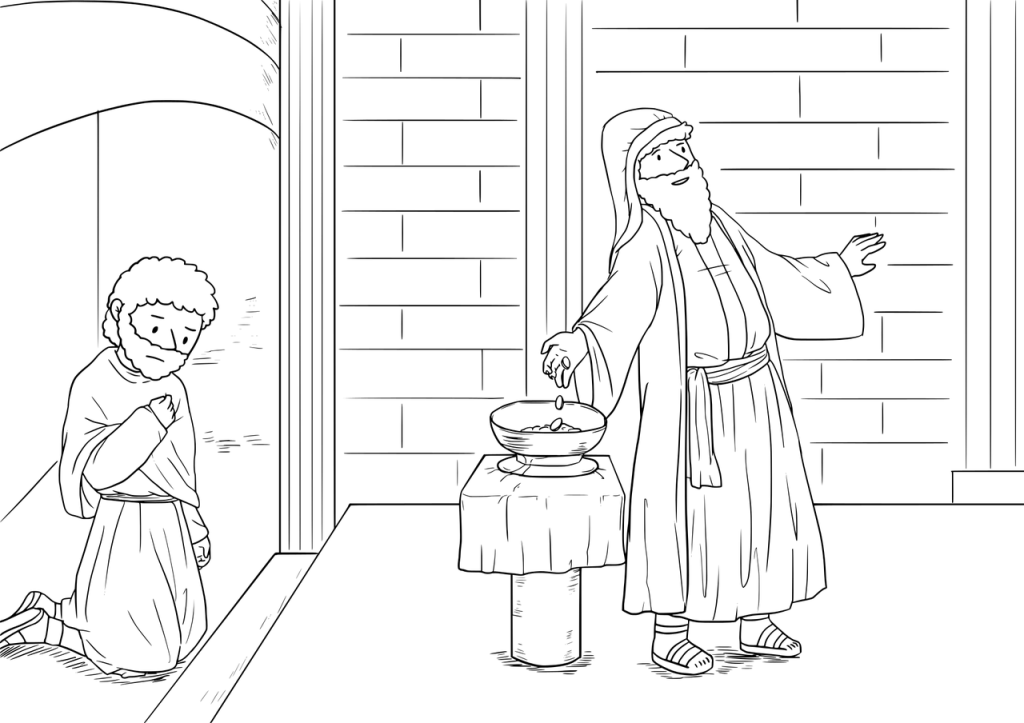
    We see that in the gospel story. Jewish law did stipulate a census tax and the securing of an animal for sacrifice, but neither of those things had to be done on Temple grounds and there is little doubt that at least some profiteering went on. But come on, what’s the harm? People paid the tax and sacrificed their animal. We see it in our own time as well. For example, the Catechism teaches that it’s a sin against the 2nd Commandment to say God’s name when we’re not praying. God’s name is holy, and we are to speak it only to bless, praise, and glorify him (CCC §2143). Still, we’re tempted to think, “No way. Everybody says, ‘OMG’ when they talk. I can’t believe God really cares about that!”

    But we forget the ancient principle of law that says that the seriousness of an offense is determined not by the person who commits the crime, but by the dignity of the victim. For example, in civil law, if a man assaults someone he might be arrested or fined, but if he assaults the President of the United States he will definitely go to prison for a very long time. Why? Because of the dignity our society bestows on the office of President.

    So with God’s law; when we sin God is offended, and because God’s dignity is infinite, every offense against him is infinite. From that perspective, think how arrogant it is for us to tell God when he should or should not be offended, or demanding that God explain himself to us. That’s exactly backward. Only God gets to say when he is offended and, as Christ implied in the Temple, only God is in a position to demand anything.

    This at last brings us to the cross. For God does demand something – justice – but in his infinite mercy demands that it be satisfied once and for all through the sacrifice of his only Son. As much as the commandments mean, as much as the Temple ever meant, infinitely more was given to us by this gift. For as he implied in today’s gospel, Jesus is the Temple, and only in his cross do we find the true tree of life, the highest expression of what we are called to be, how we are are called to love.

    In these remaining days of Lent, make time to contemplate the cross. If you do not pray the Stations of the Cross, consider doing that. Regardless, pray the words we begin with – the Act of Contrition: “O my God,” (said in prayer!) “I am heartily sorry for having offended Thee, and I detest all my sins because of Thy just punishments, but most of all because they offend Thee, my God, Who art all-good and deserving of all my love. I firmly resolve, with the help of Thy grace, to sin no more and to avoid the near occasions of sin.”

    This prayer helps us remember what God wants most: That his law be written on our hearts; that from our heart we are sorry for offending his infinite dignity; and that we are committed to avoiding the situations or places that have helped lead us into sin. All this strengthens within us the Holy Spirit’s gift of fear of the Lord, through which we come to love God so much, to respect his dignity so deeply that we never want to do anything to offend him; to say as little St. Joan of Arc said at her trial, “I would rather die than do a thing which I know to be a sin or against the will of God.”

    That is the heart of Christ, whose love is the heart of the law.

  • The Feast of the Presentation of the Lord

    The Feast of the Presentation of the Lord

    Malachi 3:1-4; Hebrews 2:14-18; Luke 2:22-40

    February 2nd is a day of celebrations. Many know it as Groundhog Day, the day when it seems the whole world watches the behavior of a groundhog in Punxsutawney, Pennsylvania. What many may not know is that this lighthearted little distraction began over a century ago as a Protestant attempt to take attention away from the Catholic celebration of Candlemas. By ancient tradition, February 2nd, the last day of Christmas, is the day on which candles to be used throughout the year are blessed at holy Mass.

    February 2nd is also reserved for a much different kind of celebration. At memorial services around the country, people will gather and candles will be lighted to honor four chaplains who in World War II served on board the USS Dorchester. On this night in 1943 the Dorchester was torpedoed by a German U-boat in the icy waters of the North Atlantic. Out of time, options, and life preservers, these four men – two Protestant ministers, a Jewish rabbi, and a Catholic priest – gave up their life jackets to four soldiers without one, locked their arms together in prayer, and went down with the ship.

    This is exactly the kind of heroic witness that goes to the heart of the greatest celebration on February 2nd – the Feast of the Presentation of the Lord. For, from the moment of their own consecrations, each of these men had, like Christ, committed himself to bringing the love and light of God to those around them. While none knew the fate that awaited him, each spent every day preparing for it; offering themselves to the Father that others may live. When the final moment came, each man came to it exactly as Simeon came to the Temple; in the Spirit, using the gifts only God can give, for the same reason that Christ came in the first place – that others may live.

    But their lives and deaths are more than just a good story; they point the way for us. We too are consecrated to the Lord. At our baptism, each of us received a lighted candle while our parents and Godparents were told, “This light is entrusted to you to be kept burning brightly. This child of yours has been enlightened by Christ. He (she) is to walk always as a child of the light.” The Feast of the Presentation is the perfect time to remember that moment and re-dedicate ourselves to it. As children we depended on others to teach us the faith and to help light its fire in our hearts; as adults we are charged to pass that faith on to others. In both ways, we are called to present ourselves to the Lord and to live out our consecration to Him.

    Begin conformed to Christ in this way will mean that we like him are to be signs of contradiction; teaching life to a culture of death, showing what happiness is to a world so frustrated in its pursuit of pleasure, and living the spiritual life as a model for those who see only the material. That will no doubt bring joy but also rejection and suffering. Jesus experienced this; as we heard in the letter to the Hebrews, he himself was tested through what he suffered. But the author doesn’t leave it there; he concludes by saying that he is able to help those who are being tested (Hebrews 2:18).

    This is the most hopeful note of all, for it means that whether those moments of testing sting like the ice water of the North Atlantic or burn like the refiner’s fire, Christ has not abandoned us; to the contrary, he walks with us, the light for our path and the Light of the world, constantly forming and conforming us in ways more and more like himself – as the prophet Malachi said, a sacrifice pleasing to the Lord.

    Processing…
    Success! You're on the list.
  • The Heart of the Matter: The 4th Sunday in Ordinary Time, Cycle B

    The Heart of the Matter: The 4th Sunday in Ordinary Time, Cycle B

    Deuteronomy 18:15-20; Psalm 95:8-9; Mark 1:21-28

    When you ask people about their favorite schoolteacher and what it was that made them so great, the answer often has less to do with what they taught than the kind of person they were. They cared about us, were compassionate to us, interested in us, challenged us, and so on. Whatever their qualities, the effect was the same – that teacher inspired us. They taught us much more than how to excel in a subject; through them we learned more about ourselves and how to make a difference in the world.

    Good teachers touch our heart, bad ones make us heartsick; they get reactions. So it was with Christ, the teacher. Last week, Mark told us of our Lord’s first class: He called people to repent, to turn their minds and hearts around. We then witnessed his mysterious, charismatic ability to draw people to himself, namely the first 4 disciples, just by asking them to follow him. It was a week full of dramatic moments and powerful, positive reactions.

    This week the drama continues but as we hear of Christ teaching in the synagogue, we see a totally different reaction. Twice Mark says that the people were astonished. While that might not seem much different, the original Greek word connotes fear; this is not a positive reaction as much as one full of anxiety and foreboding. We can feel the fear in the words of the demoniac: What have you to do with us, Jesus of Nazareth? Have you come to destroy us? I know who you are – the Holy One of God (Mark 1:24)!

    What do they fear? Is it what Moses spoke of in the first reading? Are they struck with fear at the presence of the Lord, like their ancient ancestors? Perhaps; Mark says they sensed his authority, and the demoniac certainly knew that Jesus was no ordinary rabbi. But I think a clue to another reason lies in today’s Psalm response: If today you hear his voice, harden not your hearts (Psalm 95:8f). The term “harden our hearts” essentially means “close our minds.” The person with the hardened heart hears God but does not listen, only wants certain things from God, says the right words but does little or nothing, and may even have stopped feeling the guilt of their own sin.

    Imagine the consternation inside such a person when confronted with Christ, the caring, compassionate teacher who challenges people, moves their hearts, draws them to himself, and inspires in them a longing for more. They can’t help but feel powerfully attracted to his message yet at the same time afraid of what that attraction will cost.

    So then, we come to the heart of the matter. Is the psalm talking about us? Are our hearts hardened? How do we know? Reflect again on a few of the symptoms:

    • Refusal to listen to God. Listening is not hearing; it comes from the Latin word meaning “to obey.” Do I hear but fail to obey what God tells me in Scripture and through the authority he has given his Church? Or, do I rely on my own authority?
    • Only want certain things from God. When I take an honest look at my prayer life, do I tend to talk to God more about what he can do for me than how I can conform my will to his?
    • Say the right words but do little or nothing. Have I said I would change, take full advantage of opportunities given me to do so, but then done little or nothing?
    • No longer bothered by sin. Have I persisted in sin so long now that it no longer bothers me at all?

    Every “yes” to these questions is as if we are saying to Christ, “What have you to do with me, Jesus of Nazareth?” We fear that he has come to destroy us, to condemn us to hell. He has that power; he is the Holy One of God! The longer we live this way, the more ingrained this fear becomes. We know things must change before the great reckoning, but we are so tempted to avoid it; that kind of change is going to hurt.

    We cannot allow fear to deafen us to the call of Christ, the infinitely compassionate teacher. Note his first word to the demoniac: Quiet. He knows that demons love noise and distraction, and we do, too. But he also knows that only in silence can we hear him and only in hearing resolve to obey his voice urging us to face ourselves as we are. It can be a painful moment but in it lies openness; that weakness that pleads for the strength of Christ. First, utter the simplest prayer – one word, the Name above all names: Jesus. As St. John of the Cross said, from all eternity the Father spoke only one word – the Eternal Word – Jesus, and he has no more to say. If that’s enough for God, it’s enough for us. Next, include a request: “Open my heart.” This is the gift of docility, a teachable spirit. No teacher, not even God, can move us if we resolve to keep our minds closed. With docility comes that inner clarity through which we see that Christ has come not to destroy us, but the sinfulness that has hardened our hearts. Finally, ask for mercy. This goes right to Sacred Heart of Christ.

    Do this often. It isn’t an overnight process; change of heart takes time. That’s OK; Jesus is a patient teacher and we have the rest of our lives to work on it. It is true that we know neither the day nor the hour of the “final exam” but we do know that unlike earthly teachers, Christ’s goal is not to touch our heart but to transform it; not to see that we excel in a subject but to see that we are the subject. Above all, he gives us his own Sacred Heart as the model of what a heart should be, one whose faith overcomes all fear, that can behold him and truly say, I know who you are – the Holy One of God!

  • Minute Meditation: The Liar

    Minute Meditation: The Liar

    1 John 2:22-28; John 1:19-28

    For the first few decades of my life, I didn’t try too hard to live like a Christian. Although I went to Mass, attended Catholic school, and even sang in the choir as an adult, to me the faith was more something I had to do, not something I wanted to do.

    It wasn’t until my late 30’s that I began asking myself a version of the question we heard the priests and Levites ask the Baptist in the gospel: Who are you (John 1:19)? For me the question was, “Who are you – the man who attends Mass every Sunday or the man who lives the rest of the week as if he never heard of God?” and perfectly summarized in 1 John with that simple but fateful question, Who is the liar (1 John 2:24)?

    I am. I, the man who bowed to God but knelt to the world; who taught his children the virtues but rarely practiced them; who had no trouble looking in the mirror but couldn’t face himself; who never thought of himself as denying Christ or the Father but, with every sin, was doing exactly that.

    Yet this faith I barely knew had taught me the virtue of hope and that hope is personified in the one the Baptist spoke of when he said, there is one among you whom you do not recognize… whose sandal strap I am not worthy to untie (John 1:26-27).

    No, I didn’t recognize him; I was lost. Thank God he found me, led me to the Confessional, and gave me the grace to listen as John said: Let what you heard from the beginning remain in you. If what you heard from the beginning remains in you, then you will remain in the Son and in the Father (1 John 2:24).

    Vestiges of the old me are hard to shed but with the continued grace of God I remain in him, for I have to come to realize the incomparable worth of the promise that he made us: eternal life (1 John 2:25).

  • Memories that Matter: Solemnity of Mary, Mother of God

    Memories that Matter: Solemnity of Mary, Mother of God

    Luke 2:16-21

    As a teenager, one of my sons began to have difficulty sleeping. One night I found him tossing and turning in bed and he told me about some of the stress he was feeling. I asked him to set that aside for a moment and focus instead on the best day he could remember. He settled down and after a minute began to smile. When I asked him where he was, he said we were on vacation; it was a warm summer day and he was walking on the shore of his favorite lake with his Godfather and me. I encouraged him to relax and savor every minute. It worked like a charm; he drifted peacefully off to sleep.

    Psychologists have long known that recalling happy memories can do a lot more than reduce stress. There is a relationship between memories and happiness. Specifically, people tend to get a deeper sense of happiness from memories of positive experiences they’ve had than of things they’ve bought. That resonates with me; my happiest memories aren’t about things I’ve bought but about experiences and relationships I’ve had, particularly with my family.

    The Blessed Mother is no different. The evangelist tells us that as the shepherds spoke of all they had heard and seen, Mary kept all these things, reflecting on them in her heart (Luke 2:19). That prompts us to think of all the memories she herself would have: the visit from the angel; the conception of Christ in her womb; her journeys to Elizabeth and to Bethlehem; her divine Son’s birth in a stable; just to name a few. We call her blessed for a reason! These, her deepest memories of family, demonstrate to her and to the world how close God can be, if we let him.

    Although to Mary and Mary alone was given the great privilege of calling these experiences her own, we too are given many opportunities to seek out and experience God in ways not too unlike hers. Here are just three:

    First, although we may not be visited by the archangel Gabriel, we do have our own guardian angel who always looks upon the face of God (Matthew 18:10). Throughout Scripture we see that angels move our will toward what is good (Luke 2:10-12), offer our prayers and works to God (Tobit 12:12), and protect us in times of trouble (Daniel 6:22; Psalm 90:10). Make it a habit to ask the intercession of your guardian angel.

    Second, keep in mind what St. Augustine said: The Virgin conceived in her heart before her womb. Of course we can never experience the joy Mary did as the mother of Christ; however, by the gift of faith we do conceive him in our own hearts. What’s more, we can bring Christ to birth in the hearts of others, perhaps by teaching but mostly by living as he wants us to; as he did. As Jesus himself said, whoever does the will of my heavenly Father is my brother, and sister, and mother (Matthew 12:50).

    Finally, while Mary was honored above all women to be the ark that held our Lord for 9 months, we can be honored to receive him Body, Blood, Soul, and Divinity in holy Communion almost every day of the year. Of course, Mary was uniquely prepared for that by God from the moment of her conception; nevertheless, we have access to the necessary state of grace through the Sacrament of Penance given to us by her Son. For as St. Paul said, Christ’s will for us is to present to himself the church in splendor, without spot or wrinkle or any such thing, that she might be holy and without blemish (Ephesians 5:27). Holy and immaculate, like his Mother. Her destiny is ours.

    So, when the stresses and strains of life threaten to overwhelm you, take a moment, relax, and recall how like the Blessed Mother you have been created to be: To praise God through and with his angels; to conceive him in faith and bring him to birth in the world; to receive him in holy Communion; and to return to him holy and immaculate at the end of time. These will be the memories that matter into Eternity; your own near experiences of God. Then rejoice, not only that you have such memories to bring you closer to God but that, at all times and just like our Mother Mary, God is ever close to you.

    Holy Mary, Mother of God, pray for us.

  • Ready or Not: Sunday of the 32nd Week in Ordinary Time

    Ready or Not: Sunday of the 32nd Week in Ordinary Time

    Wisdom 6:12-16; Thessalonians 4:13-18; Matthew 25:1-13

    My father died when he was 55 years old. He went out golfing with one of my brothers and had a massive coronary on the golf course. According to the coroner, Dad died from a total blockage of the left anterior descending artery of his heart – known as the “widowmaker.” He died in less than a minute.

    Awhile after his funeral, my Mom told me something I hadn’t known. Over the last year or so Dad had been going to Confession every two weeks like clockwork. That wasn’t typical of my Dad; he was a practicing Catholic and no stranger to Confession, but when I was a kid he didn’t go every two weeks. Now he was. It got me to wondering whether he had a sense that he going to die soon.

    It also got me wondering about my own life. For example, if I knew that today was my last day on Earth, what would I change? What would I do? I think, like the foolish virgins, I would be calling out, “Lord, Lord!”

    But even more to the point, I wondered what Christ would say in reply. Today and the next two Sundays are the time the Church gives us to contemplate that question and we must ask it now because Jesus makes it clear that there comes a time when it’s too late.

    As we saw in the parable, that is the fate of the foolish. Desperate, they seek help from those around them: Give us some of your oil (Matthew 25:8). It seems like a reasonable request. Why can’t the others share? Isn’t their refusal cruel or selfish? No; not when we understand what the oil represents. The oil in the parable is everything we have done to build up the Kingdom of Heaven. So even if they wanted to, the wise couldn’t give away their good works to someone else; each person has to go out and earn their own.

    That’s why it’s so important to seek wisdom like the first reading recommends, for when we seek wisdom it will be given to us. In fact, the reading says, she will make herself known in anticipation of our desire; will wait for us, will seek us, will graciously appear to us. It sounds simple. So then, why isn’t everyone wise? Because wisdom tends to come slowly, through trial and error; those who are wise most often got that way by learning from their mistakes, suffering some loss, making some real sacrifices.

    It’s human nature to avoid that but ask yourself, when I’ve wanted something in life, really wanted it, haven’t I been willing to sacrifice time, money, comfort, or whatever I needed to, to get it? As Venerable Fulton Sheen once said, love is the soul of sacrifice. In the parable our Lord isn’t really talking about young women and a wedding; he’s talking about loving him and being his disciple. Well, what are we willing to sacrifice to get that oil of service in our lamps? Are we willing to give up even the sins that are dearest to us?

    As we know, this takes work. It’s far easier to put it off, to let ourselves drift into that deadly sin of sloth, the spiritual laziness that rationalizes sin away. The problem is that sins don’t just go away; they build silently within us like a blockage to our heart that, if we let it go long enough, becomes our own spiritual widowmaker. By then, it’s too late.

    But again there is the lesson of my father. He didn’t make any drastic, sudden changes in his life; he simply started spending a little more time every month examining his conscience and cleansing himself of sin. One small step, but regularly made. Like the first reading said, taking thought of wisdom is the perfection of prudence, and whoever for her sake keeps vigil shall quickly be free from care (Wisdom 6:15).

    It’s not that we have to be that vigilant in this pursuit. Notice that both the foolish and the wise virgins fell asleep waiting for the bridegroom. In the second reading, St. Paul was dealing with people in Thessalonika whose loved ones had died while waiting for Christ’s return. But our Lord did not emphasize vigilance as much as he emphasized being prepared. When our flask is full of the oil of doing justly, loving mercy, and walking humbly with our God, it won’t matter if we have fallen asleep while waiting for Him to return. All that will matter is that we are ready.

    So then, take the time given to you and ask yourself before it’s too late: “Am I ready?”

  • Minute Meditation: St. Martin de Porres

    Minute Meditation: St. Martin de Porres

    Philippians 2:5-11

    Among the most important things we ever say, our last words probably rank pretty high. That is certainly the time to say the one thing that is closest to our heart; the thing we want others to hear and perhaps even remember us by.

    The last words of the man we remember today, St. Martin de Porres, are a perfect case in point. Brief yet the height of eloquence, they capture him as no other words could. As he lay near death, Martin continued to do what he so often did in life – he prayed. As he and his Dominican community recited the Creed, St. Martin breathed his last at the words of the Incarnation: “et homo factus est” (“And became man”).

    It is fortuitous that the first reading today gives us those beautiful words of Philippians that sing of our Lord, Jesus Christ: though he was in the form of God, (he) did not regard equality with God something to be grasped. Rather, he emptied himself, taking the form of a slave… (Philippians 2:6-7). Since those words were first written, humanity has struggled to understand this depth of humility; how the all-powerful, indivisible, unseen God could so humble himself as to take up the fragile flesh of his own creation and, through the perfect oblation of his passion, death, and resurrection lift, redeem and exalt it to the glory of God the Father.

    Imagine the mercy; imagine the kind of love that would do this.

    This was the love that St. Martin de Porres poured himself out to imitate: To be himself that same model of charity; to plumb the depths of humility that would bring him closer and closer to Christ. Driven by this, Martin spent his life doing the things that Christ did – praying constantly, working incessantly, serving the servants, offering himself whenever and wherever he could. All this made his last words not only an affirmation of the Incarnation but the most eloquent and fitting summary of his life: Humility born of love, given completely to service, that others may live.

    St. Martin de Porres, pray for us.

  • Lost and Found in Translation: Tuesday of the 30th Week in Ordinary Time

    Lost and Found in Translation: Tuesday of the 30th Week in Ordinary Time

    Ephesians 5:21-33; Luke 13:18-21

    When people say, “it’s all Greek to me,” they mean that they don’t understand what they’re hearing or reading. We may not realize it but we could often say the same thing about the bible, not so much because it really was written in Greek (and Hebrew) but because things get lost in translation. Sometimes those things don’t matter much; other times they can make a great deal of difference.

    Today’s first reading is a perfect case in point. What may come across as little more than a discourse on marriage is actually a beautiful meditation on various aspects of love that can benefit all people, married or not. The problem is that some of the subtleties lie hidden beneath the surface, lost in translation.

    For example, he begins: Be subordinate to one another out of reverence for Christ. Although the meaning seems obvious, there are nuances. First, the word we translate as “subordinate” also implies obedience, like servant to master. Second, when he says “one another” he means everyone, not a select few. Third, the phrase “reverence for Christ” literally translates “in the fear of Christ.” So, what seems like a simple exhortation to treat each other well is actually a bold challenge to love like Christ: with the humility that seeks to serve and not to be served, and the fear of the Lord by which we reverence God above all things and others out of love for him.

    When it comes to the married, St. Paul begins with what many today see as a put-down of women: Wives should be subordinate to their husbands…. And while he clearly does follow the custom of placing men at the head of the household, an important subtlety is missing from our text. The original Greek reads, wives should be subordinate to their own husbands…. Whatever the reason, St. Paul clearly feels the need to remind the Ephesians of two additional aspects of love: Chastity and faithfulness. Once again, this is a lesson for us; just as we love the Lord and have no false gods before him, so we are to be chaste – faithful to our state in life – whether lay or clergy, married or single.

    Notice too that St. Paul quotes Genesis: a man shall leave his father and his mother and be joined to his wife, and the two shall become one flesh. This is the highest unity we can achieve – a bodily and spiritual communion ordained by God and indivisible by man. When I say “indivisible” I mean exactly that. In the original Hebrew and Greek the word is not joined, but glued. Imagine gluing two sheets of paper together and then, after it has set, trying to separate them. They will tear. We all know of the pain and sadness of the disunity that comes with divorce.

    Not that unity is pain free. In any long-term relationship like marriage, unity requires self-sacrifice. This is especially true as relationships mature over time. Life tends to show us things we didn’t see in the early years; among them, the weaknesses and failings of others. Our natural tendency is to focus on our own pain and suffering, to place blame on others rather than see our own role in them, and to withhold forgiveness rather than make peace with them and ourselves.

    But as St. Paul reminds us, we are to love as Christ loves the Church: Completely, despite and beyond its weaknesses, to the point of dying that she may live. This is the daily discipline of being servant of all, faithful to our state in life whatever it is, and bound to God and each other in a relationship that is life-giving, life-sustaining, and life-affirming, no matter the cost. This is painful but that is the pain of healing, the death that gives way to the new life of resurrection.

    Our Lord points to this in parable form in the gospel, where we see another aspect of love: that it not only unites but multiplies. When the Christian dies to self like leaven, the Church rises like three measures of flour; when husband and wife die to self, their new family flourishes, rising like the branches of the mustard plant toward Heaven, a home for its children.

    This is not possible apart from the grace of God, for God is Love and his grace the glue that binds us one to the other. The power of his grace works within us to form the mind of Christ, to imitate the love of Christ, and to hope more and more in the promise of Christ: that those who love as he loves will one day live as he lives, in the eternal life and infinite love of the Most Holy Trinity.

  • The Slave of the Slaves: Memorial of St. Peter Claver

    Although I am free in regard to all, I have made myself a slave to all so as to win over as many as possible.

    1 Corinthians 9:19

    Imagine being dragged aboard a ship, naked and chained in the darkness below deck, lying helpless for several weeks, through rough seas and stifling heat. There are over 500 of you; males here, females there. You are fed just enough to keep you alive. Starvation, disease, and death are rampant. No one knows where you’re going or what awaits you when the hatch finally opens. Over the centuries of the slave trade, millions of people saw that hatch open only to a lifetime of slavery in a strange New World.

    Yet, like a drop of mercy from heaven, hundreds of thousands of these same people saw that hatch open to reveal the caring, concerned face of a gentle Spanish Jesuit. He would come below and find the newborns who were still alive, pour water over them, make the sign of the Cross and pray. He then ministered to the dying, and the dead he had respectfully removed. To the sick he brought medicine and bandaged their wounds. Those too sick to leave the ship on their own he helped carry above. When he got to you, he would clean you, give you food, clothing, and fresh water. He would speak warmly and gently through an interpreter, although no translation was needed for his touch. This was a man fluent in the language of love and by the time he had finished, he had restored a measure of the dignity so shamefully taken away. Every moment, this man acted as if he was your slave and happy to be nothing more.

    That’s because he was.

    The man was Peter Claver, a 17th century priest and Jesuit who devoted his life to ministering however he could to every slave shackled in the darkness aboard the hundreds of ships landing in the port city of Cartagena. Fr. Claver took to heart the words of St. Paul, who said, Although I am free in regard to all, I have made myself a slave to all so as to win over as many as possible (1 Corinthians 9:19).

    Father’s devotion to the service of slaves sprang from his desire to imitate the service of his model, the Blessed Mother, to whom he was devoted. As a young novice he was so moved by a pilgrimage to one her shrines that he wrote, “I must dedicate myself to the service of God until death, on the understanding that I am like a slave, wholly occupied in the service of his master.” He traveled to the New World after hearing that millions of enslaved people died there knowing nothing of Christ. After his first few years serving them, Father signed the document of his final profession to the Society of Jesus with the words, “Peter Claver, slave of the slaves, forever.”

    Before the slaves were sent on, Father took whatever time was given him to teach them about Christ. He used pictures, rosaries, crucifixes, anything he could find. He concluded every session by teaching them to say, “Lord Jesus Christ, Son of God, You are my Father. I am sorry for having offended You. I love You very much. I love You very much.” It is said that he personally baptized over 300,000 slaves.

    Fr. Claver continued his ministry for 40 years. Finally, sick, frail and exhausted, he knelt and kissed the feet of his young Jesuit successor and on the day he predicted – the Feast of the Nativity of the Blessed Virgin Mary, September 8th, 1654 – he died at the age of 73.

    portsoy-1244572_640Although the slave trade of that era is thankfully no more, slavery still abounds. Who are the people in our own lives, chained in the darkness of sin, feeling helpless, uncertain and fearful of their destiny? Who are those with wounded or even dying spirits, on the brink of losing hope? Who are those starving for affection, for shelter, for safety, for dignity? Will you be the one to open the hatch to descend into their suffering and restore what dignity you can?

    Let us pray that we, like St. Peter Claver, may be the slave of the slaves, forever.

    St. Peter Claver, pray for us.

  • Feast of the Nativity of the Blessed Virgin Mary

    Feast of the Nativity of the Blessed Virgin Mary

    Micah 5:1-4a; Matthew 1:1-16, 18-23

    It’s tempting on this Feast Day to turn to the 2nd century Protoevangelium of James and consider its many details on the birth and childhood of the Blessed Virgin Mary. After all, Scripture is silent about these things and it’s a good day to set aside some time to contemplate them. There is nothing wrong with that; it’s good, pious reading. However, it is not the mind of the Church to read the Protoevangelium at her sacred liturgies; it is not part of the canon of Sacred Scripture. So the question is, what does Sacred Scripture tell us today with regard to Mary?

    Firstly, Scripture tells us something simply in the silence itself. In its own way, silence speaks volumes. Saints have gone into ecstasy contemplating the hidden years of our Lord; I think the hidden years of the Blessed Mother’s life are also fertile ground for contemplation. Consider one possible fruit: Humility. Christ himself labored for decades in the silence and obscurity of Nazareth; Mary was content to live her entire life that way. How much more can we benefit from laboring for God in quiet imitation of them! Growth in humility is death to our own pride and vainglory; as St. Paul said, Think of what is above, not of what is on earth. For you have died, and your life is hidden with Christ in God (Colossians 3:3). Truly, Mary’s life was the epitome of what it means to be hidden with Christ in God.

    Secondly, sometimes when Scripture speaks in reference to Mary it does so indirectly. A good example is the gospel today, which is one of my very favorites. There are a few remarkable things about it but in reference to the Blessed Mother two things in particular stand out.

    First, God makes clear that women have a crucial role to play; sometimes predictable, sometimes not. We are familiar to some degree with the women prophets of Scripture such as Miriam, Deborah, Huldah, and the mysterious prophetess of Isaiah 8:3, but they don’t appear in the genealogy. Four women (apart from Mary) do: The first, Tamar, is twice-widowed of the sons of Judah and harshly treated by him, but cleverly tricks him into fathering her sons Perez and Zerah to get family support. Next comes Rahab, the Canaanite harlot who lied to help the Israelites conquer Jericho and thus preserved her family’s lives and freedom. Third is Ruth, the Moabite and widow who secured a bright future for herself and her mother-in-law by boldly lying next to the half-drunk Boaz in the fields and suggesting marriage. Finally, there is Bathsheba, wife of Uriah, whom the jealous, lustful King David had put to death that he might marry her. Bathsheba becomes mother of one of the great kings – Solomon.

    But it’s not only the women. The entire genealogy is a wonderful example of how God can, as St. Paul said, make all things work for good for those who love God, who are called according to his purpose (Romans 8:28). Our Lord’s family tree runs the gamut from the famous (Abraham, Isaac, Jacob, David, and Solomon), to the infamous (Manasseh), to the obscure (Achim, Eliud and Matthan). Each one, man or woman, Jew or Gentile, saint or sinner, cooperated with God, defied Him or both; regardless, his purpose was never frustrated but written with straight lines through all the crooked generations directly onto the immaculate heart of a young girl born of Anna, betrothed to Joseph, hailed by the angel as Full of Grace, and asked to be the Mother of the Only Son of God. If God can do all this with them, think what He can do with us.

    We who remember Mary on her birthday do well to remember the lessons from these Scriptures, for they teach not only how God works with us but how He comes to us: Not in the bluster of the mighty or those zealous for the limelight, but in the silence and obscurity of the hidden life; not in the mighty wind, the earthquake, or the fire, but in the still, small voice of a tiny baby born in a village too small to be among the clans of Judah yet big enough to hold the heart of infinite mercy and love. And we do better to ask the intercession of Mary’s Immaculate heart for the grace to say in our own lives what she said to the angel: Behold, I am the handmaid of the Lord. Be it done unto me according to thy word (Luke 1:38).

    Holy Mary, Mother of God, pray for us.