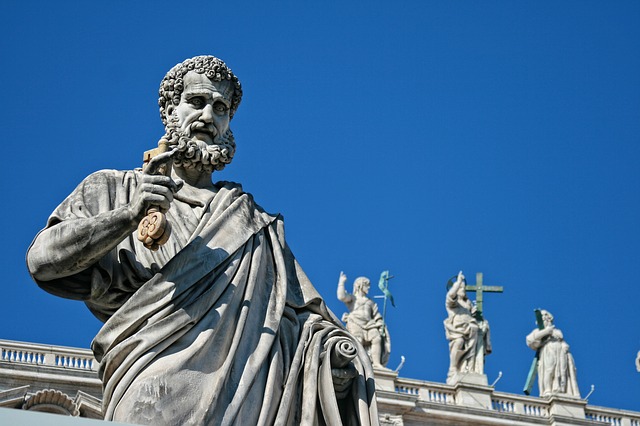
Feast of the Chair of Saint Peter, Apostle
1 Peter 5:1-4; Matthew 16:13-19
- Pope St. Leo I, who singlehandedly faced down Attila the Hun, preventing him from sacking Rome, and who later spoke so eloquently about the person and nature of Christ that the bishops exclaimed, “Peter has spoken through Leo”;
- Pope Nicholas II, who turned clerics into kingmakers;
- Pope St. Gregory VII, who drove the German King Henry IV to his knees begging forgiveness after making him stand four days in the snow waiting for it;
- Pope Julius II, the warrior pope known for his fierce temper or “terribilita,” yet whose great aesthetic sense drove him to commission Michelangelo, Raphael, and Bramante to create some of their greatest works; and
- Pope Paul III, who excommunicated the King of England, Henry VIII, organized the Council of Trent against the Protestant Revolt, instituted seminaries to train priests, and founded the Roman Inquisition to enforce purity of doctrine.
As we celebrate the Feast of the Chair of St. Peter, the Church gives us a selection from the first letter of Peter which tell us that those who tend the flock of Christ are to do so “willingly,” “eagerly,” and to “be examples.” As we look across the centuries, history shows that different popes have interpreted these words in very different ways. There have been forceful shepherds such as
There have been more pastoral shepherds such as
- Pope St. Gregory I, the first monk to be pope, such a deeply pastoral man that he saw himself as “the servant of the servants of God,” who took the care of his flock so seriously that he sold papal property to feed them;
- Pope Innocent III, who approved the Franciscan and Dominican orders, greatly deepening the spiritual lives of the faithful for generations to come;
- Pope Leo XIII, known as “the worker’s pope,” who laid the groundwork for Catholic social thought in the 20th and into the 21st century; and
- Pope St. John XXIII, perhaps the most ecumenical pope in history, who called the Second Vatican Council, wrote an encyclical on world peace, and went out of his way to change the relationship of the Church to the world and to other religions.
Of course, for every one of these shepherds we can name at least one whose pontificates were marred by scandals and abuses of every sort. And for every one of these, we can name perhaps a dozen more who passed through history almost completely unnoticed and who seem to have done nothing at all during their reign.
Yet how like St. Peter they all are! Peter, who grudgingly re-cast his nets after catching nothing on his own, only to have Jesus fill them to the breaking point; who in one breath proclaimed Jesus as the Christ and in the next tried to talk him out of his destiny; who tested the reality of Christ’s presence on the water by walking on it himself and sank as the truth sank into him; who insisted that he would never deny Our Lord but did so three times; and who ran from the cross only to end his life on a cross of his own.
And how well we know that St. Peter lies within each one of us. We let the Holy Spirit work within us, proclaiming Jesus as the Christ of God, yet at the same time allow the enemy to tempt us to lay down the cross Christ bids us carry. We challenge Christ to prove himself to us yet sink as he does so. We say that we would never deny him yet in fact deny him with every sin we commit.
So as we look at every man who has ever sat on the Chair of Peter from the greatest to the least, we should see ourselves. Within each of us lies the strength and poetry of Leo I, the “terribilita” of Julius, the compassion of Gregory I, the resolve of Gregory VII, and the openness of John XXIII. The celebration of the Chair of St. Peter is at its heart a call to look within; to be as 1 Peter reminded us, shepherds in our own way, tending those around us with the care of the Shepherd who commissioned Peter himself, giving to fragile man the keys to the Kingdom of Heaven and best of all, who loved, forgave, and strengthened Peter as he loves, forgives, and strengthens us.
 In a sense, we are all Servites. Our mission is to witness the gospel, to be at the service of God and all people, inspired by Mary his Mother and most ideal Servant. We can only do this if we do as she did: Conform our wills to that of the Father and do whatever Christ tells us. Only He knows the cross that he has in mind for us. It may be to give up what we hold most dear, to separate from family or friends, and to devote ourselves totally to God. Whatever it is, let us pray for the grace to accept it, to bear it willingly, and to remember in the words of St. Rose of Lima that “apart from the cross there is no other ladder by which we may get to heaven.”
 out with rain so intense that Benedict was forced to remain where he was. Seeing this, he became irritated and said, “May God have mercy on you, my sister. Why have you done this?” With tears in her eyes, she replied, “I asked you, and you would not listen to me. So I asked my Lord, and he has listened to me. Now then, go, if you can. Leave me, and go back to the monastery.” Of course, St. Benedict stayed and they talked through the night.
 Nevertheless, the letter to the Hebrews assures us that the God of peace furnishes us with all that is good, that we may do his will and carry out what is pleasing to him through Jesus Christ (Hebrews 13:20-21). The greatest good is Christ, the Good Shepherd who remains at our side and invites us to come away by ourselves and rest awhile. Only there, beside the restful waters where he restores our soul, can we the sheep once again become the shepherds he has called us to be.
 Christians are martyrs, not kamikazes. The word martyr means “witness,” for that’s what a martyr does; they witness the faith in whatever circumstances they find themselves. What St. Paul Miki knew, and what the emperor could not understand, is that there is only one true kamikaze, one Divine Wind. The Holy Spirit graces each martyr with the gifts they need to witness the gospel according to their inclinations; always for the building up of the kingdom.


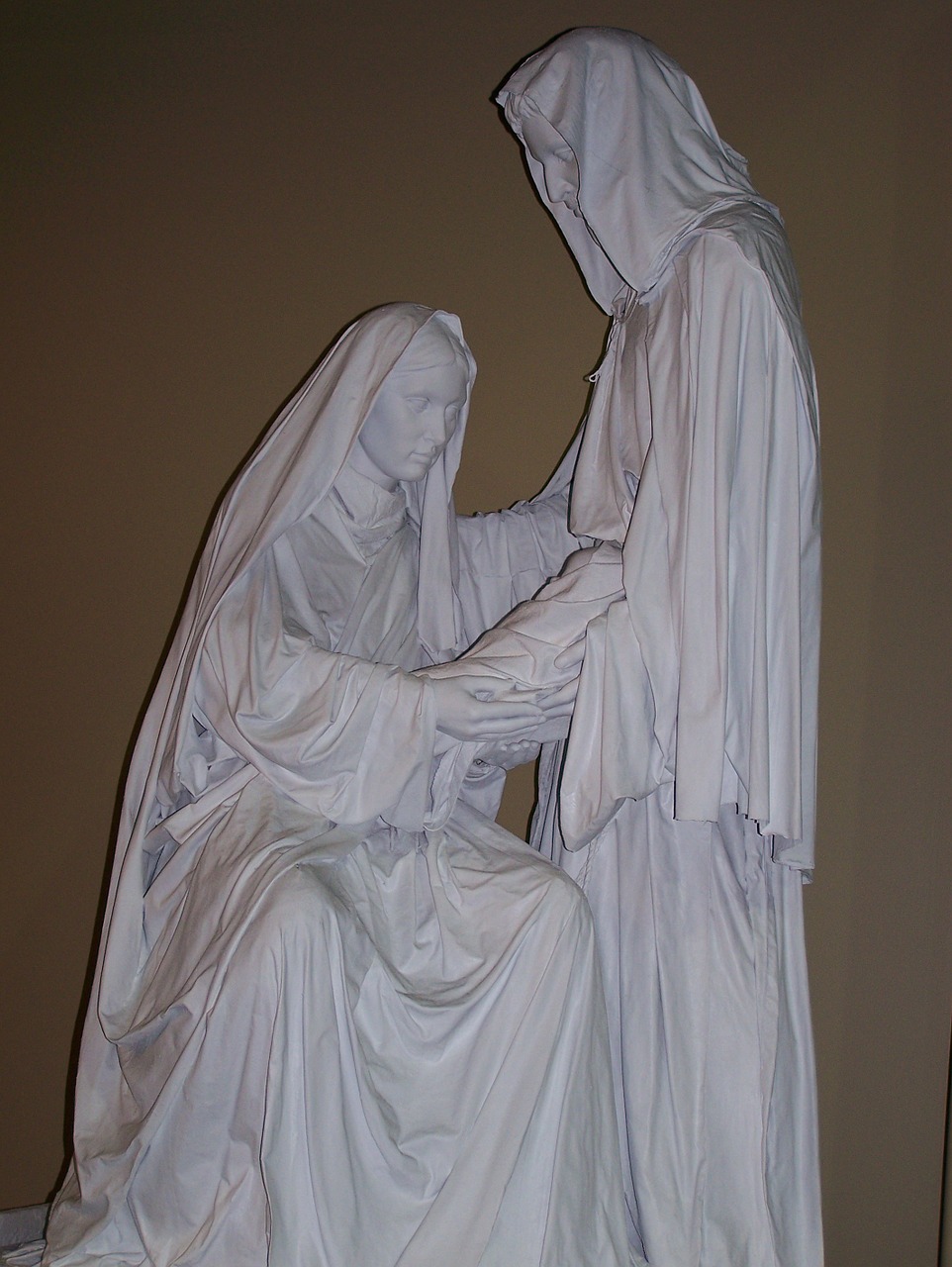 We are in no position to say what Mary was feeling when she heard Jesus define his family as all those who do the will of the Father, but here is what we do know: Mary was her son’s first and most perfect disciple. What does it mean to be his disciple? Well, recall what he said,
  Mark 10:45