Numbers 11:4b-15; Matthew 14:13-21
On September 10, 1813, after defeating the British on Lake Erie during the War of 1812, Commodore Oliver Perry famously said, “We have met the enemy and they are ours.” A century and a half later, the cartoonist Walt Kelly made a different point when he changed this to “We have met the enemy, and he is us.”
We in the Church tend to be our own worst enemy. In fact, we have centuries of experience at it. Take for example the scene we just read from the book of Numbers. First the people reminisce about the “good old days” in Egypt when they had plenty to eat, somehow forgetting the fact that starving people make poor slaves. These same people then complain about being famished and at the same time complain about the manna they are freely being fed by the hand of God. The irony isn’t lost on Moses, who is so angered by the whining that he actually prays to die rather than lead these ingrates another step of the way. If that isn’t a house divided then nothing is.
We see a second, more subtle example in the gospel reading from St. Matthew. Jesus hears of the death of John the Baptist and seeks time away from the crowds, perhaps to mourn the loss. Is he allowed to? Absolutely not; the people follow right behind wanting more healing, more miracles which, in his infinite mercy, Jesus does. However, the disciples don’t appear angry but do seem to have had enough; they try to talk Jesus into sending the crowd away. After all, the people got what they wanted; now it’s late and they need to go. Again, a house divided.
It would be easy to dismiss this divisiveness as examples of what people only do under pressure, but that isn’t true. Time and again, history shows that when the world isn’t attacking the Church, the Church is attacking herself. We see it in every parish; we see it in ourselves. Perhaps these lines sound familiar: “What a boring homily”; “That musician is terrible”; “If I ever work on this committee with so-and-so again, I swear I’ll quit”; or “If they don’t like the way we do things around here, then maybe they should go somewhere else!”
That isn’t the way of Christ and it isn’t the way of his Church. Our business isn’t to get people out, it’s to bring them in; not to tear them down, but to build them up; and not to get fed up with them, but to get them fed.
The root of the problem is our passion and our pride. It was in his frustration that Moses cried, “I cannot carry all these people by myself, for they are too heavy for me.” God never demanded this. It was the enemy within telling him that he alone must carry the people; telling the crowd that they were starving in spite of the manna; telling the disciples that no one could feed a crowd so big.
 Jesus could; Jesus did. He “took” the loaves and fish, “looked” to heaven, “said” the blessing, “broke” the loaves, and “gave” them to the disciples. If that sounds a lot like the actions of Jesus instituting the Eucharist, that’s because it is. In feeding the multitudes, Jesus showed that only God could carry the world; only God could unite a house divided. The Eucharist foreshadowed by Christ in the gospel is the sacrament of unity; it is the antidote to the enemy within that seeks to divide.
We have met the enemy, and it is us; let us go up and meet the victor, for it is Christ.
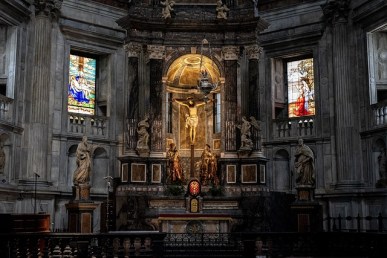 The complication is that our senses can actually keep us from seeing the spiritual reality. We become so preoccupied with what they’re telling us that we miss what lies beyond them. When I walked through St. Mary Major I saw every artistic and architectural wonder she could reveal but missed the revelation that all of it pointed to, the greatest one possible – Christ in the most holy Eucharist. As for the people at Mass, they were also at risk of preoccupation, not with works of art but with their own thoughts or problems. In either case, the task before us is to concentrate on the glory being revealed to us, for it alone is the more lasting and soul-satisfying.
 Today we honor Saints Joachim and Anne, the parents of Mary, for many reasons related to salvation in memory and reality. Most especially we honor them as husband and wife, for it was their marriage, their union that produced the Immaculate Conception, which transformed the dim, distant memory of salvation into a living, breathing, crystal clear reality. We also honor them because, as the last of that long line of generations who patiently waited through the long night for the first rays of salvation’s dawn, doing so honors all the faithful who lived through and, in whatever ways they could, passed on the events of salvation history to those who came after. Finally, we honor them as parents, for they raised their daughter in the faith, taught her the love and goodness of God, and instilled in her the devotion He preferred for the mother of His Only Son.
 If the Pharisees had been thinking from this perspective they would have realized that the disciples were not just walking through a field wantonly plucking heads of grain in supposed violation of the sabbath; they were following Christ, giving their lives every day of the week, including the sabbath, to the Lord of the Sabbath.
 The abbot reminded the king and he reminds us that the church is not a place we run to that we may lose ourselves; it is the place we come to that we may find ourselves. Over the course of his life and reign Henry spent hours on his knees in front of the Tabernacle. He may have meant to empty himself of his problems but Christ had a different plan; He desired to fill him with the grace that would enable him to face and overcome his problems.
 This is the freedom that changes not only our own life but the lives of others as well. Consider how Elisha’s freedom to follow Elijah affected the lives of others. What would have become of all the people Elisha touched in his ministry had he refused the call and simply kept on plowing? In our own time, think about how the choices we make affect the lives of others. Where would the moral development of our children be if we chose to ignore what God has taught us? What would our relationships look like if we ignored St. Paul’s exhortation to serve one another through love (Galatians 5:13)? God’s call changes all of us no matter how we choose. If we accept it we grow closer to Him and bring others closer to Him as well; if we refuse or ignore it we distance ourselves and may well keep others from Him. The choice is ours.
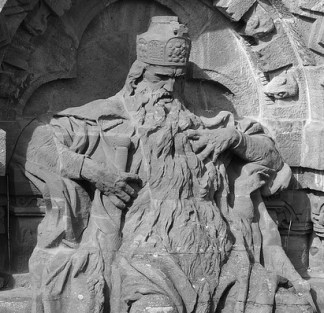 Although he was as willing to follow Jesus as the scribe in the gospel, Cyril did not lose his personality in the process. By all accounts, he was imposing, impetuous, impatient, perhaps even infuriating. He wasn’t always the perfect picture of sanctity or the epitome of virtue. Very few saints are. Sinners and saints fight the same battles, share the same temptations, and struggle with the same demons. They differ only in their response to them. The sinner looks to himself or to the world for strength; the saint looks to Christ alone. This is what Cyril knew and what St. Paul meant when he told the Corinthians:
 This may sound easy but we know it isn’t, for we too are twisted iron. Perhaps we can’t enter religious life to get twisted straight but we can enter into the silence of our thoughts and the privacy of the confessional to learn how to deal with the sins that are holding us back. Whatever they are, the example of St. Aloysius shows us that while change may be difficult or painful, it is possible.
 It took a long time – generations – but the Church in Europe triumphed even over the seemingly invincible Vikings. I say “seemingly” for we who hear the words of Christ in the gospel know that in reality the Vikings never had a chance. All they had were swords, brute strength, and a fierce warrior spirit; what is that against the gentle, persistent, indomitable power of God? Through the ministers of the Church, the Spirit of God flowed over that mighty Norman rock and carved it into a force that would defend and promote the faith they once mocked for yielding so easily.
 Although w
 Mark 10:45