Ephesians 4:1-7, 11-13; Matthew 9:9-13
Perhaps the most popular way to contemplate a bible story such as the call of St. Matthew is to imagine ourselves actually in the ancient setting as one of the characters. We see Jesus in that time and place and playing a role in the drama, say Matthew, we contemplate our own reaction to the call to follow Him.
But there is another way, and that was the one chosen by the 16th century Italian artist Caravaggio. Commissioned to paint an interpretation of the call of St. Matthew, the young artist chose not to portray the scene in its biblical setting. Rather, he set the scene in his own time, moving it from a customs post to a Roman pub. If you’ve never seen the painting, imagine: A giant canvas, mostly dark; to the left, five men in modern clothing clustered around a table in a dimly lit, sparsely furnished room. They could be gamblers; it’s hard to tell. To the right, our Lord and St. Peter in ancient garb have just entered. The only light emanates from behind Christ and illuminates the men in the room. Christ beckons toward them with a gesture reminiscent of the famous Sistine Chapel image of God creating Adam. It’s difficult to tell exactly who He beckons toward. The two men closest to Him appear either annoyed or indifferent. The man in the middle, who may be Matthew, appears shocked and points perhaps at himself, perhaps at the man next to him as if to say, “Me or him?” Finally, the two men furthest away pay no attention either to the light or to Christ; their eyes are fixed on the money.
The painting, which hangs in a chapel of the church of San Luigi dei Francesi in Rome, shocked the people of its time who were used to sacred art that showed Jesus in the places and with the people of biblical times. By bringing Him to the modern day, Caravaggio reminded them that Jesus is with all of us; He is not confined to any particular time. Gospel verses such as Jesus passed by (Matthew 9:9) are reminders that Jesus is always passing by: He is the child wasting away in a 3rd world country, the immigrant family at the border, the Alzheimer’s patient in the nursing home; the person next to us in the pew; the one looking at us in the mirror.
Further, Jesus isn’t calling only Matthew. Where Caravaggio was ambiguous let us be clear; Jesus is calling all of us. No matter who we are or how deeply invested in Him we think we already are, Jesus is always calling us into a deeper, more intimate relationship. We speak of a ‘call’ but in reality it’s a challenge; we must ask ourselves if and how we are like those men in the painting. We may be annoyed, thinking that we’ve done enough; we may be indifferent, we’ve stopped caring. Like the man in the middle, we may be astonished, perhaps hoping that Jesus is asking someone else. Or we may be paying no attention at all, too occupied with what we think is important.
A detail in Caravaggio’s painting should be pointed out. Although Jesus is beckoning toward the table, His feet are facing the exit. Jesus asks us to follow Him but He doesn’t wait. He is on a mission; there are places to go, people to see. The choice is ours. We can get up and follow as Matthew did or we can put it off, wait for a better time. Keep in mind though, that Jesus Himself chose that moment. He has a purpose, a plan, and it includes us. He may demand much but his generosity is never outdone.
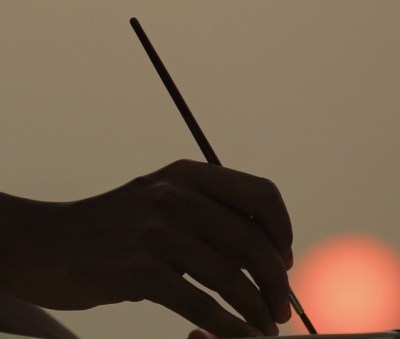 St. Paul reminds us of this when he says that grace is given to each according to the measure of Christ’s gift (Ephesians 4:11). His measure to Matthew was enough to transform him from a mere money-counter into an artist; indeed the artist who gave us the first portrait of Jesus in our New Testament. His medium wasn’t oil on canvas but words on paper, his subject not simply the man named Jesus but the Son of God and Son of Mary, the prophesied Emmanuel, “God is with us.” His palette held the many colors of Christ: teacher, healer, wonder-worker, Shepherd, Savior. He boldly painted all these images against a dark background for Jesus had come not into a roomful of Roman gamblers but into a land whose people were overshadowed by the darkness of sin and death. Where Caravaggio showed the light coming from behind Christ, Matthew knew that for all times and places Christ is the light – not the light who shines but the light who has arisen (Matthew 4:16). The long night of waiting, hoping, and wondering was over; the bright promise of salvation had dawned in Jesus, the Morning Star who never sets. This is why the great artist put the final brushstroke to his masterpiece in the words of our risen, ascending Master: And behold, I am with you always, until the end of the age (Matthew 28:20).
St. Matthew, pray for us.
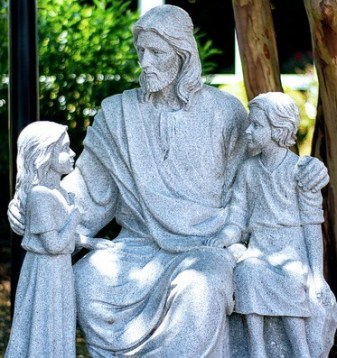 The example of the Korean Church and her martyrs teaches us that every heart open to God and acting on his word becomes a mother, sister, and brother to Christ. Even though we may not have the power of Orders, we do have Christ in the Scriptures and the power of the Holy Spirit through our baptism. We too can evangelize. If you don’t know where to begin, consider: Religious education programs can always use help teaching children the faith; there is a bible study nearby that would teach you more about Christ; there are many ministries that reach out to the hungry, the poor, and the mourning. Be docile to the promptings of the Holy Spirit; He will show you ways to bring Christ to someone in need.
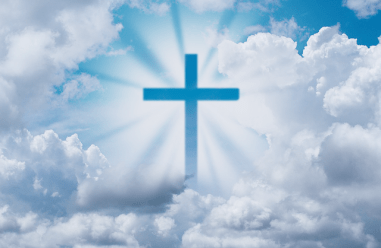 Finally, the cross is a sign of victory. It is the apparent irony seen throughout salvation history that God works for good by turning evil upon itself. It was Pharaoh who pronounced the curse by which his own people would most suffer: the death of every firstborn. In the desert it was the emblem of the serpent, reminiscent of the one whose envy brought death into the world, that would be lifted up on a tree as a sign of healing and life. It was Caiaphas, plotting to have Jesus executed, who unwittingly prophesied that it was better for one man to die than for the whole nation to perish. It was the Roman governor Pilate who first asked
  Surely his was a life lived in a manner worthy of the call. But the question remains, what about us? Are we to be another St. John Chrysostom? On one level, no; the gifts given to him were his and his alone. God doesn’t want another St. John Chrysostom. But on another level, yes, the gifts given to us are ours and ours alone and God is calling us to sanctity. We are sanctified to the degree that we take advantage of the same grace that was available to John, not to do what he did, but to do as he did. If we do not preach the gospel from a pulpit in a church we still preach it from the pulpit of our lives. Every day, we are the only homily someone will hear. If we do not shepherd a church or diocese we still have a flock; family, friends, everyone we meet. We are to teach, feed, love, and serve them as Christ did. If we do not bear the cross John bore we still take up our own and unite it to the suffering of Christ for the sake of his body, the Church.
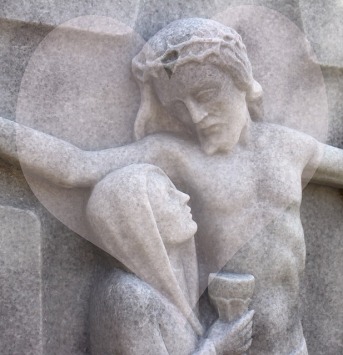 Our gospel closes with this beautiful image:
 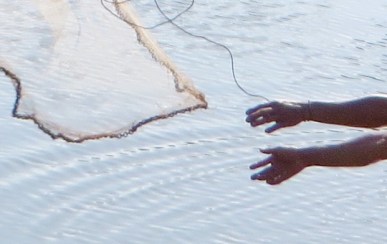 It was Simon’s willingness to put out into deep water and lower his nets despite his reservations that yielded him not only an abundant catch but more importantly the grace to see that the one who sent him was not to be called “Master,” but “Lord.” This is the same Lord before Whom we kneel as we say, “O Lord I am not worthy that you should enter under my roof, Speak but the word and my soul shall be healed.”
 Contemplate the humility, the patience, and the genius of this teacher. In our very flesh God himself becomes incarnate; in the Scriptures he consistently speaks to us; in the form of simple bread and wine, blessed and broken, he veils himself and enters into us, all done out of pure, gratuitous love that seeks only to raise us from wherever we are to a place closer to him for all eternity.
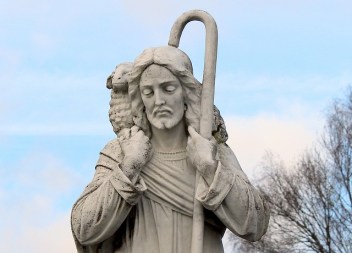 The answer can be read between the lines of our Lord’s question in today’s gospel: He doesn’t want any to be lost. He wants the shepherd to go out and find them. Even one.
 The answer to all of this is given by Jesus in the gospel and can be boiled down to one word – vigilance. If you sense that you are distracted in prayer, then let that become your prayer. Say, “Lord, see how weak I am. I can’t even focus on you now when I need you the most!” In your weakness Christ will be your strength. If you feel like God is far away, remember: God doesn’t move, we do. Weak faith causes us to drift. We strengthen it with exercise, so pray more, not less; attend Mass more often; see him in Adoration. If you find yourself putting off prayer, remember Christ’s words: At an hour you do not expect, the Son of Man will come (Luke 12:40). Also, remember his reaction to finding people not doing what he asked; it did not go well for them. Finally, when you’re discouraged remember Abraham and everything he went through. In faith he left his native land, wandered homeless, and nearly lost his only son. As if that wasn’t enough, he was never allowed to actually live in the land he was promised. Those are pretty good reasons to be discouraged! Still, no matter where he was, he always built an altar and sacrificed to God. He could lose his home, his son, and the land of his inheritance, but he never lost heart; he remained faithful, prayerful, and vigilant to the end. So can we.
 What is unique to Luke in the Transfiguration is the dimension of prayer. Only he tells us that Jesus ascended the mountain to pray. Luke properly understands it as a tale of two mountains: On the one, the unnamed mount of Transfiguration, the prayer of Jesus results in a glorious vision, he dazzling white, his face shining, his Father speaking to the apostles awakened. On the other, the mount of Gethsemane, the prayer of Jesus will end in the passion, his face sweating blood, his Father silent, and these same apostles sleeping. Luke is clear: We cannot have the glory of the Transfiguration without the suffering of the cross. In Christ, the two are inextricably bound. What’s more, this is the cost of discipleship; later in Luke Jesus will say, Whoever does not carry his own cross and come after me cannot be my disciple (Luke 14:27)
 Mark 10:45