Tag: Jesus Christ

  • To Seek, To Find, To Give, To Possess: Wednesday of the 17th Week in Ordinary Time

    Exodus 34:29-35; Matthew 13:44-46

    The French mathematician and philosopher Blaise Pascal, a Catholic, once said that he would have written a shorter letter but didn’t have time. Anyone who has tried to say exactly what they want to say in as few words as possible knows how hard that is.

    Our Lord is certainly a master of it. In two sentences he gives us a wonderfully deep insight into the spiritual life. The idea is simple; hidden treasure is found, the finder sells everything and buys the field. But there are really four things: Seeking, finding, giving up, and owning. God does them, we do them, and the result is what Israel saw with Moses in the first reading; when we are touched by God, our very being changes.

    First, seeking. In the parables, a man finds a treasure. Who is the seeker, man or God? Before answering, consider: the treasure had to be hidden first or there would have been nothing to find. The reality is that God is not hidden; he has written his image into us and around us all creation proclaims his glory. Yet as St. Augustine once said, “You were with me and I was not with you; created things kept me far from you.” Sinfulness keeps us from seeing him; we feel the emptiness, the hunger, but look to worldly things to fill it, only to find that everything the world has to offer leaves us as empty and unfulfilled as we were before. Still, God is faithful and always ready; when we turn to him with our whole heart and soul to do what is right before him (Tobit 13:6), he comes and finds us.

    No wonder the man in the parable was filled with joy! I see that kind of emotion often in people who are new to or returning to the faith; they are so happy to have finally found what their hearts had been searching for. There is great joy knowing that God is near, has our good in mind, and loves us. But we should remember too, as Scripture reminds us, of God’s joy, for he first loved us (1 John 4:19) and greatly rejoices when one is found who had gone astray (Zephaniah 3:17; Luke 15:7,10).

    Of course, joy and good feelings aren’t enough. In any relationship built on genuine love more is asked, and when that comes to the greatest of all, our relationship with God, the greatest is asked. Jesus made it a point in the parables to say that the men who found the treasure didn’t give up part of their wealth to obtain it; they gave up everything they had. As with both seeking and finding, God has given up everything first. Anyone who doubts that need only look at a crucifix. But to quote St. Augustine again, God made us without us but will not save us without us. The questions for us today are: What are we willing to give up? What stands between us and complete devotion to doing God’s will?

    Finally, possession of the treasure. For our Heavenly Father, this flows from the greatest sign of his infinite love for us – the passion and death of his only Son. As St. Paul said, you are not your own… you have been purchased at a price (1 Corinthians 6:19-20). As for us, note that the man in the first parable buried the treasure and bought the field. Why do that? In those days, owning the land meant that you owned anything that was found on it or in it; he could not claim the treasure until he claimed the land it was found on. For us, the land is our faith. When we have the faith, we possess the kingdom whole and entire; what our gospel acclamation said: all that the Father has told us (John 15:15).

    In the first reading, Moses became radiant in the presence of God and while proclaiming his word to Israel. This was the same the man who once made excuses to God to avoid being sent by him to do anything, let alone proclaim his word. But then, it wasn’t the same man; he had allowed God to work within him and through him, to “possess” him if you will, to so transform him that he became the man God called him from all eternity to be. When we are touched by God, we too should show it, and that is the other question we have to ask ourselves today: Can anyone tell that we are Christians, not by our being here, not by our rosaries or prayer books, but by the way we live our lives? Can anyone tell that we have sought God, and that he has found us?

  • One of the “Do Nots”: Friday of the 16th Week in Ordinary Time

    Exodus 20:1-17; Matthew 13:18-23

    Even though I’ve gone through it countless times over the last 35 years, each time still amazes me. I look at one of my kids, say, “Do NOT do that,” then find myself standing there incredulous, less than 5 minutes later, saying, “Didn’t I just tell you not to do that? Will you ever grow out of this?” But it was just recently, as I was going through it yet again, that I heard a voice in my head say, “You do the same thing.”

    Now, that could have been an echo of my mother or father, for I definitely did the same thing to them. It could also have been any of a number of nuns or priests, for I did it to them, too. Come to think of it, it could have been any of the adults who had to deal with me as a kid. It could have been, but I had the distinct feeling that it wasn’t. No, this was my conscience speaking, and not about past behavior, either. The voice didn’t say, “You did the same thing,” it said, “You do the same thing.”

    It’s true. Day after day, year after year, God has taught me through his word. It couldn’t be clearer than on a day like this when we literally read the 10 Commandments. Yet time after time, year after year, sometimes not 5 minutes later, I do exactly what God just said not to do. Why? If I understood the gospel today, our Lord has wrapped the reason in a parable which teaches me that I have a hearing problem.

    My ears work fine, that’s not the issue. The problem seems to be an inner, spiritual sort of deafness. When Jesus begins his explanation of the parable by saying, Hear the parable of the sower, he clearly wants his disciples to do more than use their ears; he wants their hearing accompanied by an attitude that says, ‘Lord, I am ready to be taught.’ Ask yourself how many times you’ve heard a gospel begin, thought, ‘Oh, I know this one,’ and then tuned out or paid little attention? This is the seed that falls on rocky ground; we hear but lack the docility, the teachable spirit, needed to help the word take root and endure. The gift of docility inclines us to remember that no matter how familiar a passage may seem, there is always something new to be learned.

    Our Lord also relates our hearing problem to a lack of understanding. We hear the word, but like the seed that falls on the path, let it go because we don’t understand it. In and of itself, lack of understanding is nothing to be ashamed of. Scripture can be hard to understand; it refers to cultures, peoples, and times far removed from our own. The problem comes in when we make no effort to learn more; to ask for help; to set time aside for study and contemplation of God’s word. Those who do this will find their time and effort well rewarded.

    Other times we can’t hear God because, as Jesus implies, his voice is drowned out by our own anxieties. We all know what it’s like to come to Mass or prayer with problems weighing us down. They distract us and before we know it the time has slipped by. It helps to begin preparing for our time with the Lord before leaving home, or if we’re praying at home to sit and recollect ourselves in silence before we begin. I find it helpful to repeat one of the old aspirations of the Church: “Let go and let God.” Not to forget or minimize what is on our mind but to make it part of our prayer, our offering to God, laying it on the altar and offering it as our sacrifice to the only One who can bring good out of it. I can’t think of a better way to quiet the inner voices so we can hear what God is saying.

    In years past, I thought of this parable as referring to different kinds of people: Those who hear the word of God and those who do not. That’s fine as far as it goes, but when God reminded me that I am one of the “do nots,” I looked a little deeper and saw the parable referring not to different kinds of people but different states of the spiritual life. That is great news for all of us, for it reminds us that conversion is possible; we can do something about our hearing problem. It is true that in the deafness of our sloth and arrogance, we are in the path; in our ignorance and shame, the rocky ground; in our anxieties and temptations, the thorny ground. But we don’t have to stay there; these grounds aren’t meant to be passively endured but to be grown out of. Christ ends the parable in the place we all want to be, so let us all today resolve that we will show him the humility, docility, and perseverance it takes to be transplanted into the soil that, truly hearing his word, bears fruit thirty, sixty, and a hundredfold.

  • All Things to One Man: The Solemnity of the Sacred Heart of Jesus

    All Things to One Man: The Solemnity of the Sacred Heart of Jesus

    Hosea 11:1, 3-4, 8c-9; Ephesians 3:8-12, 14-19; John 19:31-37

    In high school we once did an exercise on self-perception. Sister began by asking us to take out a sheet of paper and write down 3 negative things about ourselves. After a couple of minutes she said, “Alright, now write down 3 positive things about yourself.” I can’t remember what I wrote but I know I didn’t list three; I’m not sure I even wrote two. That was Sister’s point; self-conscious teen-agers aside, people in general tend to be very good when it comes to focusing on their negative qualities but not so good when it comes to the positive.

    The same goes for our relationship with God. If you’re anything like me, it’s probably much easier to come up with reasons why He shouldn’t think very highly of you than reasons why He should. Today, on the Solemnity of the Most Sacred Heart of Jesus, our Lord gives us at least three reasons to focus on the positive.

    First, listen again to his words in the 11th chapter of Hosea: When Israel was a child I loved him… I taught Ephraim to walk… took them in my arms… fostered them like one who raises an infant to his cheeks… stooped to feed my child… I will not let the flames consume you (Hosea 11:1, 3-4, 8-9). This isn’t the imagery of a God who loves from a distance, impersonally, or until we leave or hurt him; no, this is a God who loves intimately, with a deeply personal, boundless, and most of all, healing and merciful love.

    Second, as St. Paul makes clear, this is a love that goes beyond all words except the one, Eternal Word – Jesus. We can hear Paul struggling to express the inexpressible as he prays that we may have the strength to comprehend with all the holy ones what is the breadth and length and height and depth, and to know the love of Christ which surpasses knowledge (Ephesians 3:18-19). This is the key; divine love surpasses human knowledge and can be known only by faith (Ephesians 3:17), the gift of the Father possible only by the strength that comes from the Holy Spirit (CCC §683). To those who have faith, all the riches of grace are available.

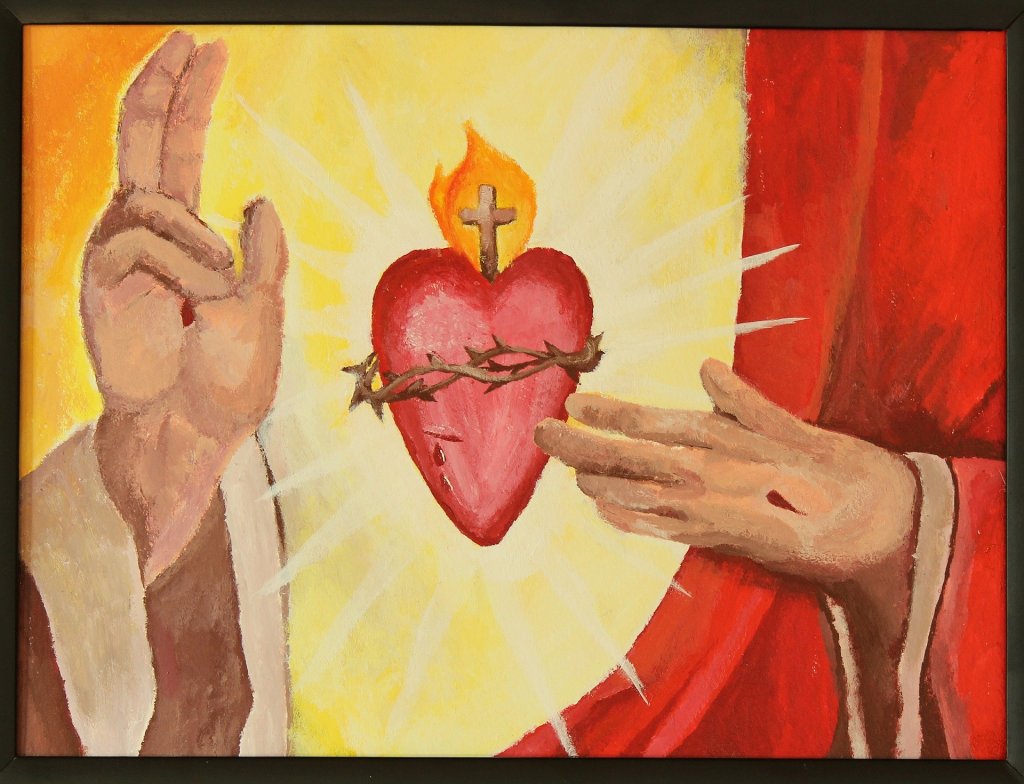
    Finally, every image of the Sacred Heart reminds us with its crown of thorns of the cost of this love. We hear in the gospel of the soldier who thrust his lance into his side, and immediately blood and water flowed out (John 19:34). There is no love worthy of the name that is not asked to endure insult, temptation, and suffering. From the dawn of humankind it is written into our nature; it’s in our blood. But it isn’t in the blood of Christ, either from his Heavenly Father or his holy Mother, the Immaculate Conception. He willingly took it on. This is perhaps the greatest and most positive of all – that God, purely out of his infinite and merciful love for us, gave his only Son that we would be raised to life eternal. As Christ himself said, there is no greater love than this.

    St. Pio of Pietrelcina, Padre Pio, understood that very well. While passing through a crowd of people all clamoring to get near him, someone shouted, “Padre, you are all things to all men!” He replied, “No, I am all things to one Man.”

    May we all come to that kind of understanding! May we all see the Solemnity of the Sacred Heart of Jesus as a day to set aside the negatives and focus on the overwhelming positive – that we too are all things to one Man. We are loved infinitely, personally, and mercifully; we are given the gift of faith which alone can make this love known to us beyond any human understanding; and finally, that as the ultimate expression of this love the Second Person of the Blessed Trinity took human form and allowed his own heart to be pierced that we may not only look upon him in mourning for the sinfulness that put him there but with rejoicing that divine love can take even the passion and death of Christ, the greatest insult of all time, and transform it into the greatest victory the world will ever know – the resurrection to eternal life for all who believe and return to God with their whole heart (Joel 2:12).

    Sacred Heart of Jesus, have mercy on us.

  • How Lows Become Highs: Memorial of Pope St. Martin I, Martyr

    How Lows Become Highs: Memorial of Pope St. Martin I, Martyr

    2 Timothy 2:8-13; 3:10-12

    In C.S. Lewis’s brilliant work The Screwtape Letters, the senior devil (Screwtape) teaches his apprentice what he calls the “Law of Undulation.” In a nutshell, this is the idea that people experience highs and lows in their relationship with God. The “highs” are those peak times when we feel especially close to God, while the “lows,” are the times when we feel dry, uninspired, and God seems far away. The “wise” demon waits out the highs and strikes during the lows.

    Of course, the genius of this is that we can all relate to it. Think back on times, perhaps a Mass or contemplative moment, when you felt a spiritual high. It felt as if God was all around you; a time of almost indescribable joy. Then think of those other times, the lows; you felt alone, your prayers dry, your faith stagnant.

    In a sense, this is part of what it means to be human. In friendship, marriage, and work, there are times we feel close to people or the job and times we don’t. It’s only natural that in our relationship with God we would experience the same thing. But as Lewis notes, sometimes those with evil intent manipulate this law to drive us away from God.

    Such was the case with Pope Martin I. His reign came at a tumultuous time; it was the 7th century, and for over 600 years people had struggled to understand the persons and natures of Christ. Was he only human? Only divine? A mixture? Did he have a human will, a divine will, or both? There were as many opinions as there were people.

    Then as now, some opinions mattered more than others, especially when it was the opinion of the highest civil power – the Emperor. Unfortunately, his opinion was heretical. Like many inside the Church, he believed that Jesus did not have a human will, or that if he did it was completely absorbed into his divine will like a drop of water in the ocean. Pope Martin disagreed, publicly and in council, holding the Church to the truth we profess to this day, that Christ had both a human and a divine will.

    Angered, the Emperor had the pope hauled to Constantinople and ordered to endorse the “official” position or face a charge of treason. When Martin refused to obey, he was imprisoned and starved for several weeks. Again he was ordered to obey, and again he refused. When it became clear that the pope would never agree, he was sentenced to death for treason. Stripped of most of his clothing, he was mercilessly whipped, then dragged in chains through the streets. The abuse he suffered was so horrific that even the residents of Constantinople, accustomed to violence, were disgusted. Eventually the sentence was commuted and Martin was exiled, where he was neglected and starved.

    When we think of the Holy Father’s situation, it seems ripe for the kind of spiritual low that demons would relish: Cut off from his flock; in prison; in chains; beaten; humiliated; vilified; starved; exiled; neglected. Who would blame him for turning inward, giving up, and spiraling down? Yet his letters written from prison and exile read like someone moving toward a spiritual high. The pope prayed not for himself but for his flock, especially the heretics, that they would repent and return to the one true faith. When he did write of himself, it wasn’t to bemoan his own suffering but to glorify God in it; he spoke of his abandonment to the will and mercy of God, and his hope that Christ would come soon to bring him home. Finally, after two years, Martin was delivered from the starvation and neglect of exile. He is the last pope (to date) to die a martyr.

    In the first reading St. Paul wrote to Timothy, If we have died with him we shall also live with him; if we persevere we shall also reign with him (2 Timothy 11-12). This reminds us not only of the glorious destiny of Pope St. Martin I, but of the need for us to pray for and practice the virtues of fortitude and perseverance. Both the spiritual highs and lows are gifts from God that are meant to be used. Although we want to hold onto the highs and treasure them, they provide the grace we need to look beyond ourselves and see how we might strengthen others, and to look within ourselves to see where we need strength, where God is working in our lives, and where he may be calling us. And if God feeds our virtues in the highs, he tests them in our lows. But again, as St. Martin shows, we don’t run from those times; rather, we persevere through them by focusing not on ourselves but on others and not by complaining about our suffering but by uniting it to the suffering of Christ for the sake of his body, the Church. To paraphrase St. Martin, throughout the highs and lows, remember that Christ is at hand, and hope in His mercy.

    Pope St. Martin I, pray for us.

  • The Invitation to Dare: Divine Mercy Sunday

    The Invitation to Dare: Divine Mercy Sunday

    Acts 4:32-35; 1 John 5:1-6; John 20:19-31

    The gospel according to John has been called the gospel of encounters. Each follows the same basic pattern: Jesus encounters someone, they test him, there is an exchange, and the encounter ends with those who tested Jesus finding that in reality they are the ones being tested: Will they believe or not? Of course, Jesus wants them to rise to the challenge but he never forces them; it’s their choice and a test of their faith.

    Between last Sunday and this, John gives us five encounters, each posing its own challenge to faith. First, the Beloved Disciple: Will he believe in the resurrection based only on the testimony of an empty tomb? No; he has to see the tomb himself and the burial cloths neatly arranged, perhaps as proof that the body of Jesus was not stolen. Then Mary Magdalene: Will she recognize the risen Lord if she sees him? No; she must hear his voice. Next, the Apostles: Will they believe if they see and hear? Only when Jesus shows them his hands and side. Then Thomas: Will he believe his brother Apostles, now eyewitnesses? No; he needs to touch the wounds of Christ. The fifth challenge is from the evangelist to us: Will we believe without being able to see, hear, or touch Jesus?

    We might be tempted to say no, for if the Beloved Disciple, Mary Magdalene, and the Apostles struggled with faith, what hope do we have? But that’s not the attitude of Christ; he calls us “blessed.” Why? Because his encounters with us are not about human failure but about the triumph of divine mercy. Jesus didn’t resent the Beloved Disciple going to the tomb; rather, he used it to inspire John to recall the words that made that trip unnecessary: Destroy this temple and in three days I will raise it up (John 2:19). He wasn’t disappointed that Mary Magdalene needed to hear him; he is the Good Shepherd whose sheep follow him because they recognize his voice (John 10:4). He wasn’t angry that the Apostles had to see his wounds; rather, he bid them peace and gave them authority to forgive sins, so that others may know the same peace and all might take to heart his words at the Last Supper: Do not let your hearts be troubled. You have faith in God; have faith also in me (John 14:1). He was perhaps kindest of all to Thomas, that from he who seemed weakest in faith came the greatest affirmation of Christ’s divinity in all the gospel: My Lord and my God (John 20:28). Finally, Jesus spoke encouragingly to us, calling us blessed because we have not seen and have believed (John 20:29).

    This is how God shows mercy: By encouraging rather than cajoling, inspiring rather than depressing, and building up rather than putting down (although justice sometimes demands the whip). For his goal is and always has been to raise us up to himself. God is love and as one spiritual writer has noted, “mercy is love bending over misery to relieve it, to redeem it, to raise it up to itself.”[1] Time and again God has shown that this is what he will do, even to the giving of his only Son, that in his infinite mercy, he might draw us closer and closer to himself.

    Today we have the opportunity to draw very close indeed, for on the Feast of Divine Mercy, Christ offers us a great gift: The renewal of baptismal grace; the complete forgiveness of sins and punishment. This grace is usually received only through baptism itself or a “perfect” sacramental confession – one made purely for the love for God.

    Of course, like all encounters with Christ, there is a challenge. We can only obtain this extraordinary grace if we worthily receive the Eucharist on the Feast of Divine Mercy or its vigil Mass. Since we are at that Mass now we’re off to a good start, but that’s not all; worthily means that we have made a good sacramental confession in the recent past (say, Lent), that we’re still in the state of grace, and that we trust in the infinite mercy of God. Also, our Lord revealed to St. Faustina that if we are to receive mercy, we must show mercy. We don’t have to do what the Christians did in the first reading – sell our homes and give the proceeds to the poor – but we do have to practice the works of mercy listed in the Catechism: Spiritual works such as teaching the faith, advising, consoling or comforting others, forgiving and bearing all wrongs patiently, and the corporal works such as feeding the hungry, sheltering the homeless, clothing the naked, visiting the sick and imprisoned, and respectfully burying the dead.

    Fr. Michael Gaitley, who has dedicated himself to spreading the Divine Mercy devotion, advises us to remember that we do these things out of love and gratitude to God, not to try and earn his mercy. Asked what the biggest misconception is about Divine Mercy, he said that many active Catholics have somehow gotten the idea that “God’s love must be earned by following all the rules, saying all the prayers, and giving money to the right causes… that the more perfect we are, the more worthy we are to draw close to Jesus. The reality is that Jesus invites us spiritually poor, weak, broken, and overburdened people to draw as close as we dare…”[2]

    Every encounter with Christ is an invitation to dare; to “become who we are.” It requires us to face who we are – poor, weak, and broken – but also to see ourselves as God sees us – eternally willed, infinitely precious, and worth any sacrifice. In this lies the wound to our pride, the admission that there is nothing we can do to earn our own salvation but also the healing truth that there is nothing we need to do, for God has already done it. All he asks is that we accept it and, on this feast of Divine Mercy, show our gratitude for it. The only question is, will we?

    1 Fr. Gabriel of St. Mary Magdalene, Divine Intimacy, #236, Section 1.

    2 Catholic Digest, April/May 2020, page 16