Tag: Jesus Christ

  • Whom Fortune Favors

    Whom Fortune Favors

    Saturday of the 21st Week in Ordinary Time

    1 Thessalonians 4:9-11; Matthew 25:14-30

    The parable of the talents is one we’re all very familiar with. Ironically, such familiarity actually works against us, for parables are at their best when they surprise us, present us with a riddle or twist that teases us into deeper contemplation about its meaning and its relevance to our lives.

    One aspect of the parable that might still be surprising concerns the talents themselves, specifically their value. In our Lord’s time, a talent was worth about 6000 silver pieces, or 20 years of wages. By using such vast sums of money (the parable goes up to 100 years’ worth), it certainly seems like Jesus wanted us to wonder what all that wealth could possibly represent.

    The fact is, we really don’t know. Some scholars see them as our abilities, the God-given gifts we are born with; we still use the word “talents” for those to this day. Maybe, but Jesus tells us in the parable that each servant got a different amount of talents according to his ability (25:15); so, there are talents and there are abilities. I tend to agree with those who see the talents as riches of a different kind; specifically, the thousands of opportunities we are given by God over the course of our lives to show people what it means to be a disciple of Christ; to be his hands at work in the world.

    What opportunities am I talking about? I think some of the best examples are right in front of us, in our own homes, with the people who are most familiar to us. Research on the family shows that while family members are actually spending more time together than before, they are also alone more often. It’s called “being alone together,” and you may have seen it: A family at dinner, perhaps at a restaurant, sits together and eats together, but spends most of that time interacting by themselves with their hand-held device. Imagine being the one in the family who asks them to put those things away and spend that time with each other. We also know that, as people age, they spend more and more time alone. Imagine being the neighbor who invites them over, or regularly visits them. And, as we all sadly know, many of our young people rarely if ever go to church, and know nothing at all about God. Imagine being the relative who invites them to the church youth group to meet new kids, eat, have fun, and see where those interactions lead. Is such a person always popular for having spoken up or done what they did? No. But is it the charity spoken of by St. Paul in the first reading, or the new commandment Jesus spoke of in John’s gospel? You already know the answer.

    Of course, these are just three examples, but they and thousands more show that what Christ is looking for isn’t skill or experience, but boldness and humility. Consider the first two servants; they knew they weren’t skilled bankers or investors, yet they doubled their master’s money. How? By doing what good servants do: they watched their master, learned from him, then imitated him as Jesus said: Immediately. They didn’t know when he would return; all they knew was that he gave them this opportunity and empowered them to act in his name. Unlike the third servant, they didn’t waste time worrying, overthinking, or second-guessing themselves or their master. Rather, they did what St. Paul advised: minded their own affairs and worked with their own hands. That’s what the master would do, so it’s what they did.

    There’s an old saying that fortune favors the bold. Here and throughout the gospels, Jesus makes it clear that he favors the bold in faith with a fortune only he can give: a share in the Master’s joy. Who doesn’t want that kind of talent?


  • Commitment, Meet Consequences

    Commitment, Meet Consequences

    Saturday of the 19th Week in Ordinary Time

    Joshua 24:14-29; Psalm 16:1,8,11; Matthew 19:13-15

    Two sisters, fed up with the way the world was going, decided that they, along with one sister’s 14 year-old son, would leave civilization behind, go into the Rocky Mountains, and live alone in the wild. Having no idea how to do it, they watched a few videos, then said good-bye to some relatives, who tried hard to talk them out of it. Eleven months later, a hiker discovered their remains. The medical examiner determined that they died of starvation just a few months after leaving.

    What a tragic way to learn that serious commitments can have serious consequences. Joshua knew that, which explains why he responded as he did when the people chose to serve God alone. Saying, You may not be able to serve the Lord (Joshua 24:19) might not have been what they wanted to hear, but they needed to hear it. History plainly showed that, time in and time out, Israel tended to obey God and serve Him when times were good, but disobeyed and turned to idols when they were not. What’s more, God had made the consequences of disobedience abundantly clear: If you forsake the LORD and serve strange gods, he will then do evil to you and destroy you (Joshua 24:20). Knowing this, Joshua was duty-bound as leader of Israel to test their commitment.

    We do something similar today when people tell us they want to follow Jesus. We could just say yes, sign them up, and let them figure it out by themselves, but that’s like giving people a couple of nature videos and expecting them to survive in the wild alone; we’re setting them up for failure. Knowing that the commitment to follow God has life-or-death consequences, we take the time to teach them everything that has been handed on to us. That takes months or even years, but when we’re done, people have a much better idea what it means to follow Christ as he wants to be followed: Totally.

    I said, “when we’re done,” but the truth is that we’re never really done getting to know the faith and committing ourselves to it. Joshua’s challenge is just as relevant to those like us, who have been practicing the faith for a while. Are we able to serve the Lord? Like Israel, we might quickly, almost unthinkingly, reply “Yes,” but, because we know how serious the consequences are, we do better to pause, look back, and see if we too have a history of less-than-total commitment to God. Maybe at one time or another we too have chosen against Him; we got angry, someone in Church hurt us, or we were tempted by something the world had to offer. Whatever the reason, we allowed ourselves to drift away. Or, maybe sometimes our commitment has been halfhearted; we serve God when and how it is convenient, but not when it takes us out of our comfort zone. Again, the result is the same. Distancing ourselves from God or taking our commitment to Him too lightly is like trying to survive on our own in the wild: All we do is starve ourselves of the One who satisfies our deepest needs, for only God can do that.

    This is why the psalmist urges us to take refuge in the LORD, to set Him ever before us; He shows us the path to life and the fullness of joy forever (Psalm 16:1,8,11). To make this point, our Lord’s example in the gospel works perfectly, for a child’s world is built on love and trust. They love with the innocence and purity of heart that simply assumes we are always there for them. Out of this love, they trust completely that we will feed them, guide them, provide for them, and keep them safe. If the Kingdom of heaven belongs to such as these, then how could we do any less?


  • Body and Soul

    Body and Soul

    Solemnity of the Assumption of the Blessed Virgin Mary

    1 Corinthians 15:20-27; Luke 1:39-56

    Speaking of God the Father, St. John of the Cross once said that, “In giving us his Son, his only Word (for he possesses no other), he spoke everything to us at once in this sole Word – and he has no more to say…”1

    In a very real way, the same can be said of the Blessed Virgin Mary. Her entire life proclaimed the greatness of the Lord. Everything she is – the humble, lowly, servant – speaks of Jesus, and everything she did – from hearing the word, to conceiving Jesus, to mothering him, to watching him die, to praying for the coming of the Spirit, her Spouse – speaks of doing his will, and the will of the One who sent him.

    So intimately united to the Blessed Trinity, body and soul, from the beginning, how could Mary be any less united to Him, body or soul, when her own earthly life came to an end? And when St. Paul, inspired by the Holy Spirit, wrote those beautiful, hopeful words: just as in Adam all die, so too in Christ shall all be brought to life, but each one in proper order: Christ the firstfruits; then, at his coming, those who belong to Christ (1 Corinthians 15:22-23), who can we imagine belonging more to Christ than Mary, his devoted daughter and mother? That is how we picture Mary best: As forever belonging to Christ, and as a model for how we should picture ourselves. For, after Jesus, that is God’s greatest gift to us through the Blessed Mother: Her destiny is our destiny; where Mary has gone, we, too, can go. Her Son suffered, died, and rose again to see to it, for her sake, and for ours.

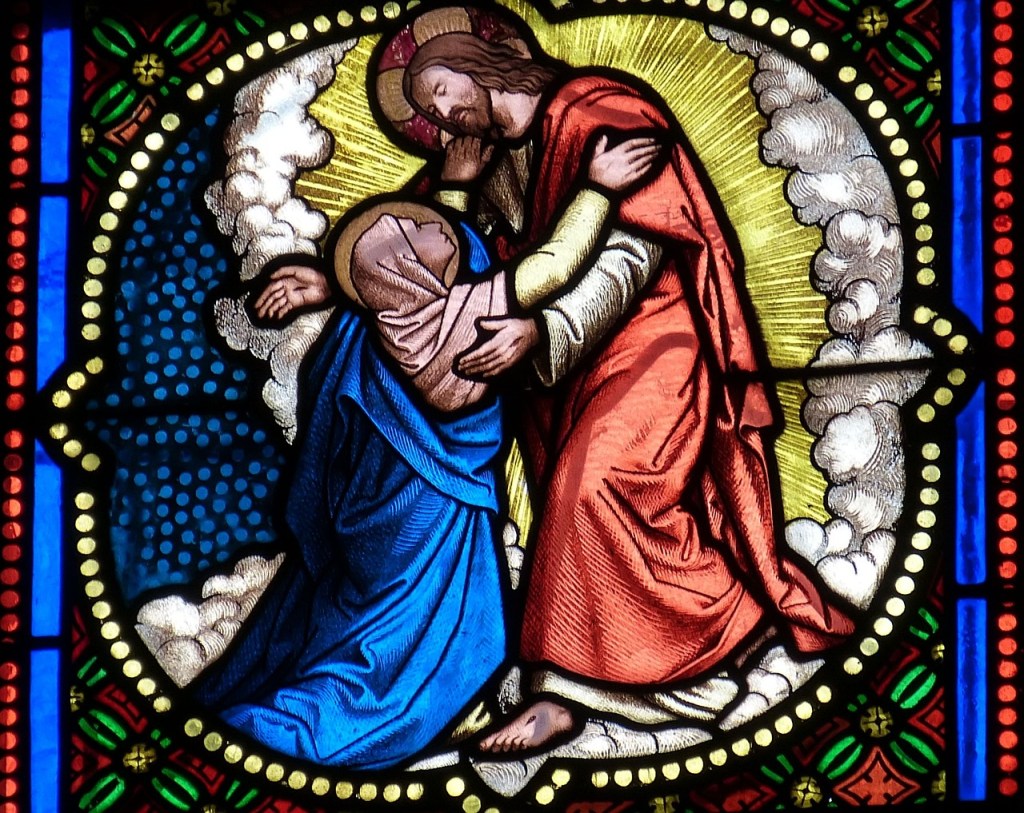
    With that in mind, and in our prayers, let us celebrate the Feast of the Assumption of the Blessed Virgin Mary for what it is: The great reunion when mother and son embrace body and soul once again in the eternal splendor of heaven. And let us today, as every day, continue to thank God for the gift of his mother, who he has made our mother, and who, to this day, hears the word of God and does it, that we may one day embrace our Lord, body and soul, in that same glory.

    Mary, assumed into heaven, pray for us.

    1St. John of the Cross, The Ascent of Mount Carmel 2, 22, 3-5 in The Collected Works of St. John of the Cross, translated by K. Kavanaugh OCD and O. Rodriguez OCD (Washington DC: Institute of Carmelite Studies, 1979), 179-180.


  • The Center of Attention

    The Center of Attention

    Memorial of Sts. Martha, Mary, and Lazarus (July 29)

    1 John 4:7-16; Luke 10:38-42

    In this section of the gospel according to Luke, Jesus teaches two important lessons. The first came in the form of the parable we know as “the Good Samaritan,” in which he showed us how God wants us to serve other people. Today we hear the second, where Jesus tells us how God wants us to serve Him.

    The setting of course is not a parable, but the home of Martha and Mary. Put yourself in their place: Jesus is coming to your home. How do you prepare for that? I’m sure there are many things you would do, all with the best intention: To make your house the warmest and most welcoming place you can. And as for yourself, what will you do when he is your guest? Without doubt, you intend to serve him as well as possible.

    How the two sisters prepared we cannot know, but we do know they served in very different ways. As for Mary, she chose to sit beside the Lord at his feet listening to him speak (Luke 10:39). Of all the disciples, only Mary is consistently found at the feet of Jesus: listening to him, weeping for him (John 11:32), and anointing him (John 12:3). This is why for centuries the Church has pointed to Mary of Bethany as a model of the contemplative life. It certainly nourished her faith; to this day, she is known as an evangelizer. John tells us that many people came to Mary after Jesus raised Lazarus from the dead (John 11:45).

    Martha took a more active role, but her faith was certainly no less. To the contrary; John puts on her lips alone the greatest affirmation of faith found in his gospel: I have come to believe that you are the Messiah, the Son of God, the one who is coming into the world (John 11:27). Nevertheless, here in Luke, Martha is distracted, burdened with much serving (Luke 10:40). Should she have chosen not to serve? That’s not what our Lord implied in the parable of the Good Samaritan; there, he commended people who actively serve their neighbor for their faithfulness. Then why did Jesus rebuke her, who was serving him? Not for her actions, but for her state of mind; Martha allowed her focus to shift away from him and onto her sister.

    It happens that, as people engage in some activity, they grow accustomed to it, and their minds begin to wander. Think about your prayer life; particularly, the prayers you say most often. Have you ever suddenly realized that your mind is a million miles away from the words your mouth is saying, even at Mass? As I said, it’s only natural, but that doesn’t mean unavoidable; it’s also natural to be vigilant. You know very well that when something is of vital importance to you, you’ll shake off any distraction to stay focused. What made Mary so noteworthy wasn’t where she sat herself, but where she put her mind: Fully on Christ, and everything he had to say. Had her thoughts been drifting somewhere else, she too would have been gently brought back to reality by Christ.

    It also happens sometimes that we serve others with mixed motives. Ask yourself if, while working in a parish ministry, you ever found yourself a little too concerned about whether people noticed or praised you, or got a little jealous when someone else was recognized and you weren’t. Again, it’s natural to want to be the center of attention now and then, to be recognized by others for what we’ve done. But, again, the issue is focus; the center of attention is God, not ourselves, and the standard of comparison is not other people, it is Jesus Christ. Who was ever more servant than he, yet when did he ever seek the limelight or care what anyone else thought? The gospels are clear that he had one goal: Doing his Father’s will. The same for Martha, the same for us; regardless what other people think or do, our goal first, last, and always, is to see and serve Christ, and thus show our love for God and our determination to do his will.

    So, today, let us take these lessons to heart. In a few moments, the Lord will be our guest in Holy Communion. The whole point of our time here is to prepare ourselves for that, to make our souls His most welcome home. We can only do that to the degree that we keep our eyes fixed on Christ, so to do what John urged us in the first reading when he said: Whoever acknowledges that Jesus is the Son of God, God remains in him and he in God (1 John 4:15).

    Sts. Lazarus, Martha, and Mary, pray for us.


  • Becoming Who We Are

    Becoming Who We Are

    Memorial of St. Philip Neri, Priest (May 26th)

    Philippians 4:4-9; John 17:20-26

    The readings today speak of two of the greatest gifts we can receive from our heavenly Father – peace and unity. St. Paul reminds us that it is the pursuit of excellence that leads us to God and the peace only he can give. In the gospel, Jesus teaches that perfection is nothing less than unity with the Father; again, a gift that only God can give.

    When I think of excellence and perfection in life, I can’t help but think of the saints, for these are the men and women who went out of their way to achieve both. I’m especially glad that we remember St. Philip Neri today, for his life provides a view of sanctity that is too often missing from the popular imagination.

    I say that because it seems to me that most people in our time see the saints as stained glass stereotypes; living in a perpetual state of sadness and gloom, cloistered from the world and everything in it. It’s as if they really believe the old pop song lyrics, “I’d rather laugh with the sinners than cry with the saints. The sinners are much more fun.”

    That’s why I like St. Philip Neri; he is exactly the opposite. Far from sadness and gloom, St. Philip was noted for his cheerfulness, going so far as to say that “Cheerfulness strengthens the heart and helps us to persevere. A servant of God should always to be in good spirits.” And far from running away from the world, Philip was born to engage it; charismatic, charming, and quick to smile, he was one of those people who lifted the spirits of a room just by walking into it. It says a lot about him that his favorite books were the Bible and his joke book. He was silly enough to walk around Rome with half his beard shaven off, and solemn enough to bring a congregation to tears. He was the scholar who taught the simple, the joker who consoled the sorrowful, the friend who welcomed every stranger, and the priest who reached out to every sinner. We call him the patron saint of laughter not simply because he excelled at making people laugh, but because he did it for the reasons St. Paul spoke of: That they might calm their anxiety, approach the Lord in prayer, and come to know the peace of Christ that surpasses all understanding (Philippians 4:4-7). This was grace at work in him for their sanctification and his own.

    St. Thomas Aquinas taught that grace perfects nature, and like all the saints, this is what St. Philip Neri shows us. The gifts God gave him – a jovial personality, the ability to relate to people, a brilliant mind, everything that made him who he was – were not meant to be replaced or suppressed; on the contrary, they were given to be made more excellent by the working of grace. What’s more, God graces each saint with their own unique gifts. Sanctity is not a matter of becoming more like someone else; it is becoming who we are. God doesn’t want another Philip Neri, He wants us, and he wants us to use the gifts He has given us, that through us people might know the peace of God and draw closer to Him and each other.

    This is the unity Christ had in mind when he said, that they may be brought to perfection as one, that the world may know that you sent me, and that you loved them even as you loved me (John 17:23). No wonder St. Paul said to rejoice! If knowing the infinite love of God is what it means to be saint, then I’m with St. Philip Neri; I’d rather laugh with the saints than cry with the sinners. The saints are much more fun.


  • The Master

    The Master

    6th Saturday of Easter

    Memorial of St. Bernardine of Siena

    Acts 18:23-28; John 16:23b-28

    I once attended a concert by a master guitarist. I don’t remember any particular piece he played, but I do remember two things. First, he was somehow able to communicate the truth and beauty of the music. When the tune was happy, the guitar laughed; when it was solemn, it contemplated; when it was sad, it wept. Second was his joy. This guitarist really enjoyed what he did, and his joy was infectious; he inspired me to want to make music, too. Of course, when I got home and tried, it didn’t sound anything like his.

    I think this is what masters in any art or science are able to do: communicate the beauty of the truth they’ve worked so hard to find, and inspire others with the joy of that truth, which motivates them to go deeper and learn more for themselves.

    Today we celebrate two masters of the faith. The reading from Acts gives us the first, Apollos. We hear of his eloquence, authority, boldness, and passion, and I don’t think it’s going too far to say that the truth and beauty of his words brought many to Christ or that his joy inspired many more.

    The calendar of the Church gives us the second, for today is the feast day of the tireless preacher, St. Bernardine of Siena. He was one of those people who always seems to be on the go. While he may not have known what to do with all that energy, God did: The hospital in his home town of Siena, where every day dozens of people were dying from the plague. Months later, getting word that his aunt was ill, Bernardine went and cared for her. Then, after praying for God’s guidance, he joined the Franciscans, where, after some years, his gift for preaching emerged. He was ordered to travel Italy and preach, which he did with every ounce of energy he had, until his death around 40 years later.

    We can learn a lot about mastery by considering the life of St. Bernardine. Obviously, he didn’t begin life as a master; he got there the way everyone else does: prayer and work. First, he prayed. As Jesus said in the gospel, whatever you ask the Father in my name he will give you (16:23). We don’t know if the answer Bernardine received was what he wanted or expected, but it was given, as Christ said, that his joy may be complete (16:24). The same goes for us. If we don’t know what our gifts are, or how to use them, then we need to ask. But then, get busy. Bernardine didn’t just sit around and wait for the answer; he got to work and looked for it. He tried the Franciscans, found it good, and kept going deeper. That’s the other part; he never did anything halfway. Whether it was theology, teaching, devotion to the Holy Name of Jesus (he created the symbol ‘IHS’ which is used to this day), or traveling and preaching to thousands, he gave himself totally – where he was and with whom he was – and did that until the day he died. Again, the same is true for us. If we don’t know where to go or what to do, be like St. Bernardine: Look around, see what the needs are. Then, choose something, put yourself totally into it, and get busy.

    I said earlier that masters of any discipline are able to do two things: Communicate the beauty of the truth they’ve worked so hard to find, and inspire others with the joy of that truth, that they might learn more themselves. While mastery in the faith is no different, we must never make the mistake of thinking that it is reserved to preachers like Apollos or St. Bernardine, or theologians or even just energetic and holy people like St. Bernardine. When it comes to communicating the truth and beauty of Christ, what speaks more eloquently than works of mercy, like feeding the hungry, visiting the home-bound, and comforting those who mourn? What training in theology do we need other than to pray as Christ taught us in the Lord’s Prayer? And what more energy do we need than to obey the words of the Blessed Mother when she said to do whatever he tells you? This is the obedience of Christ; the obedience that brings joy and inspires others, not to be like us, but to be like him.


  • The Two Wells

    The Two Wells

    The 3rd Sunday of Lent, Cycle A

    Exodus 17:3-7; Romans 5:1-2, 5-8; John 4:5-42

    Not long ago, I came across a very interesting survey. What got my attention was how brief and unusual it was, given its audience. The author asked hundreds of business men and women a single question, and wanted a single-word answer: “If you could say in one word what you want more of in life, what would that be?”

    As we think about our own answer, let me just say that “money” did not come in first (not that any of us was thinking that). No, first place went to “happiness.” Some of the other top answers were freedom, peace, joy, and fulfillment. All these from business people, many of whom are no doubt wealthy or at least holding their own financially.

    This got me to wondering about the Samaritan woman in today’s gospel, and what she would have said. We don’t know a lot about her, but from the little we do know, I would guess that she, like the people in the survey, wasn’t too happy, didn’t feel very free, was not at peace, and probably felt unfulfilled. For that matter, what about us? My guess is that we, like many people across the ages, have felt pretty much the same.

    So, how do we get that way? To borrow a concept from the gospel, by looking for the right water in the wrong well. What’s the right water? The things we most want, deep down: Happiness, peace, freedom, fulfillment. What’s the wrong well? Anything that can never supply them. We think, “If I have this food, those clothes, that home, I’ll be happy!” But after we get them, what happens? We tire of them and thirst all over again. “OK, maybe THIS food, THOSE clothes, THAT home…” It’s a cycle; the more we drink the wrong water, the thirstier we become, and the more we drink. The irony is that we will risk losing sight of everything, even God, in our relentless pursuit of what it turns out that only God can give! This is why, centuries earlier, the Lord said through the prophet Jeremiah, Two evils my people have done: they have forsaken me, the source of living waters; They have dug themselves cisterns, broken cisterns that cannot hold water (Jeremiah 2:13).

    Jacob’s well was no broken cistern but the Samaritan woman certainly was, and Jesus really wanted to see her. We know that because John says, Jesus had to pass through Samaria (John 4:4). There were well-known routes around that country, to the east and west. No, he went to see her, just like he comes to see us. Why? What does he offer people drinking from the wrong well? A way out. Remember his words to her at the start: If you knew the gift of God and who is saying to you, ‘Give me a drink,’ you would have asked him and he would have given you living water. (John 4:10). He’s challenging her, challenging all of us: Know me, and ask for the life that only I can give.

    At first, she resisted; made light of it, stayed with the water she understood. We all do that, for at least a couple of reasons. First, habits are hard to break, even harder when they’re habits we like. Second, it’s a lot easier to run from problems than it is to face them. But there is no running from Christ. He knows exactly how to get our attention; he hits very close to home. For the woman, it was when he said, Go call your husband and come back (John 4:16). Imagine the shock, not only of how he could know the truth, but having to look the truth straight in the eye. This is the encounter with Christ, who is the Truth; he not only shows us who he is, he shows us who we are. As the scholar William Barclay once said, “We never really see ourselves until we see ourselves in the presence of Christ; and then we are appalled at the sight.”

    Christ is the truth, but he is the way and the life as well. Although he does show us who we are, he also shows us who we are made to be. We saw this in the readings for the first two weeks of Lent; yes, sin entered the world, and through sin our thirst for dead water, but Christ also entered the world, and by his passion, death, and resurrection has opened the way to eternal life. Now, in the 3rd week of Lent, our Lord teaches us that the choice is ours: Are we going to keep taking water from the wrong well, or are going to turn to Christ, and take the living water of his infinite grace?

    That was the question before the Samaritan woman. We know what she did, John tells us: She left her water jar and went into the town and said to the people, ‘Come see a man who told me everything I have done. Could he possibly be the Christ’ (John 4:28-29)? She became an evangelizer. For the first time in a long time, maybe the first time ever, this woman knew happiness, peace, and fulfillment like she had never known.

    That leaves us. The choice is ours: There, the same old well, the same dead water; here, Christ, the Living Water. He comes to this well today, and every day, in the Blessed Sacrament, just to see us. All he asks is that we do what the Samaritan woman did: Have the courage to face ourselves as we are, the honesty to call the truth the truth, and the humility to put the old water jar down and seek the infinite grace of forgiveness that he is so eager to give. After that, the only question is, how much of the Living Water do you want?

  • Read the Label

    Read the Label

    Saturday of the 2nd Week of Advent

    Sirach48:1-4, 9-11; Luke 3:6; Matthew 17:9a, 10-13

    I came across a product I needed at the store and grabbed it. I paid no attention to the label, but when I got home, wondered how I missed it. It was large, bright red, and warned in bold letters: “Failure! This product is only effective if you read the instructions thoroughly. Failure to do so will result in you moaning and groaning that the product doesn’t work and generally being a pain in the bottom. Make a positive change in your life will you, and read the instructions.” The thing is, I didn’t read them. I started using the product, complained to myself that it wasn’t working right, then realized: Oh yeah… the LABEL. Reading the instructions fixed the problem.

    If our Lord was the product, John the Baptist was certainly the big, red label. How could you miss him? Wearing camel hair, baptizing, preaching, eating locusts… not the kind of man you’re going to miss. As we know, they didn’t; to the contrary, people went out in droves. Yet, our Lord refers to John as Elijah who had come but was not recognized (Matthew 17:12). How could a prophet who was so clearly seen and heard go unrecognized, and what does that tell us about ourselves? A couple of things, I think.

    For one thing, it says that appearances matter; maybe too much for our own good. Like I did with the label, people may have focused on John’s appearance rather than his message; were amused, offended, or entertained, where they were supposed to be challenged and enlightened. Or, perhaps John didn’t conform to their expectations of what a prophet should look like. The last anyone had seen him, Elijah was riding a fiery chariot to heaven (Sirach 48:9). John, standing in the river, baptizing, preaching, and snacking on locusts – this was how the awesome prophet Elijah returned?

    It’s not all that different in our own time. We sometimes judge our liturgies – their words or music – by how much they divert or entertain us, rather than how much they challenge us or help us to contemplate the divine mysteries. We also tend to ignore or discount anyone or anything that doesn’t fit our preconceived notions about what divine revelation is “supposed” to look like. We do well to remember that God often reveals himself in ways we least expect. Consider: Was it the earthquake, fire, or strong, driving wind that spoke to Elijah, or the still, small voice? Was it the son of Herod or the Son of Mary who opened the gates of Heaven?

    A second problem happens when we get the message but find it hard to accept. Herod is a good example. Scripture says that John both intrigued and troubled him (Mark 6:20); the truth drew him in, but it also made him look at himself in a way he didn’t want to. In the end, his pride won out; it was easier to silence the voice than to heed it. Again, are we all that different? The truths of Scripture and the teachings of the Church speak to us, but they can also cut right to the heart and make us very uncomfortable. It’s tempting to want to take those truths and, like Herod with John, do to them whatever we please.

    Therein lies the real problem, as Jesus points out in the gospel: What we do to the prophets, we do to him. It is true, as the acclamation said, that all flesh shall see the salvation of God (Luke 3:6), but it is also true that seeing and recognizing are two very different things. Every time we see revelation only where and how we want to see it, we limit the ability of the Holy Spirit to work within us, for it is He who helps us recognize the truth about God and ourselves. That is the ultimate failure. Eternal life is the product, God has written the way to it through his Church, and prophets like John the Baptist are the label, telling us as loudly and as clearly as they can: Make a positive change in your life, will you, and read the instructions.

  • Seeing Joy

    Seeing Joy

    Saturday of the 33rd Week in Ordinary Time

    Revelation 11:4-12; Luke 20:27-40

    While I’m not a fan of most internet videos I come across, some are genuinely moving. One of my favorites is about a young man who is given a pair of glasses by his friends. They look like sunglasses, but are designed to correct colorblindness. His reaction after putting them on is priceless; seeing the depth, variation, and vibrance of the colors that have surrounded him his entire life, the man is overwhelmed and weeps for joy.

    Today’s readings teach us that what that young man’s friends did for him, God does for us. He always has the perfect prescription for our spiritual vision.

    Sometimes we lack the “depth perception.” God speaks and we see only the surface meaning; its depth eludes us. Take the Sadducees in today’s gospel, for example. They believed that what God revealed to Moses was all He had to say; since Moses said nothing about resurrection or eternal life, God said nothing about it. This is why Jesus took them back to that first encounter between God and Moses, to those words, I am the God… of Abraham, the God of Isaac, and the God of Jacob (Exodus 3:6). By calling Him the God of the living, Jesus reveals the deeper meaning: To God and His children, there is no past, only present: I am, not I was. All are alive in Him.

    For the Sadducees, and everyone of that time, this would have been a quantum leap in understanding. Not so for us; indeed, the Communion of the Church on Heaven and Earth is a fundamental part of the faith. At every Mass, we take time to remember all three groups; we ask for healing for those on earth, mercy for those being purified, and the intercession of the saints who have entered heavenly glory.

    We may not suffer that particular depth perception problem, but we have enough of our own. For example, we all come across passages of Scripture or teachings of the Church that are hard to understand. (If that has never been true of you, then I challenge you to re-read the passage from Revelation we just heard.) The question is what we do when that happens. Do we stop asking questions, as the Sadducees and others did to Jesus?

    I propose that God wants just the opposite; He wants us to ask questions about things that challenge us, and to persevere in our search for answers. It might take a while and definitely takes patience and effort on our part, but He has guaranteed that answers will come. Christ himself said it: … everyone who asks, receives; and the one who seeks, finds (Luke 11:10).

    Of course, he never guaranteed that we’ll like what we find, but that brings up another spiritual vision problem: shortsightedness. We can get so caught up in the details and problems of daily life that we lose sight of what we’re doing it all for. No wonder people despair or lose heart! But I think that’s why we have the reading from Revelation, to remind us that, although life can be full of bitter struggles and certainly ends in death, that’s not really the end: there is the glory of resurrection and the joy of eternal life. This is a lens through which God restores our ability to see the big picture; what matters to Him isn’t how we begin but how we end, and not who we conquer but who we trust in.

    The joy of the colorblind man, as he first sees the world in living color, is infectious; it’s easy to shed a tear of joy watching him. That’s because joy is infectious. And the good news is that joy is all around us, because the opportunities are all around us to see the living God as if for the first time. Where? In Scripture, for every word is a chance to see God in a new and deeper way. In daily life, for every moment, in joy or sorrow, He is there, strengthening us and reminding us of the peace and glory that awaits. In every person we meet, for each one is created in His image and is waiting to be discovered; and in every encounter with the Blessed Sacrament, for each is a chance to come closer and closer to the deep and abiding presence of God, who is Joy itself.

  • A Matter of Time

    A Matter of Time

    Saturday of the 29th Week in Ordinary Time

    Ephesians 4:7-16; Luke 13:1-9

    Today’s gospel reading is the only time that Jesus comments on current events. There are many things he might have said about Pilate’s murderous rage against worshipers, or the tragic accident that took eighteen lives in Siloam. But look what he did say: if you do not repent, you will all perish as they did (Luke 13:3,5)! Why?

    Let me answer that question with a question: If you knew that today was your last day, what would you do? Well, Mass is a good start. After that, Confession. Then there are people to talk to: differences to iron out, wrongs to forgive, forgiveness to beg, fences to mend. And there are things you will not do: the internet, the usual line-up of TV or radio shows. In other words, you will make every moment count.

    When we compare that to life as normal, it’s easy to see how much we take time for granted. Confession? Next time; the line is too long. Fixing broken relationships? Some other time; I’m not ready. TV? The internet? Oh, there’s a lot of time to spend on those!

    This is why our Lord said what he did. As time passes and our lives go on, we lose the sense of immediacy in his call, and we risk squandering the grace he gives us in the here-and-now. We can feel his frustration in the parable; all that time and energy spent giving the fig tree everything it needed, and what was the result? It was content to take everything and give nothing in return. No wonder the owner called for its death.

    And that’s why Jesus chose the moment he did. Nothing brings home the importance of lost time more than sudden death. We think of the victims: What wouldn’t they give for just one more day with family and friends! From our own experience, we know that when we mourn the death of someone, we reminisce about the time we spent with them. What seemed like ordinary times then become treasured memories now, and there is no sorrow like that of knowing there were things we might have said to them or done with them that we never found the time for. We have to live with that loss the rest of our lives.

    And that brings us where Jesus really wants us to be: Thinking about our own lives. He knows very well that, when our final moment comes, nothing is going to matter except how we spent the time he gave us. Like the fig tree in the garden, we’ve been given everything we need to grow in every way (Ephesians 4:15): time, grace, the Church, and the virtues, to name a few. The question is, what fruit will he find? How are we building up other people? Are we growing in gifts like wisdom, knowledge, understanding, or piety? Do we see in ourselves the fruits of the Spirit: love, joy, peace, patience, kindness, generosity, faithfulness, gentleness, and self-control (Galatians 5:22-23)?

    These are what our time is best spent on. From that perspective, how precious those moments in the Confession line, how priceless the time spent mending broken relationships, and how inconsequential all those hours in front of the TV or computer screen.

    Of course, by the mercy of God, today is most likely not our final day, and God does not demand that every second be lived as if it is actually our last. However, he does want us to treat every moment as the gift that it is, to remember that only by the grace of God do we draw our next breath, and that what ultimately matters isn’t how much time we have been given, but what we do with that time.