Tag: Isaiah

  • Looking into the Eyes of Love

    Looking into the Eyes of Love

    Memorial of Our Lady of Lourdes

    Isaiah 66:10-14c; John 2:1-11

    In the first reading Isaiah called to mind the tender image of a mother comforting a baby carried in her arms… fondled in her lap (Isaiah 66:12-13). At such times, mothers might speak, but they know that words are unnecessary. They prefer the other senses: Touch, smell, and especially, sight. Many of us know this from experience; while we like to hold babies and smell them (there’s nothing like that “new baby” smell), we especially love to look into their eyes.

    In fact, scientists have recently discovered that when infants and parents lock eyes, their brain waves synchronize; that is, the child’s brain activity mirrors their parent’s. That’s not all; this phenomenon seems to continue throughout life. No wonder my mother was so good at reading my mind every time she asked me to look her in the eyes!

    I believe the same is true of the Blessed Mother and Jesus, and I think today’s gospel story is a good case in point. After Mary tells Jesus that the wine has run short, he’s not disrespectful but he does make it clear that he’s not particularly interested. Nevertheless, just a moment later, he miraculously creates about 120 gallons of fine wine. What could possibly have so moved him?

    I think only one thing could do that: Looking his Mother in the eyes.

    She had gazed into those eyes from the time she first carried him in her arms, and many times since over those thirty hidden years in Nazareth. In a very real way and beyond anything either science or St. Paul could have imagined, Mary had the mind of Christ. So, whatever was behind her eyes at that moment in Cana, he knew that it could only be motivated by the purest love of him, her Son, her Savior, and her Lord.

    And, in ways known only to Christ, Mary’s eyes were much more than a window to her immaculate soul. Hers were the eyes that beheld the angelic revelation in Nazareth; that searched for a place to give him birth; that watched and guarded him as he grew; that wept as he walked out the door for the last time. Hers were the eyes that constantly looked for ways to be the disciple she had been called from all eternity to be; the eyes now gazing at him, pleading in their own quiet way for him to save the honor of this bride and bridegroom; to show them and the world the merciful and loving Savior she had gazed upon for ten thousand wondrous days in Nazareth.

    I came across a book by Fr. Raneiro Cantalamessa, Preacher to the Papal Household, entitled, Mary, Mirror of the Church. I look forward to reading it! By that title he surely must be thinking of the Blessed Mother as we now know her and as she once described herself to Bernadette Soubirous at Lourdes: “I am the Immaculate Conception.” The titles work wonderfully together, for as St. Paul once wrote, Christ has sanctified the Church that he might present to himself the church in splendor, without spot or wrinkle or any such thing, that she might be holy and without blemish (Ephesians 5:27). It may have been the love of a young man for his mom that first moved Jesus to change water into wine at Cana, but it was the infinite love of the Son of Man for his holy and immaculate bride, the Church, that moved him to change bread and wine into his own Body and Blood at the Last Supper.

    Today we remember the one he called Woman, who we call Mary Immaculate, Mother and mirror of the Church. Let us take a moment today to thank God for giving us so loving a mother. May she continue to look tenderly upon all of us, her spiritual children, and plead that we too be made into the finest wine. She, who has for so long looked into the eyes of Infinite Love and perfectly conformed her mind to His.

    Mary Immaculate, pray for us.
  • Salt and Light

    Salt and Light

    Sunday of the 5th Week in Ordinary Time

    Isaiah 58:7-10; Matthew 5:13-16

    When I was an altar boy, the lady who watered the plants on the altar complained that the flowers were dying no matter what she did. Father asked if maybe she was over-watering them. She said no; in fact, over the last two weeks she had even started pouring holy water into the soil, but the flowers only got worse. Father looked at her and said, “Please don’t do that. When we bless the water, we put salt in it.”

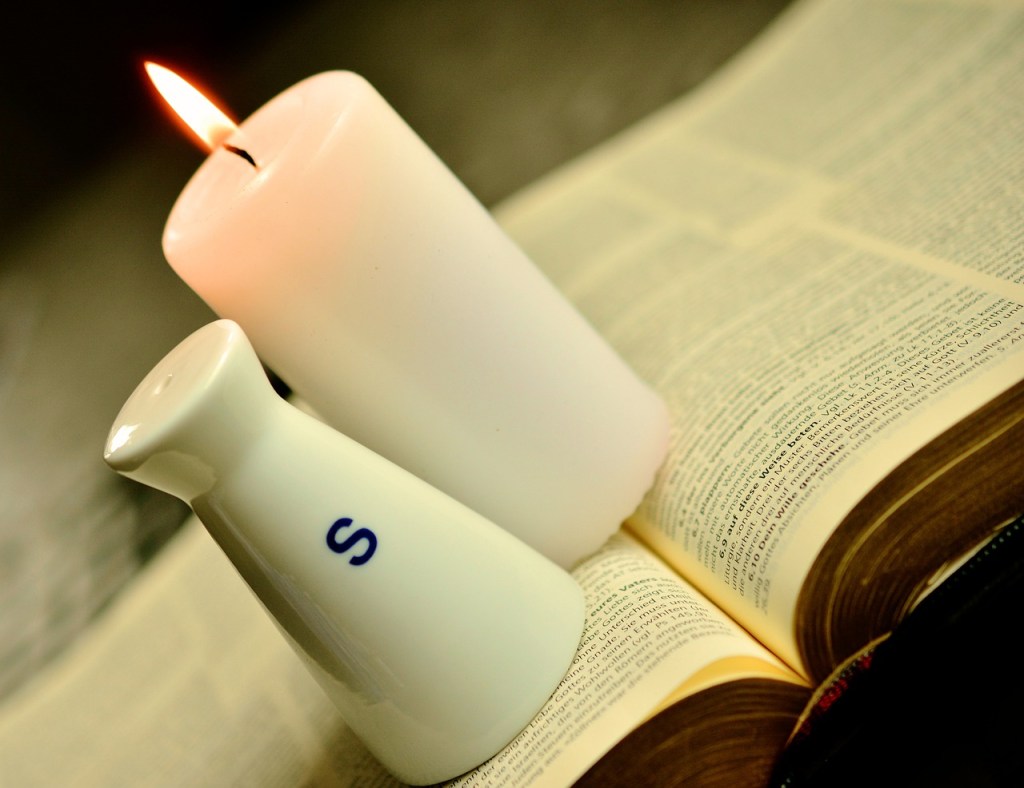
    Of course, she wouldn’t have seen that. That’s kind of the point of salt; it disappears into other things, changes how they taste or act. As our Lord was implying, we don’t focus on the salt but on the things it’s used in. The same with light; we don’t think about the light itself, but on what it allows us to see or do.

    This brought up two questions in my mind. The first one I asked myself. Who in my life has been salt and light? That is, who has shown me what it means to be the person Jesus talked about last time when he spoke of the beatitudes?

    Several people: My father, who worked without complaint as many hours as he could, as many jobs as he needed, to provide his kids with the Catholic education he never had; blessed are the meek. My mother, who brought her own elderly mother and her disabled brother home to live with us; blessed are the merciful. My wife, who took in an abused, injured baby long after her own children were grown, cut her work hours, and poured her life into getting him the services and therapies he needed; blessed are the single-hearted. My best friend, now deceased, who received an early diagnosis of Alzheimer’s yet, when he grieved, did so not for himself but for his wife and children; blessed are those who mourn. And the nun who appeared at our house one day and fed my family with food and good cheer in a time of pain and crisis; blessed are those who hunger.

    If I had said to any of these people, “You know, you really have been the salt of the earth and light of the world for me,” they wouldn’t have known what I was talking about. In fact, I did write a letter to Sister and tell her. She wrote back to me that, if I wanted to see people who had really done something, I should meet the nuns she now lived with; they had built schools, raised money, founded orders. She said, “I have done almost nothing.” The others would’ve said something similar: “What do you think I am, some theologian? I don’t have any great words of wisdom to teach anybody. I’m still working it all out myself!” But God knows what they had forgotten, what we heard from St. Paul: My faith didn’t depend on their wisdom, but on the power of the Holy Spirit working through them. I didn’t need those people to be great theologians, spiritual counselors, or anything else that they weren’t; I needed them to be who God made them to be; to use the talents and abilities he’d already given them. Jesus didn’t say in the gospel that we will be the light of the world or the salt of the earth; he said that we are.

    That brings up the second question: Am I actually being salt and light? Wait; didn’t I just quote Jesus saying that we already are? Yes, but he also said that salt can lose its taste, and light can be hidden. In other words, salt and light don’t have a will or an agenda, they just do what they do. We, on the other hand, can be pretty easily tempted to look for ways to draw attention to ourselves, to show what great and holy people we are. Pretty soon – in fact, on Ash Wednesday, coming up – we’re going to hear Jesus talk about that, and it’s pretty much like dumping salt water into flower pots: He’s going to advise us, in his own way, don’t do that. We have to will to be salt and light for the world, and then do so for the benefit of others.

    OK, how? Well, that depends on our own situation, but in general the outline was given in the first reading. For example, Isaiah urged us to share our bread with the hungry. Is it really that simple – just hand out food to hungry people? Maybe; if you’ve ever been to the food pantry, you know there are a lot of hungry people. But remember too that there are all kinds of hunger: Some for food; others, for someone to listen to them; still others, someone to visit them. The same for shelter, clothing, and all the rest; the list goes on and on. It can be overwhelming, which leads to discouragement, so take the advice of St. Teresa of Calcutta: “If you can’t feed a hundred people, then feed just one.”

    In other words, start somewhere. But start; that’s the point. The salt isn’t getting any fresher, the light any brighter, until we put our will, our humility, and our back into it. Then, there is no limit to what salt and light can do; not for our benefit, but, as our Lord said, that others may may see our good deeds and glorify our heavenly Father.

  • Encountering God

    Encountering God

    Saturday of the 14th Week in Ordinary Time

    Isaiah 6:1-8; 1 Peter 4:14; Matthew 10:24-33

    My family and I had the good fortune of going on a pilgrimage to Italy. The churches we visited were, to say the least, breathtaking; each in its own way a masterpiece of art and architecture. It was easy to be overwhelmed by the splendor of it all.

    While exploring one of them, I happened to look toward the main altar. A small group of people were gathered in a roped-off space. I assumed it was a tour group waiting for a talk to begin. When I looked back later, I saw that in fact it was people attending Mass. I suddenly realized that, wandering through that majestic space, I got lost in the outward beauty but forgot the deeper one. I was encountering art; they were encountering God.

    As the first reading reminded us, the prophet Isaiah also encountered God, and its effect resounds to this day. Who can hear Holy, holy, holy is the LORD of hosts! All the earth is filled with his glory! and not think of the holy Mass? For the Mass, indeed every sacrament, is an encounter with the living God. Pope Francis made this clear when he wrote that Christ, the Incarnation, is Himself the “very method that the Holy Trinity has chosen to open to us the way of communion. Christian faith is either an encounter with Him alive, or it does not exist… We need to be present at that Supper, to be able to hear his voice, to eat his Body and to drink his Blood. We need Him. In the Eucharist and in all the sacraments we are guaranteed the possibility of encountering the Lord Jesus and of having the power of his Paschal Mystery reach us. The salvific power of the sacrifice of Jesus, his every word, his every gesture, glance, and feeling reaches us through the celebration of the sacraments.”1

    We heard in the Old Testament readings this week forebodings of this encounter. On the one hand, God said to Israel through Hosea, I will allure her; I will lead her into the desert and speak to her heart (2:16); it is time to seek the LORD (10:12); I drew them with human cords, with bands of love; I fostered them like one who raises an infant to his cheeks (11:4); and finally, Return, Israel, to the LORD, your God… Take with you words, and return to the LORD (14:2-3). But on the other hand, we also heard Him say that Israel made idols for themselves (8:4); their heart is false (10:2); and the more I called them, the farther they went from me (11:2).

    The pattern is clear: God seeks encounter, to share his love; we, to avoid. Why? Fear, mostly. It’s in our nature. God calls us to be holy – set apart – but we fear not fitting in. He calls us to speak truth in the open, but we are silent, fearing the challenge. He calls us to give ourselves completely to him, but we fear the loss of control. He calls us to the humility of service, but we fear giving up our pride. And where does this fear leave us?Empty, ashamed, hiding in the darkness of our sins, and afraid to open ourselves up to the all-seeing light of Christ.

    But his light is also the perfect love that drives out fear (1 John 4:18). That is why Jesus urges his disciples to become like their Master, that His love will transform us. Our encounter with the living God in every sacrament is meant to bear witness to the transformative power of His love. Why else would Jesus say, What I say to you in the darkness, speak in the light; what you hear whispered, proclaim on the housetops (Matthew 10:27)? Aren’t the most loving words the ones so often spoken in the darkness, or whispered in our ears? The perfect love that drives out fear is the heart of our encounter with God in the liturgy, the love that is meant to evoke in us the same sense of humble self-surrender that Isaiah felt when he cried out, I am a man of unclean lips (Isaiah 6:5).

    It was the loving and living word of God that cleansed him, the same one who comes to us and seeks to perfect in us the effect of that encounter: the Spirit of God who rests upon us (1 Peter 4:14), who moves us to speak in the light, to proclaim what God has whispered, and to say as Isaiah said, Here I am, send me!

    1https://www.vatican.va/content/francesco/en/apost_letters/documents/20220629-lettera-ap-desiderio-desideravi.html