1 Kings 19:16b, 19-21; Galatians 5:1, 13-18; Luke 9:51-62
St. Thomas More once said, perhaps in paraphrase of St. Augustine, that Scripture is shallow enough for a mouse to wade and deep enough for an elephant to drown. Today’s first reading is a perfect case in point, for it tells us of the call of the prophet Elisha in a story that anyone can understand yet at the same time touches depths of discipleship.
First, there is an element of the unexpected to the call. In the ordinariness of a working day Elisha suddenly finds himself in the midst of the extraordinary. One moment he is plowing a field, the next he is being cloaked in the mantle of Elijah. To this day God touches people in the ordinary moments of life. He may speak through Scripture, a homily, a prayer, a song; the Spirit may inspire someone to approach you and directly ask you to consider a certain ministry or calling. All of these are examples of God reaching out to us in ways or at times that may surprise us.
We shouldn’t be surprised. Elisha wasn’t; raised in the faith, he knew that God calls who He wills when He wills and for His own purposes. Elisha didn’t know how he was a part of the divine plan but he was open to being whatever was necessary. That is a lesson for us and is underscored by St. Paul when he urges us to be guided by the Spirit (Galatians 5:18). We don’t know God’s ultimate plan but we do know His infinite love and mercy. In that love He asks not for our understanding, only that we be open to doing His will. This takes the faithfulness and trust of a saint. We aren’t born saints but we become them by using the grace of God to conform our will to His as an act of faith, purely out of love for Him and our neighbor.
This isn’t easy; life-changing transformations rarely are. Things tend to get in the way and Elisha had two: Wealth and power. Few people of his time had enough money to own land and twelve oxen, yet Elisha did. Because he was landed and had money he would also have been a man of some power and influence. Following Elijah meant giving all that up. Yet that is exactly what he did; he slaughtered his oxen, burned his farm equipment to roast them for the people, and left to become Elijah’s attendant. Money and influence can be hard to let go of but if they keep us from doing God’s will then they’re no more than chains. Breaking their hold is what St. Paul meant when he said that we are called for freedom (Galatians 5:13).
 This is the freedom that changes not only our own life but the lives of others as well. Consider how Elisha’s freedom to follow Elijah affected the lives of others. What would have become of all the people Elisha touched in his ministry had he refused the call and simply kept on plowing? In our own time, think about how the choices we make affect the lives of others. Where would the moral development of our children be if we chose to ignore what God has taught us? What would our relationships look like if we ignored St. Paul’s exhortation to serve one another through love (Galatians 5:13)? God’s call changes all of us no matter how we choose. If we accept it we grow closer to Him and bring others closer to Him as well; if we refuse or ignore it we distance ourselves and may well keep others from Him. The choice is ours.
Finally, the commitment to follow our Lord is all-encompassing; a total gift of heart, mind, and soul. Elisha didn’t agree to a term of service or to give God part of his time; he gave himself totally and unreservedly. In the gospel Jesus added an urgency to that; when a man told Jesus that he would follow after burying his father – a very pious deed – we heard Jesus reply, Let the dead bury their dead. But you, go and proclaim the kingdom of God (Luke 9:60). Although we believe that he is referring to those who are spiritually dead – that is, dead in sin (Ephesians 2:1,5) – Jesus nevertheless reminds us that the call is from God and God’s will takes precedence over everything.
Such total commitment demands not only great faith but also great love. We might look at our faith life and think “I love God but do I really have to do all that? OK, so I’m not always faithful; what’s the big deal?” If so, I invite you to try something. Imagine you’re at a wedding. When the groom is asked, Do you promise to be faithful to her in good times and in bad, in sickness and in health, to love her and to honor her all the days of your life? he replies, “I love her but do I really have to do all that? So I’m not always faithful; what’s the big deal?” I think most of us would agree that his answer is a non-starter. Marriage, Holy Orders: These sacraments aren’t service contracts, they’re covenants; total gifts of self and nothing less.
This is not to say that total faithfulness will guarantee success. We are human, we fall. Even our best efforts may still get rejected. But like the town in Samaria that rejected Jesus, the proper response isn’t to call down fire from heaven but to keep moving, keep serving, keep in mind that Christ loved and forgave his persecutors even from the cross.
This is the depth of discipleship: to have nowhere but Christ to lay our head, to call down on cold hearts only the fire of the Holy Spirit, to bury in ourselves any spiritual indifference, and to never look behind at what might have been, for Christ has called us to keep going, keep trying to bring ourselves and anyone who is willing, closer and closer to Him.
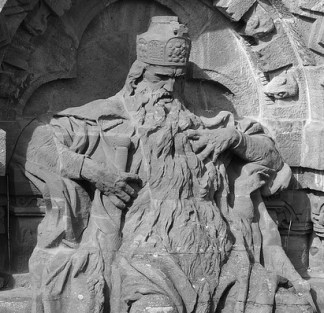 Although he was as willing to follow Jesus as the scribe in the gospel, Cyril did not lose his personality in the process. By all accounts, he was imposing, impetuous, impatient, perhaps even infuriating. He wasn’t always the perfect picture of sanctity or the epitome of virtue. Very few saints are. Sinners and saints fight the same battles, share the same temptations, and struggle with the same demons. They differ only in their response to them. The sinner looks to himself or to the world for strength; the saint looks to Christ alone. This is what Cyril knew and what St. Paul meant when he told the Corinthians:
 This may sound easy but we know it isn’t, for we too are twisted iron. Perhaps we can’t enter religious life to get twisted straight but we can enter into the silence of our thoughts and the privacy of the confessional to learn how to deal with the sins that are holding us back. Whatever they are, the example of St. Aloysius shows us that while change may be difficult or painful, it is possible.
 It took a long time – generations – but the Church in Europe triumphed even over the seemingly invincible Vikings. I say “seemingly” for we who hear the words of Christ in the gospel know that in reality the Vikings never had a chance. All they had were swords, brute strength, and a fierce warrior spirit; what is that against the gentle, persistent, indomitable power of God? Through the ministers of the Church, the Spirit of God flowed over that mighty Norman rock and carved it into a force that would defend and promote the faith they once mocked for yielding so easily.
 Although w
 No one can give what they do not possess. Father Anthony possessed great faith and great charity, but what transformed him from service in an Augustinian monastery to service as one of the greatest preachers and teachers of the faith was his love of Christ, shown in his constant willingness to discern and pursue the call of Christ in his life as well as his desire to keep Christ at the center of his life. As he once so eloquently said, “If you preach Jesus, he will melt hardened hearts; if you invoke him he will soften harsh temptations; if you think of him he will enlighten your mind; if you read of him he will satisfy your intellect.”
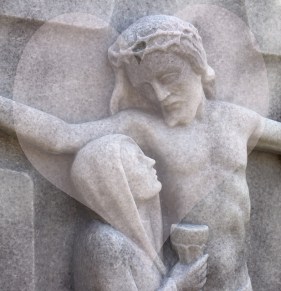 The life of Blessed Diana d’Andalo shows us that to those docile to His promptings the Holy Spirit will show both the greatness and the folly inside ourselves. Diana’s folly lay in the selfishness and will to dominate that has plagued mankind since it first heard the voice that whispers You can be like God (Genesis 3:5). Her greatness lay in her steadfast determination to conquer any enemy, especially herself; to cast aside all fear, remain in God’s love, keep faith in Christ, and abandon herself to the power and working of the Holy Spirit, that her love for God and her neighbor may be made as perfect as possible.
 Norbert did not become a saint because he fell off a horse and heard a Scripture verse; he became a saint because he took a hard look at himself and realized that he had no idea what happiness is. Happiness is beatitude, or eternal union with Christ. As a young man he once aspired to imitate Christ through Holy Orders, but when that life looked difficult and a worldly one much easier, he allowed himself to settle for less. We aren’t so different. In our own spiritual lives, we sometimes try to draw closer to Christ by setting some new and ambitious goal, only to find how hard it is to do in practice. Like Norbert, we end up settling for less and allowing other more worldly things to come between us and a closer union with God.
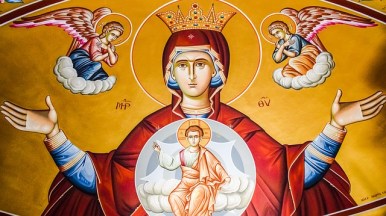 The first reading closes with this exhortation from St. Paul: Rejoice with those who rejoice, weep with those who weep. Have the same regard for one another; do not be haughty but associate with the lowly; do not be wise in your own estimation (Romans 12:15-16). What better or more fitting words are there to describe her whose very soul rejoices in God, her Savior? In the fullness of the grace bestowed on her as a singular gift of God and there visiting Elizabeth and pregnant with the Christ-child, Mary is the very answer to the question Nathanael would ask, “Can anything good come from Nazareth (John 1:46)?” Anything good, indeed! Only she, who by her fiat consented to bring the world Goodness itself; she, not wise in the world’s estimation yet wise enough to leave us with the best advice a mother could tell her children, Do whatever he tells you (John 2:5).
 Mark 10:45