Tag: Happiness

  • The Paradox of Love: Friday of the 19th Week in Ordinary Time

    Joshua 24:1-13; Psalm 136:1; Matthew 19:3-12

    Today’s readings remind me of that famous scene in the musical Fiddler on the Roof when Tevye asks Golde, his wife of 25 years, do you love me? She replies, “Do I love you? For 25 years I’ve washed your clothes, cooked your meals, cleaned your house, given you children, milked the cow, after 25 years, why talk about love right now?” He repeats, do you love me? “I’m your wife.” I know… But do you love me? She thinks out loud, “Do I love him? For 25 years I’ve lived with him, fought him, starved with him, 25 years my bed is his, if that’s not love, what is?” Then you love me? Finally, she replies, “I suppose I do…”

    Why does this scene remind me of the readings? Because today Scripture focuses on what love is in its essence, and that scene highlights three key aspects of it.

    First, love is a verb. We love not in what we say but in what we do. Through Joshua, God speaks to people who, from the time of Abraham, through the oppression in Egypt, the fleeing, struggling, and starving in the desert, might well have asked, “God, do you love us?” Today we hear God reply: “Do I love you? Remember all the things I’ve done for you, and look what lies before you: You’ve made it to the Promised Land!”

    That reply echoes through the ages to today, to every one of us. We each have our own struggles, physical and spiritual. Through all of them, God isn’t sitting silently in the background; he is in every moment, working in ways beyond our understanding. His work may be unknown to us this moment, this month, or this year, but like the Promised Land, its fruit lies waiting. We must never mistake silence for inaction or indifference; God is eternally vigilant, eternally loving, always acting for our good.

    This brings up the second point: Love is timeless. How fitting that we hear Psalm 136 today, especially the antiphon, His mercy endures forever. The Hebrew word translated as “mercy” is hesed, which includes mercy but implies action, things we do when we are motivated by love and loyalty to someone else. In the scene from Fiddler on the Roof, remember that Golde replied, “After 25 years, why talk about love right now?” To her, the amount of time was not the point; she had committed her life to her marriage.

    Jesus speaks of this kind of commitment in the gospel when he quotes the passage from Genesis that a man is joined to his wife, and the two shall become one flesh (Genesis 2:24). Again to go back to the ancient language, the word for “joined” literally means, “glued.” Imagine gluing two pieces of paper, allowing them to dry, then trying to tear them apart. We know what will happen; the kind of pain and suffering that only such tearing can bring.

    This leads us to a third aspect of love, which in the words of venerable Fulton Sheen is that love is the soul of sacrifice. Recall how Golde replied when Tevye asked if she loved him: all the sacrifices she had made, the things she had endured, for him. But not just for him, for herself as well. Only those willing to make the greatest sacrifice for love’s sake can know the deepest joys that love brings. When it comes to love, joy and sacrifice can never be separated; in married life, in ministry, in whatever kind of service we are called, only those who are most fully open, who risk the greatest vulnerability, can know the deepest, most fulfilling joy: to know and to be known, to accept and be accepted; to love and to be loved.

    As in all things, the best model for all these aspects of love is our Lord, Jesus Christ. Who performed greater works of love than he? Whose love is more timeless? Who is the soul of sacrifice more than he who was willing to empty himself into his own creation to show us that those who risk the ultimate sacrifice of themselves are given the ultimate joy of resurrection to eternal life? Only Christ could most perfectly show us all this, the great paradox of love: that giving is receiving; that most fully knowing means to be most fully known; and that only by dying to ourselves can we reach the promised land of eternal life.

  • One of the “Do Nots”: Friday of the 16th Week in Ordinary Time

    Exodus 20:1-17; Matthew 13:18-23

    Even though I’ve gone through it countless times over the last 35 years, each time still amazes me. I look at one of my kids, say, “Do NOT do that,” then find myself standing there incredulous, less than 5 minutes later, saying, “Didn’t I just tell you not to do that? Will you ever grow out of this?” But it was just recently, as I was going through it yet again, that I heard a voice in my head say, “You do the same thing.”

    Now, that could have been an echo of my mother or father, for I definitely did the same thing to them. It could also have been any of a number of nuns or priests, for I did it to them, too. Come to think of it, it could have been any of the adults who had to deal with me as a kid. It could have been, but I had the distinct feeling that it wasn’t. No, this was my conscience speaking, and not about past behavior, either. The voice didn’t say, “You did the same thing,” it said, “You do the same thing.”

    It’s true. Day after day, year after year, God has taught me through his word. It couldn’t be clearer than on a day like this when we literally read the 10 Commandments. Yet time after time, year after year, sometimes not 5 minutes later, I do exactly what God just said not to do. Why? If I understood the gospel today, our Lord has wrapped the reason in a parable which teaches me that I have a hearing problem.

    My ears work fine, that’s not the issue. The problem seems to be an inner, spiritual sort of deafness. When Jesus begins his explanation of the parable by saying, Hear the parable of the sower, he clearly wants his disciples to do more than use their ears; he wants their hearing accompanied by an attitude that says, ‘Lord, I am ready to be taught.’ Ask yourself how many times you’ve heard a gospel begin, thought, ‘Oh, I know this one,’ and then tuned out or paid little attention? This is the seed that falls on rocky ground; we hear but lack the docility, the teachable spirit, needed to help the word take root and endure. The gift of docility inclines us to remember that no matter how familiar a passage may seem, there is always something new to be learned.

    Our Lord also relates our hearing problem to a lack of understanding. We hear the word, but like the seed that falls on the path, let it go because we don’t understand it. In and of itself, lack of understanding is nothing to be ashamed of. Scripture can be hard to understand; it refers to cultures, peoples, and times far removed from our own. The problem comes in when we make no effort to learn more; to ask for help; to set time aside for study and contemplation of God’s word. Those who do this will find their time and effort well rewarded.

    Other times we can’t hear God because, as Jesus implies, his voice is drowned out by our own anxieties. We all know what it’s like to come to Mass or prayer with problems weighing us down. They distract us and before we know it the time has slipped by. It helps to begin preparing for our time with the Lord before leaving home, or if we’re praying at home to sit and recollect ourselves in silence before we begin. I find it helpful to repeat one of the old aspirations of the Church: “Let go and let God.” Not to forget or minimize what is on our mind but to make it part of our prayer, our offering to God, laying it on the altar and offering it as our sacrifice to the only One who can bring good out of it. I can’t think of a better way to quiet the inner voices so we can hear what God is saying.

    In years past, I thought of this parable as referring to different kinds of people: Those who hear the word of God and those who do not. That’s fine as far as it goes, but when God reminded me that I am one of the “do nots,” I looked a little deeper and saw the parable referring not to different kinds of people but different states of the spiritual life. That is great news for all of us, for it reminds us that conversion is possible; we can do something about our hearing problem. It is true that in the deafness of our sloth and arrogance, we are in the path; in our ignorance and shame, the rocky ground; in our anxieties and temptations, the thorny ground. But we don’t have to stay there; these grounds aren’t meant to be passively endured but to be grown out of. Christ ends the parable in the place we all want to be, so let us all today resolve that we will show him the humility, docility, and perseverance it takes to be transplanted into the soil that, truly hearing his word, bears fruit thirty, sixty, and a hundredfold.

  • All Things to One Man: The Solemnity of the Sacred Heart of Jesus

    All Things to One Man: The Solemnity of the Sacred Heart of Jesus

    Hosea 11:1, 3-4, 8c-9; Ephesians 3:8-12, 14-19; John 19:31-37

    In high school we once did an exercise on self-perception. Sister began by asking us to take out a sheet of paper and write down 3 negative things about ourselves. After a couple of minutes she said, “Alright, now write down 3 positive things about yourself.” I can’t remember what I wrote but I know I didn’t list three; I’m not sure I even wrote two. That was Sister’s point; self-conscious teen-agers aside, people in general tend to be very good when it comes to focusing on their negative qualities but not so good when it comes to the positive.

    The same goes for our relationship with God. If you’re anything like me, it’s probably much easier to come up with reasons why He shouldn’t think very highly of you than reasons why He should. Today, on the Solemnity of the Most Sacred Heart of Jesus, our Lord gives us at least three reasons to focus on the positive.

    First, listen again to his words in the 11th chapter of Hosea: When Israel was a child I loved him… I taught Ephraim to walk… took them in my arms… fostered them like one who raises an infant to his cheeks… stooped to feed my child… I will not let the flames consume you (Hosea 11:1, 3-4, 8-9). This isn’t the imagery of a God who loves from a distance, impersonally, or until we leave or hurt him; no, this is a God who loves intimately, with a deeply personal, boundless, and most of all, healing and merciful love.

    Second, as St. Paul makes clear, this is a love that goes beyond all words except the one, Eternal Word – Jesus. We can hear Paul struggling to express the inexpressible as he prays that we may have the strength to comprehend with all the holy ones what is the breadth and length and height and depth, and to know the love of Christ which surpasses knowledge (Ephesians 3:18-19). This is the key; divine love surpasses human knowledge and can be known only by faith (Ephesians 3:17), the gift of the Father possible only by the strength that comes from the Holy Spirit (CCC §683). To those who have faith, all the riches of grace are available.

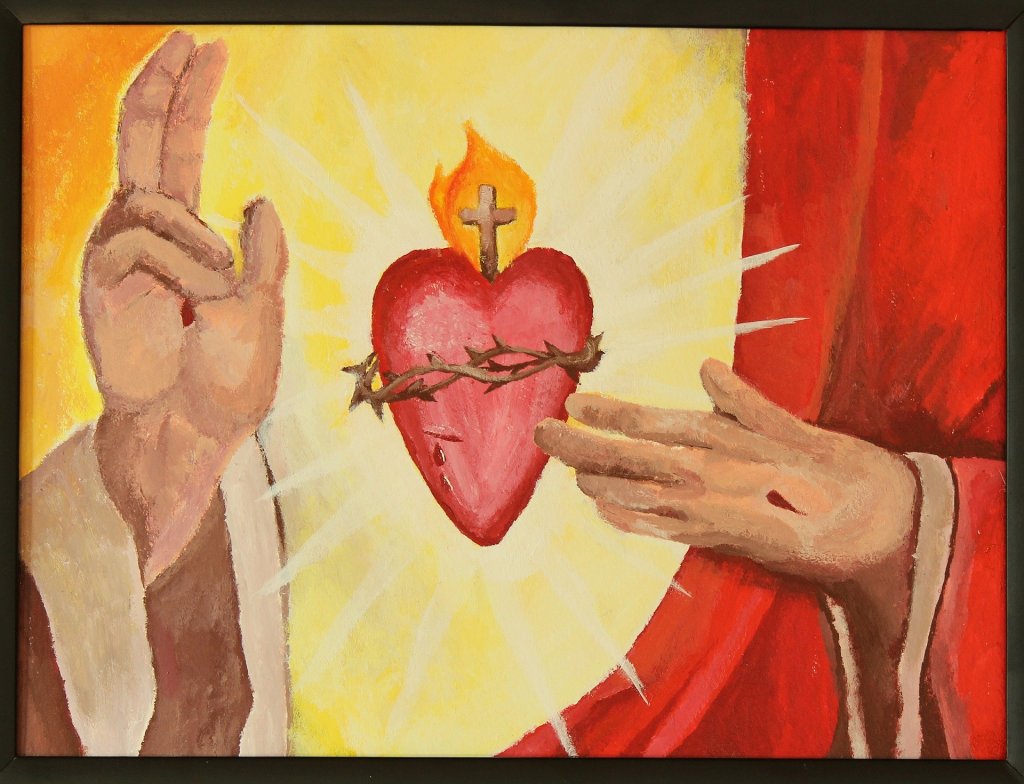
    Finally, every image of the Sacred Heart reminds us with its crown of thorns of the cost of this love. We hear in the gospel of the soldier who thrust his lance into his side, and immediately blood and water flowed out (John 19:34). There is no love worthy of the name that is not asked to endure insult, temptation, and suffering. From the dawn of humankind it is written into our nature; it’s in our blood. But it isn’t in the blood of Christ, either from his Heavenly Father or his holy Mother, the Immaculate Conception. He willingly took it on. This is perhaps the greatest and most positive of all – that God, purely out of his infinite and merciful love for us, gave his only Son that we would be raised to life eternal. As Christ himself said, there is no greater love than this.

    St. Pio of Pietrelcina, Padre Pio, understood that very well. While passing through a crowd of people all clamoring to get near him, someone shouted, “Padre, you are all things to all men!” He replied, “No, I am all things to one Man.”

    May we all come to that kind of understanding! May we all see the Solemnity of the Sacred Heart of Jesus as a day to set aside the negatives and focus on the overwhelming positive – that we too are all things to one Man. We are loved infinitely, personally, and mercifully; we are given the gift of faith which alone can make this love known to us beyond any human understanding; and finally, that as the ultimate expression of this love the Second Person of the Blessed Trinity took human form and allowed his own heart to be pierced that we may not only look upon him in mourning for the sinfulness that put him there but with rejoicing that divine love can take even the passion and death of Christ, the greatest insult of all time, and transform it into the greatest victory the world will ever know – the resurrection to eternal life for all who believe and return to God with their whole heart (Joel 2:12).

    Sacred Heart of Jesus, have mercy on us.

  • Memories that Matter: Solemnity of Mary, Mother of God

    Memories that Matter: Solemnity of Mary, Mother of God

    Luke 2:16-21

    As a teenager, one of my sons began to have difficulty sleeping. One night I found him tossing and turning in bed and he told me about some of the stress he was feeling. I asked him to set that aside for a moment and focus instead on the best day he could remember. He settled down and after a minute began to smile. When I asked him where he was, he said we were on vacation; it was a warm summer day and he was walking on the shore of his favorite lake with his Godfather and me. I encouraged him to relax and savor every minute. It worked like a charm; he drifted peacefully off to sleep.

    Psychologists have long known that recalling happy memories can do a lot more than reduce stress. There is a relationship between memories and happiness. Specifically, people tend to get a deeper sense of happiness from memories of positive experiences they’ve had than of things they’ve bought. That resonates with me; my happiest memories aren’t about things I’ve bought but about experiences and relationships I’ve had, particularly with my family.

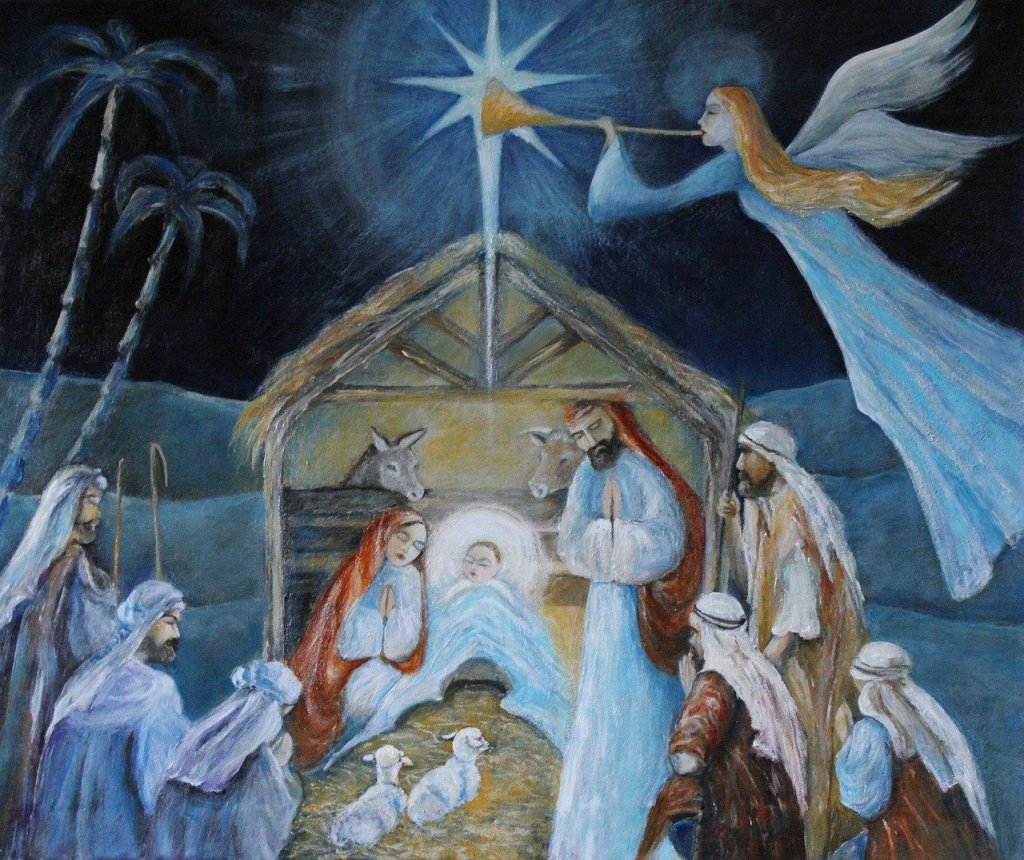
    The Blessed Mother is no different. The evangelist tells us that as the shepherds spoke of all they had heard and seen, Mary kept all these things, reflecting on them in her heart (Luke 2:19). That prompts us to think of all the memories she herself would have: the visit from the angel; the conception of Christ in her womb; her journeys to Elizabeth and to Bethlehem; her divine Son’s birth in a stable; just to name a few. We call her blessed for a reason! These, her deepest memories of family, demonstrate to her and to the world how close God can be, if we let him.

    Although to Mary and Mary alone was given the great privilege of calling these experiences her own, we too are given many opportunities to seek out and experience God in ways not too unlike hers. Here are just three:

    First, although we may not be visited by the archangel Gabriel, we do have our own guardian angel who always looks upon the face of God (Matthew 18:10). Throughout Scripture we see that angels move our will toward what is good (Luke 2:10-12), offer our prayers and works to God (Tobit 12:12), and protect us in times of trouble (Daniel 6:22; Psalm 90:10). Make it a habit to ask the intercession of your guardian angel.

    Second, keep in mind what St. Augustine said: The Virgin conceived in her heart before her womb. Of course we can never experience the joy Mary did as the mother of Christ; however, by the gift of faith we do conceive him in our own hearts. What’s more, we can bring Christ to birth in the hearts of others, perhaps by teaching but mostly by living as he wants us to; as he did. As Jesus himself said, whoever does the will of my heavenly Father is my brother, and sister, and mother (Matthew 12:50).

    Finally, while Mary was honored above all women to be the ark that held our Lord for 9 months, we can be honored to receive him Body, Blood, Soul, and Divinity in holy Communion almost every day of the year. Of course, Mary was uniquely prepared for that by God from the moment of her conception; nevertheless, we have access to the necessary state of grace through the Sacrament of Penance given to us by her Son. For as St. Paul said, Christ’s will for us is to present to himself the church in splendor, without spot or wrinkle or any such thing, that she might be holy and without blemish (Ephesians 5:27). Holy and immaculate, like his Mother. Her destiny is ours.

    So, when the stresses and strains of life threaten to overwhelm you, take a moment, relax, and recall how like the Blessed Mother you have been created to be: To praise God through and with his angels; to conceive him in faith and bring him to birth in the world; to receive him in holy Communion; and to return to him holy and immaculate at the end of time. These will be the memories that matter into Eternity; your own near experiences of God. Then rejoice, not only that you have such memories to bring you closer to God but that, at all times and just like our Mother Mary, God is ever close to you.

    Holy Mary, Mother of God, pray for us.

  • Lost and Found in Translation: Tuesday of the 30th Week in Ordinary Time

    Lost and Found in Translation: Tuesday of the 30th Week in Ordinary Time

    Ephesians 5:21-33; Luke 13:18-21

    When people say, “it’s all Greek to me,” they mean that they don’t understand what they’re hearing or reading. We may not realize it but we could often say the same thing about the bible, not so much because it really was written in Greek (and Hebrew) but because things get lost in translation. Sometimes those things don’t matter much; other times they can make a great deal of difference.

    Today’s first reading is a perfect case in point. What may come across as little more than a discourse on marriage is actually a beautiful meditation on various aspects of love that can benefit all people, married or not. The problem is that some of the subtleties lie hidden beneath the surface, lost in translation.

    For example, he begins: Be subordinate to one another out of reverence for Christ. Although the meaning seems obvious, there are nuances. First, the word we translate as “subordinate” also implies obedience, like servant to master. Second, when he says “one another” he means everyone, not a select few. Third, the phrase “reverence for Christ” literally translates “in the fear of Christ.” So, what seems like a simple exhortation to treat each other well is actually a bold challenge to love like Christ: with the humility that seeks to serve and not to be served, and the fear of the Lord by which we reverence God above all things and others out of love for him.

    When it comes to the married, St. Paul begins with what many today see as a put-down of women: Wives should be subordinate to their husbands…. And while he clearly does follow the custom of placing men at the head of the household, an important subtlety is missing from our text. The original Greek reads, wives should be subordinate to their own husbands…. Whatever the reason, St. Paul clearly feels the need to remind the Ephesians of two additional aspects of love: Chastity and faithfulness. Once again, this is a lesson for us; just as we love the Lord and have no false gods before him, so we are to be chaste – faithful to our state in life – whether lay or clergy, married or single.

    Notice too that St. Paul quotes Genesis: a man shall leave his father and his mother and be joined to his wife, and the two shall become one flesh. This is the highest unity we can achieve – a bodily and spiritual communion ordained by God and indivisible by man. When I say “indivisible” I mean exactly that. In the original Hebrew and Greek the word is not joined, but glued. Imagine gluing two sheets of paper together and then, after it has set, trying to separate them. They will tear. We all know of the pain and sadness of the disunity that comes with divorce.

    Not that unity is pain free. In any long-term relationship like marriage, unity requires self-sacrifice. This is especially true as relationships mature over time. Life tends to show us things we didn’t see in the early years; among them, the weaknesses and failings of others. Our natural tendency is to focus on our own pain and suffering, to place blame on others rather than see our own role in them, and to withhold forgiveness rather than make peace with them and ourselves.

    But as St. Paul reminds us, we are to love as Christ loves the Church: Completely, despite and beyond its weaknesses, to the point of dying that she may live. This is the daily discipline of being servant of all, faithful to our state in life whatever it is, and bound to God and each other in a relationship that is life-giving, life-sustaining, and life-affirming, no matter the cost. This is painful but that is the pain of healing, the death that gives way to the new life of resurrection.

    Our Lord points to this in parable form in the gospel, where we see another aspect of love: that it not only unites but multiplies. When the Christian dies to self like leaven, the Church rises like three measures of flour; when husband and wife die to self, their new family flourishes, rising like the branches of the mustard plant toward Heaven, a home for its children.

    This is not possible apart from the grace of God, for God is Love and his grace the glue that binds us one to the other. The power of his grace works within us to form the mind of Christ, to imitate the love of Christ, and to hope more and more in the promise of Christ: that those who love as he loves will one day live as he lives, in the eternal life and infinite love of the Most Holy Trinity.

  • The Slave of the Slaves: Memorial of St. Peter Claver

    Although I am free in regard to all, I have made myself a slave to all so as to win over as many as possible.

    1 Corinthians 9:19

    Imagine being dragged aboard a ship, naked and chained in the darkness below deck, lying helpless for several weeks, through rough seas and stifling heat. There are over 500 of you; males here, females there. You are fed just enough to keep you alive. Starvation, disease, and death are rampant. No one knows where you’re going or what awaits you when the hatch finally opens. Over the centuries of the slave trade, millions of people saw that hatch open only to a lifetime of slavery in a strange New World.

    Yet, like a drop of mercy from heaven, hundreds of thousands of these same people saw that hatch open to reveal the caring, concerned face of a gentle Spanish Jesuit. He would come below and find the newborns who were still alive, pour water over them, make the sign of the Cross and pray. He then ministered to the dying, and the dead he had respectfully removed. To the sick he brought medicine and bandaged their wounds. Those too sick to leave the ship on their own he helped carry above. When he got to you, he would clean you, give you food, clothing, and fresh water. He would speak warmly and gently through an interpreter, although no translation was needed for his touch. This was a man fluent in the language of love and by the time he had finished, he had restored a measure of the dignity so shamefully taken away. Every moment, this man acted as if he was your slave and happy to be nothing more.

    That’s because he was.

    The man was Peter Claver, a 17th century priest and Jesuit who devoted his life to ministering however he could to every slave shackled in the darkness aboard the hundreds of ships landing in the port city of Cartagena. Fr. Claver took to heart the words of St. Paul, who said, Although I am free in regard to all, I have made myself a slave to all so as to win over as many as possible (1 Corinthians 9:19).

    Father’s devotion to the service of slaves sprang from his desire to imitate the service of his model, the Blessed Mother, to whom he was devoted. As a young novice he was so moved by a pilgrimage to one her shrines that he wrote, “I must dedicate myself to the service of God until death, on the understanding that I am like a slave, wholly occupied in the service of his master.” He traveled to the New World after hearing that millions of enslaved people died there knowing nothing of Christ. After his first few years serving them, Father signed the document of his final profession to the Society of Jesus with the words, “Peter Claver, slave of the slaves, forever.”

    Before the slaves were sent on, Father took whatever time was given him to teach them about Christ. He used pictures, rosaries, crucifixes, anything he could find. He concluded every session by teaching them to say, “Lord Jesus Christ, Son of God, You are my Father. I am sorry for having offended You. I love You very much. I love You very much.” It is said that he personally baptized over 300,000 slaves.

    Fr. Claver continued his ministry for 40 years. Finally, sick, frail and exhausted, he knelt and kissed the feet of his young Jesuit successor and on the day he predicted – the Feast of the Nativity of the Blessed Virgin Mary, September 8th, 1654 – he died at the age of 73.

    portsoy-1244572_640Although the slave trade of that era is thankfully no more, slavery still abounds. Who are the people in our own lives, chained in the darkness of sin, feeling helpless, uncertain and fearful of their destiny? Who are those with wounded or even dying spirits, on the brink of losing hope? Who are those starving for affection, for shelter, for safety, for dignity? Will you be the one to open the hatch to descend into their suffering and restore what dignity you can?

    Let us pray that we, like St. Peter Claver, may be the slave of the slaves, forever.

    St. Peter Claver, pray for us.

  • The Wounds of Love: St. Birgitta of Sweden

    The Wounds of Love: St. Birgitta of Sweden

    Galatians 2:19-20; John 15:1-8

    I once instructed a woman in the RCIA program who excelled in her studies of the faith. After receiving the sacraments she moved away and I lost track of her. Years later, I learned that she had stopped practicing the faith. She was now “spiritual but not religious.” I think that means she believes that while there is a spiritual dimension to the world, it isn’t what we understand as the faith most fully revealed to us in Christ.

    The sticking point for her, as for many, may well have been the passion and death of our Lord. Indeed, the crucifixion was called by St. Paul a stumbling block to Jews and foolishness to Gentiles (1 Corinthians 1:23). But to one of the saints, St. Birgitta of Sweden, the crucifixion held a special place; it was the nexus of the physical and spiritual worlds.

    Birgitta lived a life full of the joys and sorrows of family. Born in Sweden around the year 1303, the daughter of a governor, by age 42 she had already been a wife for 28 years and a widow for one. She had a wide and deep experience of motherhood; as mother of 4 boys and 4 girls, she saw one daughter run off to marry a troublemaker, one son die as a boy, one as a man, and another daughter grow up to become St. Catherine of Sweden.

    She also knew the life of the working world. While raising her own children she served as lady-in-waiting to the queen of Sweden. Her kind, motherly way drew her into the confidence of the king and queen, both of whom tended to enjoy worldly life too much for their own good. Birgitta worked as hard as she could to keep their religious concerns before them; this became a frustrating and unfortunately futile struggle.

    Finally, Birgitta knew the religious life as well. After becoming a widow and devoting herself to care of the poor, who greatly loved her, she dedicated buildings and land on family property to a new contemplative order. She wrote the rule for her order which became known as the Order of the Most Holy Savior.

    At the same time, Birgitta lived a full life in the spiritual world. She was a mystic. At age seven, she had a vision of being crowned by the Blessed Mother. Three years later came her most profound mystical experience: The crucified Christ appeared to her and bid her gaze upon him. When she asked who had so cruelly treated him, he replied, “Those who despise me and spurn my love for them.” This was her own Damascus road moment; although she had many visions, dreams, and locutions afterwards, she devoted the rest of her life to the contemplation of Christ’s suffering.

    After wisely consulting her spiritual advisor and obtaining his approval, Birgitta began to share her visions with the world. She met with Magnus, the king of Sweden, and advised him that Christ would visit a plague on the land if he and the queen did not change their ways. As usual, he laughed off her vision. The Black Death came two years later, wiping out half the population. Needless to say, the king stopped laughing.

    Birgitta next focused her attention on the popes, who had long since deserted Rome in fear for their lives. Leaving Sweden with her daughter Catherine, she moved to Rome. In the midst of its crumbling churches and society, Birgitta ministered to the sick, fed the poor, housed pilgrims, and called on the pope to return. Her call took on a special intensity due to her dislike of pope Clement VI, who she called “a murderer of souls, more unjust than Pilate and more cruel than Judas.” During a thunderstorm on the night of December 3rd 1350, lightning struck the bells of St. Peter’s, melting them. Birgitta prophesied this as a sign that Clement’s life was coming to an end. He died a few days later. When the next pope fled to get away from her Birgitta literally chased him down, begged him to approve her order, which he did, and to return to Rome, which he did not do. After her death in 1373, her call for the popes to return was taken up by St. Catherine of Siena. Not long after, the papacy returned to Rome to stay. Birgitta was vindicated.

    In the first reading, St. Paul wrote:

    I have been crucified with Christ; yet I live, no longer I, but Christ lives in me; insofar as I now live in the flesh, I live by faith in the Son of God who has loved me and given himself up for me (Galatians 2:19-20).

    jesus-753063_640

    Birgitta’s life is a testament to the triumph of St. Paul’s words. From the moment of that first overwhelming spiritual encounter with the suffering, crucified Christ when she was 10 years old, she began to internalize them; to sense as we all must, not only the pain of Christ’s passion but the passion behind his pain. The ultimate reality of the cross is love, a love so great it unites heaven and earth, the physical and spiritual. What else could it be but love that would cause God himself to take on our humanity, our sinfulness, and in the face of humanity’s rejection, nail it to the cross? Birgitta spent her life contemplating not the pain of futility but the pain which Oscar Wilde called the wounds of love. In her own way, St. Birgitta spent her life showing her family, her king, her people, and her pope that this is not only a love worth dying for; it is a love worth living for – eternally.

    St. Birgitta, pray for us.

  • No Reluctant Prophet: Monday of the 16th Week in Ordinary Time

    No Reluctant Prophet: Monday of the 16th Week in Ordinary Time

    Micah 6:1-4, 6-8; Psalm 50:23; Matthew 12:38-42

    So far in this chapter of Matthew we have seen Jesus being treated by the Pharisees like a man on trial. They have twice accused him of violating the sabbath, once of being in league with demons, and now, joined by the scribes, they confront him with the demand for a sign from God (Matthew 12:38).

    Given their lack of faith in Jesus this may seem reasonable but it betrays at least two problems they have in their relationship with God. First, no scribe or Pharisee, no human being is ever in a position to put God on trial or make Him prove anything. If anyone is on trial it’s us, as the prophet Micah said in the first reading: the LORD has a plea against his people, and he enters into trial with Israel (6:2). What’s more, we don’t get to tell God who He works through or how He does things. As He also said through Micah, I brought you up from the land of Egypt… I released you… I sent before you Moses, Aaron, and Miriam (6:4). God calls the people, God determines the path. Second, notice how Christ responds to the demand of the scribes and Pharisees by speaking of an “unfaithful” – or “adulterous” – generation (Matthew 12:39). This nuptial language goes to the heart of the real problem, which is the failure of these men to understand that our relationship with God is not a contract, or something we negotiate. It is a covenant, a mutual giving of our entire selves one to the other; a commitment that is total and unto death.

    Jesus drives this point home with true irony by bringing up Jonah for as everyone knew, Jonah was a prophet who was “total” only in his defiance of God’s will and “unto death” only in his effort to avoid doing it. The so-called “reluctant” prophet, Jonah sailed the other way when God called him to preach to pagan Nineveh, tried to drown himself in the sea when he got caught, spoke as little prophecy as possible, angrily complained when Nineveh repented, and worried more about losing the shade from a plant than about the possibility of over a hundred thousand Ninevites dying. Jonah was the perfect example of how not to commit yourself to God.

    Yet Christ took that prophet and made a sign out of him: Just as Jonah was in the belly of the whale… so will the Son of Man be in the heart of the earth (Matthew 12:40). Out of that one point of deep darkness – the disobedient man’s descent into the belly of the beast – Christ brings one point of brilliant light – the obedient Son of Man’s descent into the heart of the earth, or, as we say in the Apostles’ Creed, his descent to the dead. There of course he would preach as Jonah could only wish to, and release those repentant souls who had been awaiting the redemption only He could bring.

    Had the scribes and Pharisees recognized the prophetic truth that Christ had just spoken, they would have known that all they had left was the question from Micah: With what shall I come before the LORD, and bow before God most high (6:6)? Since they did not, we turn to ourselves, for we too are on trial. In our own ways, we are all guilty of being a reluctant prophet: Avoiding various calls to serve, stubbornly resisting God’s will, doing the minimum possible, complaining to God about people whose repentance only He can know, and worrying more about our own comfort than about the suffering of many around us.

    So, with what shall we come? Scripture makes it clear: Prayer and sacrifice. As Micah urges us to do right, love goodness, and walk humbly with God (6:8), we pray for the virtues: Prudence, to know what is right; fortitude, to do it; wisdom, to see and love God’s goodness in all people; humility, to walk with God where He leads; and faith, to trust and praise Him at all times. This is a sacrifice, for like Jonah we are inclined to do what we want, love what we want, and walk where we please. But through the psalmist God reassures us: He that offers praise as a sacrifice glorifies me; and to him that goes the right way I will show the salvation of God (Psalm 50:23). The Salvation of God is Christ, who does only right, is love and goodness itself, and who walked in perfect humility all the way from the heart of his Father to the womb of his Mother, from the height of the cross to the heart of the earth, and from the Sacraments he has given the Church into the hearts of all believers.

  • The Vision of True Faith: Sts. John Fisher and Thomas More

    The Vision of True Faith: Sts. John Fisher and Thomas More

    Genesis 12:1-9; Matthew 7:1-5

    In the story The Emperor’s New Clothes, author Hans Christian Anderson cleverly lays bare not only the emperor but also the human tendency to go along with the crowd. This becomes most obvious near the end of the story, when a child proclaims the truth that all can see but none are willing to admit: “He hasn’t got anything on!”

    In the England of the 16th century, King Henry VIII was emperor and his new clothes were the pretension that he alone held supreme authority over the Church in England. For reasons related to his marriage annulment from Catherine of Aragon it was convenient for him to believe this, and history is clear that those who surrounded the king were like the crowd in Anderson’s story; they knew it was fantasy but called it reality anyway.

    Jesus had a word for them, and he used it in the reading from Matthew: hypocrites. The meaning of the word hypocrite has changed over the centuries. Nowadays we think of a hypocrite as someone who says one thing and does another, but in those days a hypocrite was someone who pretended, like an actor; a person who got along by going along.

    In the reading from Genesis, Abraham went along with God, but there was no pretense. Although to the naked eye he held a promise as invisible as the emperor’s new clothes or King Henry’s pretensions, Abraham was in reality clothed by God in a seven-fold blessing that made him the father of one nation and a blessing for every other nation on earth. Abraham would never live in the Promised Land but he would build an altar there to worship the one, true, and living God.

    This is the vision of true faith; it is the eyes to see the truth and the courage to live out the destiny that beckons, come what may.

    Born of the same faith, this was the same vision given to St. John Fisher and St. Thomas More. When King Henry VIII demanded not a denial of the faith but a redefinition of it, they looked past their earthly king to their heavenly one. Christ was their help and their shield, and it was love for him and his Church that emboldened them to expose the naked ambition of a king who would arrogate to himself the keys of the Kingdom of God. Of course, that kind of courage comes at a cost, but the same courage that compelled them to remain with Christ did not abandon them when their own journey led them up the platform at Tower Hill in London to be executed.

    While we must remember the courage and faith with which these men died, we must never forget that this was same courage and the same faith by which they lived; it is the same faith and courage by which we too must live. In our own time we have heard politicians warn, “Religious beliefs must change.” Henry VIII might have said that. How little things have really changed.

    Like Bishop John Fisher, Sir Thomas More and all holy martyrs, our conscience must choose. Will we be the hypocrite who marvels at the emperor’s new clothes or the child who sees the truth and calls it what it is? The witness of the saints testifies now and for all time that there is only one Emperor; he who shed his vestments at the foot of the cross yet was clothed in the glory to which we all aspire and who comes to us cloaked in a host. Ask him and he will remove the wooden beam from your eye that you may better behold the wooden beam that saved the world.

    St. John Fisher and St. Thomas More, pray for us.

  • The Sanctity of Suffering: Feast of St. Germaine

    The Sanctity of Suffering: Feast of St. Germaine

    2 Corinthians 5:14-21; Luke 10:29-37

    Of all of life’s difficult questions, perhaps the most challenging concerns suffering. It can be put very simply: Why do good people suffer? Of all the saints, the one whose life most clearly poses that question is the young girl known as St. Germaine.

    She was born Germaine Cousin in 1579 in Pibrac, a small village in south central France. When Germaine was just a baby her mother died. Laurent, her father, soon married a woman named Hortense who for some reason intensely disliked Germaine. It may have been because Germaine was born with a deformed arm, prone to illness, and suffered from a disease that caused unsightly, discharging lesions on her neck.

    Under the pretense that she might infect others, Hortense insisted that the little girl live outside, either in the unheated barn or under the stairs. So, Germaine slept on mat, was given only table scraps to eat, and never owned a pair of shoes. By the age of five, Hortense forced her to work every day shepherding sheep or spinning a quota of wool, a difficult task given the deformity of her arm. Regardless, failure meant starvation. As if all this weren’t enough, neighbors saw her stepmother regularly beating the child.

    Her one consolation was also the greatest; Germaine loved our Lord and His Mother. Denied a formal education, she taught herself enough about the faith to receive First Communion. She loved adoring and receiving Our Lord in the Holy Eucharist and never missed daily Mass even though this meant leaving the flock, which she innocently and simply entrusted to the Good Shepherd. No harm ever came to it. She loved to pray the rosary and would fall to her knees to recite the Angelus at the sound of the bells, no matter where she was. The other children noticed Germaine’s piety and would gather around her to listen as she taught them about Jesus and Mary.

    Adults also noticed but dismissed her as either a lunatic or religious fanatic. Still, no one could deny her charity. Even though all she had to eat was bread, she gave it to the poor whenever she came upon them. When some townspeople witnessed the waters of a local stream part for Germaine on her way to holy Mass, everyone began to realize that God was specially present to this starved, frail, abused young girl.

    Once this news reached her family, they began to repent. Her father finally put a stop to his wife’s abusive behavior and offered his daughter a place at home with the other children. In her humility, Germaine begged to be allowed to remain outside and it was there, early in the summer of her 22nd year, that her father found her. She had passed away during the night, lying on her bed made of twigs.

    The life of St. Germaine is so compelling, so heartrending that we cannot help but ask again: Why would God allow such suffering to happen? I think that before we focus on God, we should use the story of St. Germaine to take a deeper look inside ourselves.

    First, we cannot blame God for the suffering we willfully inflict on each other. Of her own free will, Hortense banished Germaine from the house, starved her, overworked her, and beat her. While few of us have ever gone this far, we have all found ways to hurt others. In anger, pain, or frustration, we’ve banished people from our lives, starved them of affection, demanded too much from them, and even been verbally abusive toward them. Like Hortense, they may be some of the people closest to us.

    Then there is the suffering we don’t cause but also don’t do anything about. Laurent stood idly by for years and allowed his wife to abuse his daughter. On top of this, neighbors watched in silence as Hortense physically abused Germaine. They may have thought it was none of their business, but the parable of the Good Samaritan reminds us that the true neighbor is the one who shows mercy (Luke 10:35-37). Again we must ask ourselves how we are Good Samaritans to the hungry, sick, addicted, imprisoned – all the needy of our time.

    Finally and most mysteriously, there is suffering that just seems to happen. No one caused Germaine’s birth defect, frailty, or skin disease. We look to God and wonder why He would allow anyone to suffer like this.

    Although we cannot know the answer in this lifetime, the example of this little saint gives us some insight into it. St. Germaine did not endure suffering, she triumphed over it. Suffering was not a test given to her but a means through which she might glorify God and sanctify herself. No one likes to have misfortunes or hardships come their way, but how would virtues such as fortitude, patience, humility, or long-suffering develop without them? Without virtue, the terrible conditions in which Germaine found herself would have been a living hell; with them, they became a sanctifying fire. Thus, it was not anger or revenge but love of Christ that impelled her (2 Corinthians 5:14); for the sake of that love she drew closer to Him and in imitation of it she brought others to Him. Such is the marvelous, inscrutable way of God that Germaine would become the instrument by which Hortense herself, the source of so much of her suffering, would repent and be converted.

    Let the example of St. Germaine always remind us that we are not defined by what we’ve been given but by what we give; not by who we are but by who we become; and not by our suffering but by our God-given dignity.

    St. Germaine, pray for us.