Ephesians 4:1-7, 11-13
St. Paul urged us to live in a manner worthy of the call we have received (Ephesians 4:1). Sounds like good advice, but very general. How do we do that? What are we to do? Perhaps we can get insight by seeing how a saint did it. Since today we remember St. John Chrysostom, let us take a look at his life and see if we can formulate an answer.
John was born in Antioch around the year 347, the son of a military commander who died as a young man. His mother, a pious and devout woman, raised him in the faith and saw to it that he had the best education possible. A naturally gifted speaker, he studied under Libanius, a pagan but the greatest orator of his time.
Following the custom of the age, John was baptized at the age of twenty. Drawn to the life of the desert monks, he spent four years in a monastery and two more in a cave as a hermit. The physical demands of that life proved too much, so he returned to Antioch.
Soon ordained to the diaconate, John spent the next five years refining his skill as a homilist, becoming so good that upon ordination to the priesthood he was appointed preacher to the bishop. Over the years the grace of ordination infused his natural ability as an orator to produce not only a passionate, articulate man, deeply in love with Christ, but also one unafraid to speak his mind in words that either warmed like a gentle flame or raged like a firestorm. In his great love for the poor he once gently reminded the people, “Do not judge the poor man, do not seek an account of his life, but free him from his misfortune.” Another time, moved to righteous anger he scolded, “You are large and fat, you hold drinking parties until late at night, and sleep in a warm, soft bed. And do you not think of how you must give an account of your misuse of the gifts of God?”1
Some call that brutal honesty, others tactlessness; John called it truth and knew as our Lord did that even when bluntly spoken, truth has a way of drawing people to itself. So it did; over the years John’s preaching won hearts in great number. But there was more than that. His authenticity was so appealing. All could see that he practiced what he preached. Like our Lord, John led a pious, austere life; gentle with penitents, generous to the poor, and loving to all, even when love meant bringing a whip to the Temple.
Also like Jesus, John made his share of enemies, chief among them the emperor’s wife and some very powerful clergy. Their dislike turned to outright hatred when three things happened: First, he was appointed bishop of Constantinople, the emperor’s city, over the empress’s choice; second, he instituted a reform of the clergy who he believed were lax in their pastoral duty; and third, he turned his stinging eloquence loose on the debauchery and immodesty of society, up to and including the empress and her friends.
Not surprisingly, his enemies fought back. Unlike John they didn’t fight fair, seeing to it that he was charged with false crimes, convicted, and banished as far away as possible. Although vindicated in time, John was getting on in years and the physical cruelty of his guards more than sufficient to bring about his eventual death. Bishop John died on the road to exile on the Feast of the Exaltation of the Holy Cross, September 14th, 407.
Chrysostom means “golden mouth.” It was a name given him long after his death in homage to his giftedness as a preacher. But this was a man blessed with many gifts: great intellect, resilience, compassion, a deep love of God, and keen insight into human nature, to name just a few. Yet, as great as they all were, the greatest of all was the gift of grace given as St. Paul said, according to the measure of Christ’s gift (Ephesians 4:7). Grace builds on nature, enabling us to use our natural gifts for our own good and that of the world. Consider its effect in the life of John Chrysostom: Raised by a holy, faithful mother, baptized as a young man, driven by the Spirit into the desert, preaching the gospel to the all who would listen, struggling against arrogant, worldly power and suffering the passion and death of his own Calvary road in exile. Grace empowered him to live a life not only devoted to Christ but configured to him.
 Surely his was a life lived in a manner worthy of the call. But the question remains, what about us? Are we to be another St. John Chrysostom? On one level, no; the gifts given to him were his and his alone. God doesn’t want another St. John Chrysostom. But on another level, yes, the gifts given to us are ours and ours alone and God is calling us to sanctity. We are sanctified to the degree that we take advantage of the same grace that was available to John, not to do what he did, but to do as he did. If we do not preach the gospel from a pulpit in a church we still preach it from the pulpit of our lives. Every day, we are the only homily someone will hear. If we do not shepherd a church or diocese we still have a flock; family, friends, everyone we meet. We are to teach, feed, love, and serve them as Christ did. If we do not bear the cross John bore we still take up our own and unite it to the suffering of Christ for the sake of his body, the Church.
St. John Chrysostom teaches us that living in a manner worthy of the call we have received is using the gifts God has given us, infused by the grace he alone can give, to bring out of our diversity the unity that raises the Church to mature manhood, the full stature of Christ (Ephesians 4:13).
St. John Chrysostom, pray for us.
1St. John Chrysostom, 21st homily on 1 Corinthians
 Our gospel closes with this beautiful image:
  It was Simon’s willingness to put out into deep water and lower his nets despite his reservations that yielded him not only an abundant catch but more importantly the grace to see that the one who sent him was not to be called “Master,” but “Lord.” This is the same Lord before Whom we kneel as we say, “O Lord I am not worthy that you should enter under my roof, Speak but the word and my soul shall be healed.”
 He counsels us to do the same. We may be very busy attending to all the needs of children, family, or work. Whatever dominates your time, resolve to find even a few moments during the day to retreat to your own “deserted place” and listen for that still, small voice which is God.
 Contemplate the humility, the patience, and the genius of this teacher. In our very flesh God himself becomes incarnate; in the Scriptures he consistently speaks to us; in the form of simple bread and wine, blessed and broken, he veils himself and enters into us, all done out of pure, gratuitous love that seeks only to raise us from wherever we are to a place closer to him for all eternity.
 Thus, the encounter with Christ is the key to evangelization. As Cardinal Francis George once said, evangelization consists of introducing people to Christ and allowing him to take over from there. No matter how eloquent, forceful or dramatic we are, the human word pales in comparison with the Eternal Word. Like Nathanael, every person has their own “fig tree” moments; at one time or another, everyone quietly contemplates the eternal, the divine, the transcendent. This is a mystical silence into which we dare not intrude; it is the stillness in which God speaks. The God who sees what we cannot – the heart and soul – speaks to whole person as we cannot. Again like Nathanael, the effect is all-encompassing and all-surpassing.
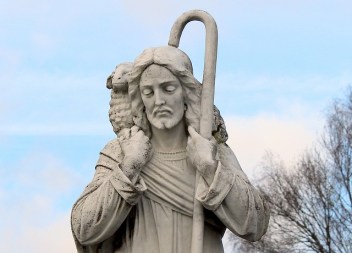 The answer can be read between the lines of our Lord’s question in today’s gospel: He doesn’t want any to be lost. He wants the shepherd to go out and find them. Even one.
 The answer to all of this is given by Jesus in the gospel and can be boiled down to one word – vigilance. If you sense that you are distracted in prayer, then let that become your prayer. Say, “Lord, see how weak I am. I can’t even focus on you now when I need you the most!” In your weakness Christ will be your strength. If you feel like God is far away, remember: God doesn’t move, we do. Weak faith causes us to drift. We strengthen it with exercise, so pray more, not less; attend Mass more often; see him in Adoration. If you find yourself putting off prayer, remember Christ’s words: At an hour you do not expect, the Son of Man will come (Luke 12:40). Also, remember his reaction to finding people not doing what he asked; it did not go well for them. Finally, when you’re discouraged remember Abraham and everything he went through. In faith he left his native land, wandered homeless, and nearly lost his only son. As if that wasn’t enough, he was never allowed to actually live in the land he was promised. Those are pretty good reasons to be discouraged! Still, no matter where he was, he always built an altar and sacrificed to God. He could lose his home, his son, and the land of his inheritance, but he never lost heart; he remained faithful, prayerful, and vigilant to the end. So can we.
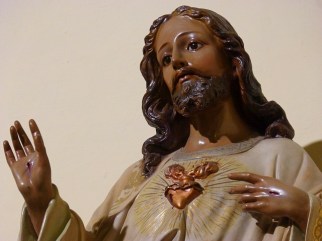 Jesus spent his life and ministry showing us what it means to love as God loves: He made himself vulnerable in the sight of others, exposed his deepest longings, deepest fears, deepest joys, his deepest self. Of course, he risked rejection and it cost him his life, but that is what love does; it was in the nature of his perfect divinity that from the depths of his infinite love and mercy, he glorified what mankind so quickly crucified.
 What is unique to Luke in the Transfiguration is the dimension of prayer. Only he tells us that Jesus ascended the mountain to pray. Luke properly understands it as a tale of two mountains: On the one, the unnamed mount of Transfiguration, the prayer of Jesus results in a glorious vision, he dazzling white, his face shining, his Father speaking to the apostles awakened. On the other, the mount of Gethsemane, the prayer of Jesus will end in the passion, his face sweating blood, his Father silent, and these same apostles sleeping. Luke is clear: We cannot have the glory of the Transfiguration without the suffering of the cross. In Christ, the two are inextricably bound. What’s more, this is the cost of discipleship; later in Luke Jesus will say, Whoever does not carry his own cross and come after me cannot be my disciple (Luke 14:27)
 Mark 10:45