Tag: faith

  • Open the Door

    Open the Door

    Isaiah 7:10-14; Psalm 24:7c, 10b; Matthew 1:18-24

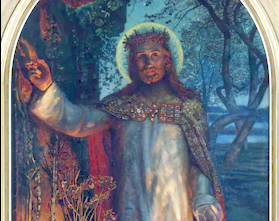
    You’ve probably seen the famous painting of Jesus standing on a porch, holding a lantern, and knocking on the door. The painting is called “The Light of the World,” and its artist, William Holman Hunt, embedded a few symbols into it, two of which are very appropriate for Advent.

    First is the door itself; it has no handle on the outside. Second is the bottom of the door; weeds are growing everywhere. What did Hunt intend with these symbols?

    The answer lies in the Psalm response chosen by the Church today: Let the Lord enter; he is the king of glory. The door opening only from the inside means that we have to let Jesus enter. He will not force his way in. The weeds symbolize a life where prayer has been crowded out. Again, if we don’t take the time to speak to Jesus, to ask him in, he will not enter.

    So, is there anything keeping me from opening the door and letting God more fully into my life? There are probably many things, but I can think of two.

    First, fear. Despite his outward appearance of piety (“I will not tempt God!”), King Ahaz was afraid. What did this arrogant young man have to fear? Loss of control. He couldn’t allow anyone, even God, to take control from him. But notice in the gospel how Joseph is just the opposite: He allowed God full control, to the point of listening to Him in dreams.

    Second, distraction. That was another problem with Ahaz. He was too occupied with himself and his kingdom to make time for God. Again, Joseph was the opposite; even in his dreams, he discerned and listened to God’s voice. In return, God made him the guardian of Jesus and his Most Blessed Mother.

    That brings us to ourselves. We might ask who we’re more like – Ahaz or Joseph – but perhaps we’re a little of both. Our “inner Ahaz” may fear giving God control. He might ask a lot of us, or lead us where we don’t want to go. Or we too may be distracted, our hearts so cluttered with other things that we aren’t really listening for God or speaking much with Him.

    Let us use these last days of Advent, when things can get so busy, to remind ourselves that God doesn’t need to take control. As Emmanuel, “God With Us,” He is already in control. Fear is useless; what is needed is faith. We need only be still, ask Him for the faith we need, then “open the door”: Pray, listen, and trust that He who is already near may truly be “with us” – in our homes and hearts, now and for all the days to come.

  • Front and Center

    Front and Center

    Feast of the Dedication of the Lateran Basilica in Rome

    Ezekiel 47:1-2, 8-9, 12; 1 Corinthians 3:9c-11, 16-17; John 2:13-22

    Today, we celebrate the Feast of the Dedication of the Lateran Basilica. My guess is that several of you have been to Rome and seen it firsthand. If so, you know how strikingly beautiful it is, how ancient, how rich in history. The first Catholic basilica and the cathedral of the Holy Father, we call it St. John Lateran, but its dedication 1700 years ago was neither to St. John the Baptist nor St. John the Evangelist; those came centuries later. The first dedication was to Christ the Savior, whose image stands front and center at the top of the basilica.

    That statue is much more than a mere adornment; it is a symbol that Christ is to be front and center of our worship. We see in the gospel that some in the Temple allowed themselves to focus on earthly concerns rather than the spiritual. Jesus knew that with that mindset, both the beauty of the Temple and, most importantly, what it pointed to – the presence of God – was lost to them.

    It’s no different for us. We have lives, and with them earthly concerns, but if we allow ourselves to be distracted by them, then we too have lost our focus.

    Keeping Christ front and center means giving him our total self. At Mass, we do that by placing everything – our prayers, works, joys, and sufferings – on the altar at the Offertory, and making them our sacrifice to the Father, united with the perfect sacrifice of His Son.

    Outside of Mass, keeping Christ central means remembering, as St. Paul said, that we are the Church to the outside world. What matters to them isn’t our buildings, statues, or rituals (important as they are), but whether our actions as Christ’s Body make the world a better place. And that’s why St. Paul next speaks of our call to be holy. We must continually strive to grow in holiness, every day and in every part of our life.

    Of course, that can only be done with God’s grace, symbolized in Ezekiel’s image of water flowing from the temple. While water has never flowed directly from the Temple Mount, the Gihon Spring (Jerusalem’s ancient source of fresh water) did flow near there and emptied into the Dead Sea. Using this imagery, God assures us that, if His grace was a little stream of water, it’s powerful enough to transform even the saltiest lake on Earth into fresh water! How consoling, especially when we feel powerless over our troubles. With God’s grace at work, we can face anything!

    The dedication of the Lateran basilica is a wonderful feast, but must start with the dedication of our own interior temple. Let zeal for the Father’s House move us to purify and re-dedicate ourselves as temples pleasing to the Lord, with Christ Jesus – our one and only foundation – front and center wherever we are and whatever we’re doing.

  • The Foundation of Faith

    The Foundation of Faith

    The 28th Sunday in Ordinary Time (C)

    2 Kings 5:14-17; 2 Timothy 2:8-13; Luke 17:11-19

    I don’t think the first thing most of us do when we receive bad news or suffer is stop and thank God for it. More likely, especially when the news or suffering is very bad, our reaction is one of fear, confusion, disbelief, even shock. Personally, I don’t recall ever saying, “I have a serious illness? Oh, thank God!” No, I’ve been much closer to the lepers in today’s gospel… begging for mercy.

    But recently, I learned that Pope Benedict XVI (retired and finally with time to spare) fell and broke his wrist, rendering him unable to finish a project he was working on. Speaking about it, Benedict said that when God lets us stumble, there’s a lesson in it, often involving humility and patience. Where I might’ve been angry, frustrated, or disappointed, the Holy Father sounded… grateful.

    Clearly, it was time for me to rethink my idea of gratitude.

    Today’s Scriptures reinforce that. For example, I can see why Naaman was grateful for being healed, but why cart two loads of dirt home from Israel? Then in the gospel, I can see why the leper returned to thank Jesus, even to falling at his feet, but why did Jesus respond as he did?

    Both examples teach us something vital: The gratitude God is looking for isn’t the passing pleasantry of a favor done for us, or even the deeper thankfulness we feel when He answers a prayer the way we want. Rather, gratitude is a way of life, of seeing God at all times as the source of everything we need, and of being thankful for his kindness and faithfulness no matter what life has in store for us. This is the gratitude that transforms us and is the foundation of our salvation.

    Again, look at the readings. Because the ancients believed that a peoples’ god was tied to their land, Naaman brought the dirt home to show the world that the Hebrew God was his God, too. Healing transformed his faith. As if to underscore that, note what Jesus says to the leper: your faith has saved you (Luke 17:19). Where once there was a leper – a Samaritan at that – through gratitude there was now a man not only healed, but saved.

    Gratitude and faith are intertwined. One opens onto the other. Gratitude is the recognition of grace, and faith is the trust that grace is always there. That is why in our second reading, St. Paul could rejoice in chains, and why the Catechism says that “Every joy and suffering, every event and need can become the matter for thanksgiving” (CCC #2638).

    Every joy. Every suffering. Everything. That should have particular impact on us at Mass, for nowhere do we give greater thanksgiving than in the Eucharist itself, whose very name means “thanksgiving.”

    So, when you come to receive Christ today, whether in the Eucharist or spiritual communion, bring every joy, every suffering, and, like the one leper who returned, give thanks. For gratitude is not merely the doorway to salvation; it is the foundation upon which salvation is built.

  • If You Will, You Can Make Me Clean

    If You Will, You Can Make Me Clean

    As I lie on these hospital tables, beds, and gurneys – shuffled from one test or procedure to another – one Scripture verse keeps echoing through my mind: If you will, you can make me clean (Mark 1:40).

    A leper, suffering and solitary, kneels before Jesus and makes this plea. How he came to believe in Jesus, we don’t know. But I do know the desperation behind those words. I feel it.

    I have excellent, highly trained specialists working on my case. I trust them completely. But as each one would admit, they can’t simply will away the disease that is slowly trying to kill me.

    These men and women give me hope. But none of them are Hope. Only the man standing before the leper is that.

    And of course, Christ is willing. The leper is healed.

    That’s where I want to be, too. Everyone facing illness or trauma wants that healing. It’s easy to get frustrated and cry out:“He can do it! Why hasn’t He healed me? So many are praying! Lord, please will that I be healed! Please…”

    Silence.

    But not inaction.

    What do I mean? Well, look at what Mark says happened next: After Jesus cured the man, the leper went out and told everyone what had happened, while Jesus remained outside, in deserted places (Mark 1:45).

    In other words, Jesus traded places with him.

    So what am I saying – that Jesus has traded places with me? In a very real way, yes.

    In His divine nature, Jesus can only love infinitely. And that love was most fully expressed in His suffering and death on the cross. As He said, “There is no greater love than to lay down one’s life for a friend” (John 15:13). And by His wounds, says Isaiah, we are healed (Isaiah 53:5).

    Love is healing, and there is no love without suffering.

    As I have lain here, I’ve realized something: I’m glad I have this cancer instead of my wife, my children, my siblings, or anyone else. I don’t mean that in a self-congratulatory way, I just mean that this suffering is shaping me. It’s making me a better man, in the sense of showing me even more clearly the vital importance of love in action. Love has to drive everything I do: every conversation, every act, every moment… joyful or painful.

    That’s how Christ lived, and how he calls me to live, too; not just in the good times, but also in the worst – to the cross and beyond.

    And that’s why Christ is my true Hope. Not because I expect him to will away my disease with a word (though of course he could), but because, out of love, he already healed the deeper, spiritual disease: sin and eternal separation from him.

    He asks me to unite myself to the Father’s will just as he did, and to trust that I’m not forgotten any more than he was. He took upon himself the leprosy of sin and went into the wilderness of suffering in my place so that I can proclaim, even where I am now, the love that is stronger than death (Song of Songs 8:6).

    Will my cancer be healed? I don’t know. Maybe God will heal me through the people at this hospital. Maybe He’ll heal it directly. Maybe He won’t heal it at all.

    But, no matter what, He loves me. He has taken my place. And in doing so, He has already made me clean in the only way that truly matters.

  • Let Your “Yes” Mean Yes

    Let Your “Yes” Mean Yes

    Saturday of the 10th Week in Ordinary Time

    2 Corinthians 5:14-21; Psalm 103:1-4, 9-12; Matthew 5:33-37

    Psychologists and those who study social media behavior have found that people tend to form groups and make friends with others who share their interests or beliefs. On platforms like Facebook or Instagram, these “echo chambers” reinforce shared views—people like and share what “fits,” and ignore what doesn’t.

    Dig a little deeper, and something more emerges. When posting within these like-minded groups, people tend to tailor their words to what they think the group will approve of. That is, they don’t always say what they really believe—they say what they think will be popular.

    Why? Because we all want to belong, we all want to be liked. Unfortunately, some people want it so badly they will sacrifice their honesty to get it.

    But imagine Jesus with a social media account. Do you think for one second that he would trade honesty for popularity?

    Of course not. He says so plainly in today’s Gospel: “Let your ‘Yes’ mean ‘Yes,’ and your ‘No’ mean ‘No.’ Anything more is from the Evil One” (Matthew 5:37).

    Truth matters. Integrity matters. It’s not just about the words—it’s about being consistent, undivided, and unafraid.

    It’s also about how those words are said, and to whom. In 2 Corinthians, St. Paul reminded us that we are a new creation, entrusted with the message of reconciliation. That doesn’t mean shouting or condemning, but being honest, courageous, and above all, merciful – in imitation of our Lord, who, as the psalmist said, is kind and merciful.

    At the same time, neither kindness nor mercy mean compromise. The same God who is kind and merciful is also true. So are we called to be – clear, compassionate, and rooted in something much deeper than popularity.

    God doesn’t need people trying to fit in. He needs ambassadors; people who live with integrity, speak truthfully, and reflect His mercy with courage and love. So let us resolve to do that, keeping in mind that, long after social media and all its groups, politics, and ephemera are gone, the only ‘like’ that will matter is the one that comes from Christ—on the post of our life.

  • The Swing of Things

    The Swing of Things

    Thursday of the 7th Week of Easter

    Acts 22:30; 23:6-11; John 17:20-26

    In mid-August of 1936 at the Berlin Olympic Games, the rowing crew from the United States, a team of 8 working-class boys, raced against the best teams from around the world – including the highly favored Nazi team – and took home the gold medal. But even beyond that, the American team at times experienced something rarer still, something very hard to achieve. It’s called, “swing.”

    In rowing, the boat itself can work against its crew. If even one oarsman is slightly out of sync with the others, the boat pulls to one side and resists moving straight ahead. Only when the team work as one does that resistance ease – or, if their unison is perfect, vanish – in which case it feels as if the boat is gliding on its own. That’s swing, and every now and then, that team of American rowers felt it. Rowing in perfect unity, it would seem as if the boat was sailing through the water all on its own.

    That’s the unity Christ wants to see in his Church, the spiritual unity where every member of the Body moves in time with the Holy Spirit. Of course, he didn’t pray and work for that so we could win medals, but that we might be brought to perfection as one (John 17:23).

    Like swing, that’s hard to achieve. Why? Because pride is like the boat when the crew is out of sync – resisting, dragging, veering us off course. We’re all given gifts of the Spirit, and we want to use them to their fullest. The problem is that pride tempts us to use them in ways that glorify ourselves. Too often, that ends badly. That’s what we see with the Sanhedrin in this story from Acts. The issue really wasn’t that they were in conflict with each other; creative, spirit-filled people will disagree. No, the real issue was division. God had given them gifts more than sufficient to achieve unity – if their pride would allow them. Unfortunately, it didn’t. The result? A war of words, perpetual division, and no peace.

    I think that’s why Holy Father Leo recently said something that strongly echoes a theme in our gospel: ‘Peace is possible when disagreements and the conflicts they entail are not set aside, but acknowledged, understood, and surmounted.’ Like a great rowing crew, each of whom has their own strengths, every person in the Church is gifted by God but also called by Him to subordinate our desire to dominate and use our gifts not for dominance but for the common good.

    What the Sanhedrin failed to achieve is still possible for us – if we will it; if we, like that champion rowing team, choose to surrender to a shared rhythm, trust one another, and keep our eyes fixed on the same goal. Remember that Jesus prayed “that they may all be one.” That unity will come only when we surrender our pride, fear, and agenda, so that the Church may glide, not by her own strength, but by the grace of God.

  • Together

    Together

    Wednesday of the 5th Week of Easter

    Acts 15:1-6; John 15:1-8

    Talking once to a friend about the Church and his willingness to come into it, I remember him replying, “I don’t need a ‘Church.’ All I need is Jesus and a bible.”

    On one level, I understand what he meant. He was looking for a personal relationship with Christ, and we all want that. However, on another level, and especially in light of today’s readings, I have to ask myself, “Is that really what Jesus had in mind?”

    As I look at the bible, I don’t think so.

    While he did call the Apostles individually, Jesus formed them as a group. They were taught together, rebuked together, and sent out together. This wasn’t just Jesus’ method — it reflected a deeper, communal vision embedded in their Jewish heritage. As Jews, God called them to be His people (Genesis 17:7-8). Even their religious leaders worked as a group.

    So, in times of crisis, it shouldn’t be surprising that, as we see in Acts today, the Apostles didn’t go off alone to pray and decide individually. Rather, they met in Jerusalem. They listened. They discerned. They argued. But they did it together.

    The same is true for us. Christ calls each of us individually, but he forms and guides us through his Mystical Body, the Church. The Holy Spirit comes to us individually, too, but as we see in the Apostles at Pentecost, He also works powerfully in and through the community.

    Thus, being a Christian isn’t simply a matter of striking out on our own. We are called to marriage, vocation, and prayer, but each of these is nourished like branches within a community of faith, where Christ is the Vine. And as branches, we do not grow in isolation. Like the Apostles, we are meant to stay connected – to Christ and to one another. That’s how we bear fruit.

    That’s also how we make big decisions. Since the Apostles, there have been hundreds of local councils and twenty-one ecumenical (world-wide) councils — including the Second Vatican Council in our own time. Molded by Christ, we never go it alone; we bring issues before the Body, before the Lord. We listen, discern, and even argue, but we do it together.

    So, yes, a Bible and prayer life are essential. But they aren’t enough. Why? Because Christ didn’t leave us a bible. He left us the Church. And it’s in that Body, guided by the Holy Spirit, that we always have – and will always continue to – find truth, strength, and fruitfulness.

  • Who’s Writing the Script?

    Who’s Writing the Script?

    Monday of the 4th Week of Easter

    Acts 11:1–18, Psalm 42/43; John 10:1–10.

    If you’ve ever seen the late Robin Williams in an interview or movie, you know how good he was at taking a simple “Yes” or “No” and exploding it into a five-minute burst of voices, stories, and laughter. For him, it was as if there was no script; he followed the spark, and suddenly there was life and possibilities that no one had seen before.

    This is especially true in his role as the Genie in Aladdin. The writers didn’t bother to give Williams a script. Instead, they gave him the framework and allowed him to improvise. The result? Where about an hour of dialog might’ve been expected, he gave them sixteen! Overjoyed and inspired, the writers and animators built the movie around it. What might have seemed like chaos was pure creativity, full of life.

    That’s exactly what today’s readings reveal about God.

    In Acts, Peter has seemingly failed to “stick with the script” by going to Gentiles. But, in his role as shepherd, Peter allows God to write the script, and God is making it clear that the Holy Spirit will come down on Gentiles just like He did the Apostles. Wisely, Peter then speaks the line we all need to hear: “Who was I to hinder God?”

    Behind Peter’s challenge is the voice of Christ in the Gospel, who refers to himself as “the gate.” That is all the framework we need; He is not a wall, checkpoint, or entrance for a select few. He is the way in for all, and all who enter through him receive not just life, but abundant life.

    Thus, the readings remind us that God isn’t bound by our scripts. Rather, he is completely free; He pours mercy where we don’t expect it and calls people we might never choose. Like the wind that blows where it wills (John 3:8), the Holy Spirit moves in ways we don’t always understand, but always with purpose. And, just like with Robin Williams in Aladdin, when God starts moving, our best response is to listen and try our hardest to do His will. No matter how difficult, no matter how unexpected.

    Of course, that’s challenging. Think of the three martyrs we remember today. The first two, Achilleus and Nereus, understood their role as soldiers very well. However, when they encountered Christ, it became clear to them that although Caesar had cast them in one role, God had chosen another. They listened, laid down their swords, and eventually, their lives. The third was just a boy, 14 years old. Called before the Roman authorities, young Pancras was pressured to deny Christ. At an age when most people expect the script to be a happy, full life, Pancras allowed God to give him his lines, even if that meant death, which it did. He was martyred alongside Nereus and Achilleus.

    Together, these and all the saints remind us of two things. First, God calls whom He wills. Age doesn’t matter. Status doesn’t matter. What matters is willingness. Second, they allowed God to re-write the story of their lives, even if it cost everything.

    So, what about us? Today, let’s ask ourselves: Do I try to keep God inside my comfort zone? Do I write the part I want Him to play? Or am I ready to be surprised by mercy, and willing to do whatever He asks?

    Peter’s question is our question. Who are we to hinder God? Let’s let Him speak, even if we think it’s off-script. Because His script is written to bring us exactly what Christ said in the gospel: Life – life to the full.

  • Three Roads, One Pattern

    Three Roads, One Pattern

    Thursday of the 3rd Week of Easter

    Acts 8:26-40; Psalm 66:16; John 6:44-51

    Today’s reading from Acts may seem like a beautiful but isolated story – Philip and the Ethiopian riding through the desert – but it is, in fact, just one of three “road encounters” given to us by St. Luke, each a powerful snapshot of how God works through the sacraments. All three stories follow the same pattern:

    1. God initiates an encounter with someone;
    2. He brings the Church in to help; and
    3. The person being helped receives grace that changes them forever.

    The first time Luke gave us this pattern was in his story of the disciples on the road to Emmaus. Remember? Christ approaches two discouraged disciples who fail to recognize him. He opens the Scriptures for them, then breaks bread (gives them the Eucharist), and vanishes. Eyes opened and hearts on fire, the pair joyfully rush back to the Apostles as witnesses. Today, God sends Philip, who breaks open the Word for the Ethiopian, baptizes him, and vanishes. Afterward, the man goes on his way, rejoicing. Finally, on the road to Damascus, Saul has a mystical encounter with Christ, who cannot be seen. Later, Ananias anoints him and his eyes are opened. Saul takes his Roman name, Paul, and as we all know goes on to spend his life changing the landscape of Christianity forever.

    This is how Luke shows us the power of the Sacraments: God initiates, the Church mediates, and the person is changed forever. In all seven the pattern is the same: First, God calls us. We may think it’s our idea to be baptized, anointed, forgiven, or given the Eucharist, but it is God who calls us. He always initiates; for, as Jesus says in today’s gospel, No one can come to me unless the Father draws him. Next, we gather; Scriptures are read, and our eyes are opened to better understand its meaning and application to our lives. Then, the sacrament is received. The best example is right here, at the Eucharist, where we receive Christ himself; as he says, the bread that I will give you is my Flesh for the life of the world. Finally, we hear – Go forth. That is, we are sent out, as the two disciples at Emmaus, the Ethiopian, and St. Paul, to witness, rejoice, and change the world – each in our own way. For, as the psalmist sang, “He has given life to our souls… Hear now, all you who fear God, while I declare what he has done for me.”

    That is the voice of someone who has been changed, and cannot help but witness. And that is the effect of the Sacraments given us by Christ, who continues to meet us on the roads of our lives. He has drawn us here, feeds our minds and hearts with his Word, our souls with his Body, and sends us from here to change the world. Every time we receive a Sacrament, let us keep in mind: this is no mere routine – this is an encounter. Christ meets us here; Christ touches us here. And we will never be the same.

  • Seeking the Face of God

    Seeking the Face of God

    Feast of Sts. Philip and James

    1 Corinthians 15:1–8; John 14:6–14

    When Philip says, “Lord, show us the Father, and that will be enough for us,” it might sound as if Jesus was disappointed in him. “Have I been with you for so long a time and you still do not know me, Philip?”

    But over time, I’ve come to hear something different in that response — not rebuke, but compassion. Not frustration, but invitation.

    After all, when Jesus was a boy and Mary found him in the Temple, he asked her, “Did you not know that I must be in my Father’s house?” (Luke 2:49). Surely Jesus wasn’t disappointed in his mother. He knew that even she — Full of Grace — would need to ponder these things in her heart, to grow in her understanding of the divine mysteries. If the Blessed Mother had to wrestle with them, why wouldn’t Philip?

    So no, I don’t believe Jesus was scolding Philip. I believe he saw in his question not failure, but hunger: a longing to know God more deeply, to see Him more clearly.

    In that way, Philip stands for all of us. Don’t we all long to understand the faith better? Don’t we all wish God would just show Himself, and end the doubt, confusion, and struggle?

    But He doesn’t. Not all at once. Maybe that’s because the work of faith — the growth, the struggle, the contemplation — is part of the gift.

    So today, as we celebrate Saints Philip and James, Jesus teaches us two important lessons through Philip’s honest question.

    The first lesson is that God can be right in front of us — and we might not see Him. Again, consider Philip. He spent years walking with Jesus. He saw him heal the sick, feed multitudes, even raise the dead. Still, he didn’t understand that to see Jesus was to see the Father — to see the fullness of God’s love.

    That isn’t just Philip’s problem, it’s ours too. We may not walk with Christ on the roads as the Apostles did, but we have our own sacred encounters.

    • Do we recognize him in the Eucharist — truly present, Body and Blood, Soul and Divinity — or do we doubt?
    • Do we see his face in the people around us — especially those who are suffering, neglected, or difficult to love – or just inconvenience?
    • Do we trust that God truly hears and responds to our prayers, even when He seems silent? Or do we take silence as God’s refusal to answer?

    Jesus is always closer than we think. If we miss Him, it isn’t because He’s not there. It’s because we haven’t yet trained our hearts to see.

    The second lesson is that what we learn about Christ isn’t just for us — it’s meant to be shared. Notice that Jesus doesn’t end the conversation with Philip. He moves it forward by saying, “Whoever believes in me will do the works that I do — and will do greater ones than these.” Greater than healing the sick or feeding thousands? Yes! Because our Lord’s earthly ministry was never meant to end. It was meant to multiply — through the Church, through the apostles, through us.

    That’s exactly what Philip and James did. They didn’t understand everything perfectly, but they believed. They went out. They preached, taught, healed, and led the early Church. Ultimately, they gave their lives for Christ.

    What does this mean for us? At least three things:

    1. We don’t need to be perfect to be disciples. We need only be willing to keep trying.
    2. We don’t need to understand every mystery of the faith to be faithful. We need to keep learning — and keep growing in trust.
    3. We don’t need to have all the answers before we begin sharing the Gospel. We need to believe that God will give us the grace we need to be His witnesses — in word and deed — so that others may see Him in us.

    Today and every day, let us ask Christ for eyes of faith to see him in the Eucharist, in each other, in the Scriptures, and in the silence of prayer. Let us ask, too, for the courage of Philip and James; to take what we’ve seen and heard and carry it boldly into a world longing for the love of Christ. And like them — like all the saints — may we be faithful witnesses to every person God puts in our path. And may we never stop seeking the face of God — in Christ, in each other, and in everyone.