Tag: Eucharist

  • No Mistaking the Road

    No Mistaking the Road

    Wednesday in the Octave of Easter

    Luke 24:13-35

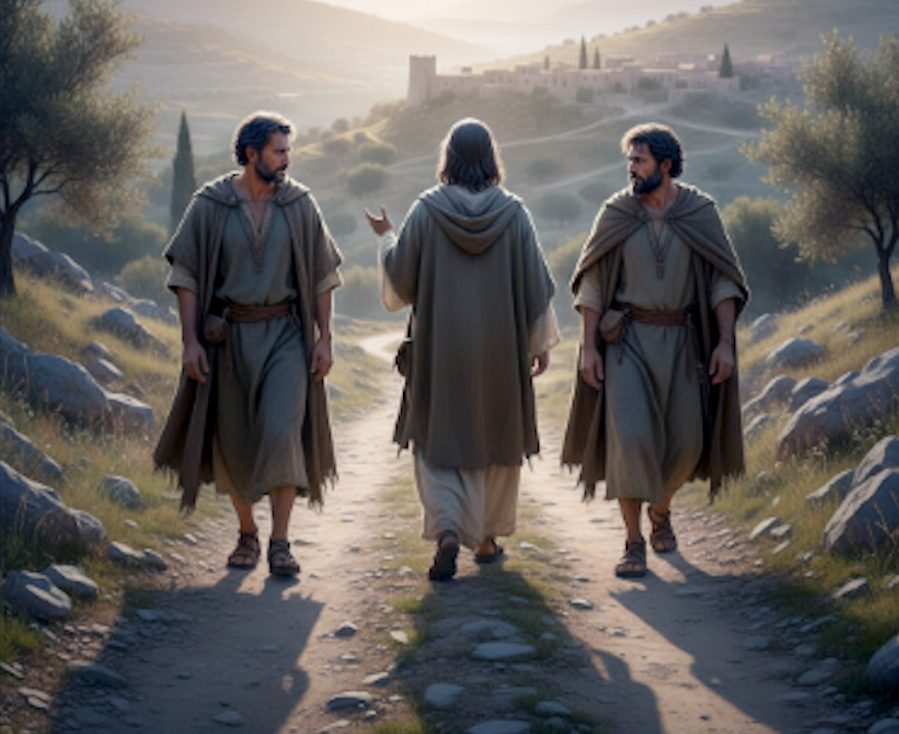
    Perhaps you noticed something kind of puzzling in the gospel story we just heard. As Jesus meets the two disciples walking toward Emmaus, we hear that “their eyes were prevented from recognizing” him. Then later, as they head back to Jerusalem, they say, “Were not our hearts burning within us while he spoke to us on the way?”

    So, if their hearts were burning while Jesus spoke, what kept them from recognizing him?

    While there could be many reasons, let me give you mine. It came to me when filling in for Father Chris a couple of weeks ago in his lecture series on prayer.

    While researching that topic, I learned that St. Thérèse of Lisieux once said to novices, “I see clearly that you are mistaking the road, and that you will never arrive at the end of your journey. You want to climb the mountain, whereas God wishes you to descend it. He is awaiting you in the fruitful valley of humility.”

    So, what prevented them from seeing him? They did—because they had already decided what Jesus was supposed to be, and where he was supposed to be found.

    How do I know? They themselves tell us. Listen to their language. Jesus ‘was’ a prophet. We ‘were hoping’ he was the one. Their hope is already in the past. And even though “some women” reported that Jesus was alive again, and the Apostles saw the empty tomb, these two end with, “but him they did not see.” You can almost hear the confusion, disillusionment – and maybe even grief – in their voices.

    These are the eyes that cannot recognize Jesus; eyes that envision him waiting for them in some mountaintop, mystical experience where there are no problems, no questions, no fears, no doubts.

    But, borrowing from St. Thérèse, they were trying to climb a mountain where God had not asked them to go. And as St. Thérèse reminds us, he was waiting for them—not at the top—but in the valley… on the road… exactly where they were. That’s where Jesus is. And that’s where he meets all of us. Right here, where we are. We might be fooled into thinking he’s nearest to us in our mountaintop experiences. We feel so close to him then! Of course, he is “up there,” but as today’s gospel makes clear, he’s also “down here” when we’re at our weakest – when we question, fear, doubt, or hurt.

    And he’s not just near. He is speaking. We don’t hear him saying things like, “Look, here I am,” but he is there. First, he listens as we talk about what we’re thinking and feeling. Then he speaks. How do we know his voice? As the saints have said over the centuries, God’s voice sounds like a quiet invitation:

    • Not “figure everything out,” but “stay with me.”
    • Not “You are failing,” but “You are mine.”
    • Not “Fix this now,” but “Let’s take the next step. I am here with you.”

    From this perspective, it’s not at all surprising that Jesus asked them questions and let them speak first, or that he used Scripture to help them see that he was there. Christ would not always be walking on the road to Emmaus with them, but he would always be there in the word, giving light to their darkness. And, as he showed later that evening, he would always be with them in the Blessed Sacrament, feeding them with the greatest gift he could give – himself.

    Among all its other virtues, this beautiful story reminds us that Christ never waits until our problems are sorted out, after we repent, or after we get the theology right. No. He meets us now, right where we are – on the road, with all its confusion, problems, or disillusionment.

    So the next time you find yourself confused, discouraged, or wondering where God is, don’t look somewhere else. Look at the road you’re on. Because that’s exactly where he will meet you.

  • What Heaven Notices

    What Heaven Notices

    Wednesday of the 2nd Week of Lent

    Matthew 20:17–28

    Someone once told the famous evangelist Billy Graham that God would surely reward him for his greatness as a preacher. Graham replied that he once dreamed about that.

    In his dream, he died and went to heaven. As he entered, Peter ushered him toward the heavenly throne. Once there, the Lord said, “Everyone, the great preacher, Billy Graham, is now here with us.”

    After a long, mystified silence, an angel asked, “Who, Lord?” Smiling, God said, “Oh, I’m sorry. You know him as Ruth Graham’s husband.”

    And when they heard that, all of Heaven cheered.

    While it’s a charming story, it makes a serious point. When we think of greatness, what do we think of? Being above others? Higher up? Recognized? Applauded?

    That seems to be what James and John had in mind in today’s Gospel. They wanted the seats of honor, one at our Lord’s right, one at His left, when He comes into His kingdom. But notice the timing; they ask this just after Jesus told them for a third time He’s going to Jerusalem to suffer and die. His emphasis is the cross; theirs is thrones.

    But notice, too, that Jesus doesn’t scold their desire for greatness. Instead, he redefines it: “… the rulers of the Gentiles lord it over them… it shall not be so among you.” In other words, greatness in the Kingdom of Heaven isn’t found in being above others, but in reaching toward them. Not in climbing higher, but in bending lower. Not in being served, but in serving.

    Then we hear the decisive words: “The Son of Man did not come to be served but to serve, and to give His life as a ransom for many.” Jesus hasn’t just redefined greatness, he has embodied it.

    This is what Jesus asked of James and John, all of his Apostles, and everyone who calls themselves Christian.

    Billy Graham understood that. He didn’t want to be remembered for eloquence or influence. He wanted to be remembered for love. Because in the end, titles fade. Recognition fades. Even the memory of accomplishments fades. Only love remains.

    Of course, the desire for greatness isn’t wrong. God placed it in us. As Holy Father Benedict XVI said, we weren’t made for comfort, we were made for greatness. But Lent teaches us that greatness is found in the narrow road of self-gift and service. We are asked to fast, pray, and give alms, not to be impressive but to be free – free to serve as Christ served.

    Actually, as he still serves. For Christ serves us today, as he has every day for centuries, in the holy Eucharist. The One who is truly seated at the right hand of God the Father comes to us again; not to be admired from a distance, but to serve us with His very Body and Blood.

    Then he sends us out to do the same.

    So today the question isn’t: “How can I be recognized,” but “whom can I serve in a way that no one will notice?”

    That is greatness in the Kingdom. And that’s what Heaven notices.


  • Three Roads, One Pattern

    Three Roads, One Pattern

    Thursday of the 3rd Week of Easter

    Acts 8:26-40; Psalm 66:16; John 6:44-51

    Today’s reading from Acts may seem like a beautiful but isolated story – Philip and the Ethiopian riding through the desert – but it is, in fact, just one of three “road encounters” given to us by St. Luke, each a powerful snapshot of how God works through the sacraments. All three stories follow the same pattern:

    1. God initiates an encounter with someone;
    2. He brings the Church in to help; and
    3. The person being helped receives grace that changes them forever.

    The first time Luke gave us this pattern was in his story of the disciples on the road to Emmaus. Remember? Christ approaches two discouraged disciples who fail to recognize him. He opens the Scriptures for them, then breaks bread (gives them the Eucharist), and vanishes. Eyes opened and hearts on fire, the pair joyfully rush back to the Apostles as witnesses. Today, God sends Philip, who breaks open the Word for the Ethiopian, baptizes him, and vanishes. Afterward, the man goes on his way, rejoicing. Finally, on the road to Damascus, Saul has a mystical encounter with Christ, who cannot be seen. Later, Ananias anoints him and his eyes are opened. Saul takes his Roman name, Paul, and as we all know goes on to spend his life changing the landscape of Christianity forever.

    This is how Luke shows us the power of the Sacraments: God initiates, the Church mediates, and the person is changed forever. In all seven the pattern is the same: First, God calls us. We may think it’s our idea to be baptized, anointed, forgiven, or given the Eucharist, but it is God who calls us. He always initiates; for, as Jesus says in today’s gospel, No one can come to me unless the Father draws him. Next, we gather; Scriptures are read, and our eyes are opened to better understand its meaning and application to our lives. Then, the sacrament is received. The best example is right here, at the Eucharist, where we receive Christ himself; as he says, the bread that I will give you is my Flesh for the life of the world. Finally, we hear – Go forth. That is, we are sent out, as the two disciples at Emmaus, the Ethiopian, and St. Paul, to witness, rejoice, and change the world – each in our own way. For, as the psalmist sang, “He has given life to our souls… Hear now, all you who fear God, while I declare what he has done for me.”

    That is the voice of someone who has been changed, and cannot help but witness. And that is the effect of the Sacraments given us by Christ, who continues to meet us on the roads of our lives. He has drawn us here, feeds our minds and hearts with his Word, our souls with his Body, and sends us from here to change the world. Every time we receive a Sacrament, let us keep in mind: this is no mere routine – this is an encounter. Christ meets us here; Christ touches us here. And we will never be the same.

  • The Lesson of the Right Tree

    The Lesson of the Right Tree

    Wednesday of the 5th Week in Ordinary Time

    Genesis 2:4b-9, 15-17; Mark 7:14-23

    Throughout the bible, certain phrases appear in pairs, one at the beginning and the other at the end of a section. Think of these phrases as bookends, and what appears in-between as an explanation of their meaning. Sometimes, the bookends appear close together, for example in the same biblical story, other times further apart, like the beginning and end of a book.

    Today we hear the first of two bookends that are separated by virtually the entire bible. We heard it when the author of the second Creation story spoke of the tree of life in the middle of the garden. The other bookend will not appear until the very last book of the bible, Revelation, whose author says, To the victor I will give the right to eat from the tree of life that is in the garden of God (Revelation 2:7).

    Seeing these two instances as bookends allows us to see the story of the bible in terms of the tree of life. It’s ironic that the other tree in the middle of the garden, the tree of the knowledge of good and evil, gets so much attention; then again, we humans often focus on where we’ve gone wrong, and how we got where we are. While there’s good reason for that, today is a day to focus on what has gone right, and how to get where we’re going.

    The reason for that positive outlook lies in today’s saint. She was a very positive person; her joy was infectious, and her perspective inspires people like me to this day. I’d like to call her by name, but we don’t know it. As a child in Sudan, she once did, but that was before slavery, which was so physically traumatic that she forgot her own name. In time, one of her masters nicknamed her “Bakhita,” Arabic for lucky.

    Bakhita was not raised a Christian, but the Spirit was quietly active in her life. While still a young woman and serving as nanny to a little girl, she was sent to a convent with the child. There, the sisters introduced her to Christ, and she fell so completely in love with him that she vowed never to love another. Once freed from slavery, she kept that vow; she became a Catholic, took the name Josephine, and served our Lord faithfully and joyfully as a Canossian sister until her death 42 years later.

    What should draw us to St. Josephine Bakhita isn’t the sympathy she so deserves; it is her unshakable, unwavering refusal to take her eyes off Jesus Christ, whom she rightly recognized as the Tree of Life. The superabundant graces he poured upon her were more transforming than any of the harsh treatment she endured; so powerful were they that she went to her grave thanking those who treated her so badly. As she said, she never would have met the true love of her life had she not trod the road, and endured the cross, that she did.

    The truth of Scripture from the perspective of this great saint is inescapable. All the evils Christ spoke of: theft, greed, malice, deceit, licentiousness, arrogance, folly – the ones suffered by Bakhita – spring not only from the hearts of slave traders and masters, but from our own hearts as well. And, although the bible wisely spends a lot of time on the lessons we can learn from our fascination with the wrong tree, the most powerful truth of all is found in the lesson of the right tree – the bookend from Revelation: To the victor I will give the right to eat from the tree of life that is in the garden of God. Who is the victor? We are; all of those who, like St. Josephine Bakhita, understand that Jesus Christ, the Tree of Life from whom we are invited to eat, is not only the center of the bible, but the center of our lives as well.

    St. Josephine Bakhita, pray for us.