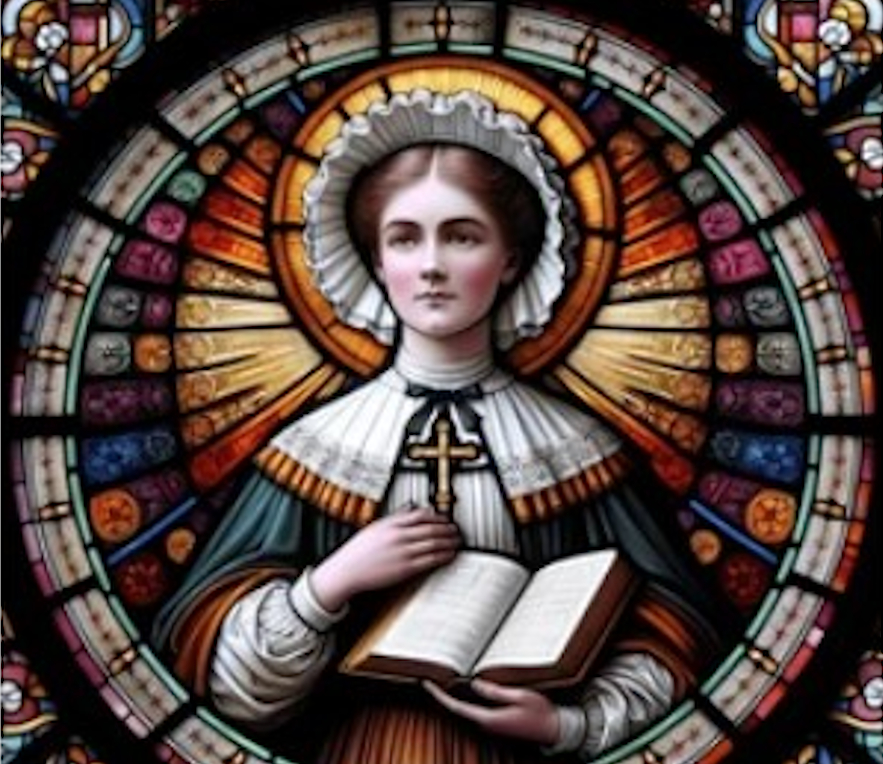
Memorial of St. Elizabeth Ann Seton
John 1:35-42
Today’s gospel is the same one chosen to formally welcome those who wish to become full members of the Church, or seek a deeper understanding of it. We can see why; two disciples follow Christ, spend time with him, and are so affected by that encounter that they in turn become evangelizers and bring people to Christ. It’s also the perfect gospel to consider our saint of the day, Elizabeth Ann Seton; her life as an American, a woman, and a Catholic, shines a light on this story that helps us better understand the depth and complexity of the call of Christ, its cost, and its rewards.
Born in New York City in 1774 into a wealthy Episcopalian family, Elizabeth was intelligent, devout, and beautiful; a prize for any young man of her time. In 1793, she wed a handsome young businessman, William Magee Seton, and in nine years was the mother of 5 children. Although she also had to care for William’s siblings, whose parents had both died, Elizabeth was a busy but happy homemaker.
Unfortunately, disaster soon struck. William’s business began to fail, and, even worse, so did his health. Hoping warmer weather would help his tuberculosis, the Setons and their eldest daughter sailed to Northern Italy to stay with William’s business friends, the Filicchi family. This didn’t work. William died in December of 1803, leaving Elizabeth a widow with 5 young children and a failed business.
This would hardly be the time we’d expect Christ to turn and say, “Come, and you will see,” but that’s exactly what happened. While caring for Elizabeth and her daughter, the Filicchis went about their lives, which included Catholicism. They never pressured Elizabeth, but did invite her to join them. Having been warned earlier about the dangers of the “smells and bells of Catholicism” by her spiritual director, Elizabeth observed guardedly at first. However, as time passed and she began to see the rhythm of devout Catholic life – including daily Mass, Eucharistic Adoration, and devotion to the Blessed Mother – she felt Christ calling her in a way she never had before. Coming across a copy of the Memorare, she was so moved by it that it became one of her favorite prayers. Finally, watching a procession on Corpus Christi, Elizabeth found herself on her knees with the Catholics as the Eucharist passed by. In her mind, she heard an Anglican pastor snickering: ‘Elizabeth, these silly peasants believe that piece of bread is really and truly Jesus Christ.’ Deep inside, she replied, ‘So do I.’
When she returned to America, she was Anglican on the outside, but Catholic on the inside. Knowing it would cost her dearly to convert, she struggled with the decision, but finally, two years later, became a Catholic, taking Mary as her Confirmation name in honor of the Blessed Mother.
Elizabeth was right; conversion made a hard life even harder. Her family and William’s shunned her, and the boarding house she had opened was lost when people found out she was Catholic. But, filled with the zeal those first disciples felt after staying with Christ, nothing could stop her. She moved her family to the one Catholic Diocese in the country, Baltimore, and opened a school for girls. Soon, Catholic women from around the country joined her. Over time, they formed a convent and Elizabeth founded the Sisters of Charity of St. Joseph, the first female religious order in America. Their mission was to teach girls, especially those who could not afford an education. Elizabeth was named first superior and given the title “Mother.” In 1813, she and 18 other sisters took vows of poverty, chastity, obedience, and service to the poor and in 1814, accepted their first mission, an orphanage in Philadelphia. By 1817, the sisters were working in New York.
Sadly, even this success was tinged with sorrow. Two of Mother Seton’s daughters died from tuberculosis, and a short time later, Mother herself suffered from ill health. She died January 4, 1821, just 46 years old. Nevertheless, her legacy lives on. Elizabeth Ann Seton was beatified in 1959 and canonized in 1975, the first native-born American saint. Not only that, she is patron saint of Catholic schools, educators, teachers, people who have lost parents, people who have lost children, people who have been rejected for their faith, people with in-law problems, and all who travel at sea.
The life of Mother Seton teaches us that it isn’t what happens to us but our response that matters. It’s easy to have faith when things are going well, but what about when they aren’t? Didn’t Elizabeth wonder where God was when her husband died, his business failed, her family shunned her, the boarding house closed, and her children died? Perhaps. Still, look how she responded. She may have gotten down, but she didn’t stay down; she got up, got busy, and found ways to serve. It is the same for us. When Christ calls us to come and see, he makes no guarantee that the road will be easy and there will be no suffering. Rather, he asks us to follow him whatever the road; not to run from suffering but to walk through it with him; to risk everything for love of Him. It is a tall order, but as St. Elizabeth Ann Seton showed so well, and as St. Teresa of Avila reminded us, those who risk everything for love of God will find that they have both lost everything and gained everything.
St. Elizabeth Ann Seton, pray for us.
—
 Mark 10:45