Tag: Discipleship

  • Overcoming Familiarity

    Overcoming Familiarity

    Wednesday of the 4th Week in Ordinary Time

    Mark 6:1-6

    When Abraham Lincoln first met Frederick Douglass, he didn’t think much of him. He certainly didn’t regard him as an equal; to the contrary, he believed that Douglass had nothing to teach him. But over time and repeated meetings, Lincoln came to see that Douglass, while not educated the way he was, possessed a moral clarity and insight on the issue of slavery that he himself lacked. He came to depend on Douglass for advice. At Lincoln’s second inauguration, when policemen barred Douglass from coming near, Lincoln insisted that he stay. In fact, he took Douglass by the hand and said, “There is no man in the country whose opinion I value more than yours. What do you think of my speech?”

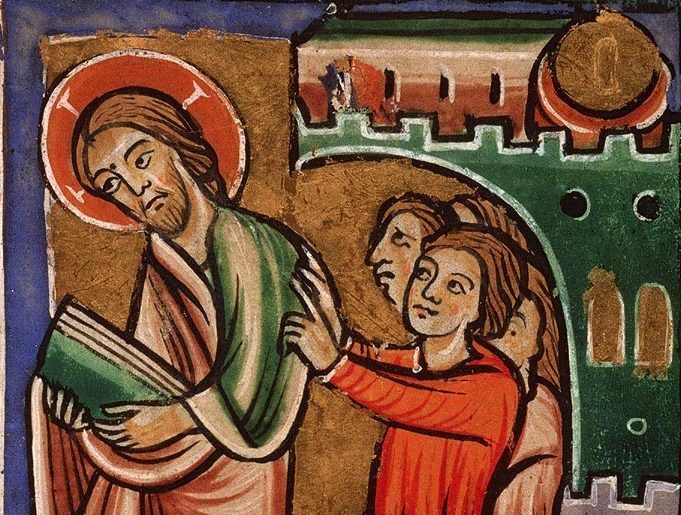
    Because Lincoln opened himself to listen to Frederick Douglass, a deeper truth was allowed to shape history. Sadly, this was not the case with the people of Nazareth, who allowed familiarity with Jesus to harden their hearts to the point that God was left with no room to work. As Mark tells us, he was not able to perform any mighty deed there (Mark 6:5).

    We all know the old adage that familiarity breeds contempt, but I think it can also breed dismissal. The people of Nazareth dismissed the idea that Jesus had anything to teach them; as far as they were concerned, they already knew everything worth knowing about him.

    I can’t really criticize them. I’ve seen a similar attitude at times in myself. Because I’ve studied theology a lot, read many books and articles, and taken many classes, I get tempted to think, “OK, now I think I know everything I need to know about God.” If you’ve ever had similar thoughts, I urge you to remember this gospel passage, for that’s exactly the kind of thinking that closes the door to God, giving Him no room to work in us or through us.

    Our faith thrives on openness, and the key to openness is humility. That’s what brought Lincoln around – the humility to recognize his own limits, and to start listening where he least expected wisdom to be found.

    Today’s gospel presents us with the same choice. It’s not whether Jesus has power, but whether we will allow him to teach us again; perhaps through Scripture passages we’ve heard many times before, a person we think we already understand well enough, or a moment that feels ordinary.

    The people of Nazareth could not move past asking, “Isn’t this the carpenter?” The question for us is simpler and more unsettling: Have we already decided who Jesus is, and stopped listening?


  • Immersion

    Immersion

    The Baptism of the Lord (A)

    Matthew 3:13-17

    A German immigrant living in Italy asked how best to learn Italian. The advice he got was simple: Go down to the marketplace and spend time there. Listen. Speak. Make mistakes. Do this enough times and the language will become yours.

    That was it: No textbook, no computer program. Immersion, pure and simple. And it worked. In time, he spoke Italian fluently.

    Immersion is really what we celebrate as we remember the Baptism of the Lord. In ancient times, it wasn’t the custom to stand at a baptismal font and be sprinkled with a few drops of water. No, people were plunged into it, going under as the old, sinful self, and coming back up as the new, redeemed self.

    That practice was done in imitation of Christ’s own baptism in the Jordan by John. Of course, Jesus didn’t need repentance. Still, he chose to plunge fully into the waters – with sinners. With us. Knowing our weakness, our confusion, our need for mercy, God didn’t just stand and watch from a distance. He entered the water. And not only entered, but completely immersed himself in the human condition.

    Thus he teaches us that belonging – that taking up our mission – is revealed in immersion, not observation. For the baptized Christian, life isn’t a spectator sport, something to merely observe, but something to totally immerse ourselves in. Just as that man didn’t master Italian by reading a book or using a computer program, we don’t learn to live like Christ by occasional exposure to him or his Church.

    That brings up the difficult questions Christ wants us to ask ourselves: Do I live a “Christmas and Easter” type faith, or do I live it every day? Do I look at others in need and hope someone will help them, or do I “take the plunge” and do it myself?

    No matter how we answer such questions, let us remember that we learn the language of Christ by immersion: Prayer, reception of the sacraments, being an active part of the community, and by practicing mercy, especially to those who we may think least deserve it.

    If we aren’t where we know we need to be in these things, that’s OK. God has given us time. To learn the language of love, forgiveness, and self-gift, we must go down to the marketplace and spend time where those things are spoken. Where is that? Not the clean, clear water of a baptismal font or an easy chair, but the muddy and unclear water of humanity – of the cross. But as Jesus showed, that’s the place to do as he did, to immerse ourselves fully.

    That is what our Lord, Jesus Christ showed us, not just at his baptism, but by his life, death, and resurrection. And that’s what the Father showed when He said,”This is my beloved Son, with whom I am well pleased.”

    In the same way, we don’t learn how to live “fluently” as God’s beloved sons and daughters by watching from the shore. We learn it by immersion.

  • Holy Families, Not Perfect Ones

    Holy Families, Not Perfect Ones

    Sirach 3:2-6, 12-14; Colossians 3:12-21; Matthew 2:13-15, 19-23

    The Scriptures for the Feast of the Holy Family speak honestly about family life; not as perfect, but as a place where faith is tested and love is learned.

    Sirach tells us, “Take care of your father when he is old… even if his mind fails, be considerate of him.” He does not limit this call to ideal relationships. It is a summons to faithful love, even when family bonds are complicated or strained.

    That passage reminds me of a time when, as a teenager, I traveled with my father to New York to be with his own father, who was alone and dying of cancer. I didn’t know the details, but I knew there had been difficulties between them. Yet during those few days, I didn’t see that. All I saw was a patient, gentle, attentive son. No speeches, no attempts to fix the past… just the silence of Dad’s presence, care, and compassion.

    Those images have never left me. More importantly, they helped me see Dad in a new and illuminating light. Just like he had struggles with his father, I had struggles with him. Despite all that, watching him live out that kind of reverent love went a long way toward healing our relationship. That mattered, because Dad died young. Had I waited, that healing might never have come.

    St. Paul urges us to “put on compassion, kindness, humility, gentleness, and patience.” In the Gospel, Joseph does just that: he silently rises, protects those entrusted to him, and trusts God with his family’s future. Watching Dad live that way has challenged me to do the same.

    And it’s about challenge, after all. While the Feast of the Holy Family rightly draws our eyes to Jesus, Mary, and Joseph, it’s not about comparing the Holy Family’s perfection to ours. Rather, the Feast invites us to challenge ourselves; that the love in our family be stronger than our resentment, our presence stronger than our history, and our faith strong enough to act — quietly, faithfully, and one day at a time— so that God’s love and peace may work through us to bring healing and wholeness.

  • The Foundation of Faith

    The Foundation of Faith

    The 28th Sunday in Ordinary Time (C)

    2 Kings 5:14-17; 2 Timothy 2:8-13; Luke 17:11-19

    I don’t think the first thing most of us do when we receive bad news or suffer is stop and thank God for it. More likely, especially when the news or suffering is very bad, our reaction is one of fear, confusion, disbelief, even shock. Personally, I don’t recall ever saying, “I have a serious illness? Oh, thank God!” No, I’ve been much closer to the lepers in today’s gospel… begging for mercy.

    But recently, I learned that Pope Benedict XVI (retired and finally with time to spare) fell and broke his wrist, rendering him unable to finish a project he was working on. Speaking about it, Benedict said that when God lets us stumble, there’s a lesson in it, often involving humility and patience. Where I might’ve been angry, frustrated, or disappointed, the Holy Father sounded… grateful.

    Clearly, it was time for me to rethink my idea of gratitude.

    Today’s Scriptures reinforce that. For example, I can see why Naaman was grateful for being healed, but why cart two loads of dirt home from Israel? Then in the gospel, I can see why the leper returned to thank Jesus, even to falling at his feet, but why did Jesus respond as he did?

    Both examples teach us something vital: The gratitude God is looking for isn’t the passing pleasantry of a favor done for us, or even the deeper thankfulness we feel when He answers a prayer the way we want. Rather, gratitude is a way of life, of seeing God at all times as the source of everything we need, and of being thankful for his kindness and faithfulness no matter what life has in store for us. This is the gratitude that transforms us and is the foundation of our salvation.

    Again, look at the readings. Because the ancients believed that a peoples’ god was tied to their land, Naaman brought the dirt home to show the world that the Hebrew God was his God, too. Healing transformed his faith. As if to underscore that, note what Jesus says to the leper: your faith has saved you (Luke 17:19). Where once there was a leper – a Samaritan at that – through gratitude there was now a man not only healed, but saved.

    Gratitude and faith are intertwined. One opens onto the other. Gratitude is the recognition of grace, and faith is the trust that grace is always there. That is why in our second reading, St. Paul could rejoice in chains, and why the Catechism says that “Every joy and suffering, every event and need can become the matter for thanksgiving” (CCC #2638).

    Every joy. Every suffering. Everything. That should have particular impact on us at Mass, for nowhere do we give greater thanksgiving than in the Eucharist itself, whose very name means “thanksgiving.”

    So, when you come to receive Christ today, whether in the Eucharist or spiritual communion, bring every joy, every suffering, and, like the one leper who returned, give thanks. For gratitude is not merely the doorway to salvation; it is the foundation upon which salvation is built.

  • Stick to the Plan

    Stick to the Plan

    21st Sunday in Ordinary Time (Cycle C)

    Isaiah 66:18-21; Hebrews 12:5-7, 11-13; Luke 13:22-30

    Suppose two high school students ask the track coach what they should do over the summer to qualify for the team next fall. The coach gives each one a training plan and urges them to stick to it. The first student does exactly that, even though he finds it demanding. The other, also seeing the demands, decides that he’s basically fit already, so an hour a week of casual exercise should be enough. When fall comes, we’re not surprised that the first student makes the team while the second doesn’t come close.

    This Sunday’s readings remind us that life in Christ works the same way. First, Isaiah tells us that everyone is invited to “be on God’s team;” no one is left out. But then, Hebrews hints that this may not be easy; the Author speaks of discipline, endurance, even pain. Still, this will end in glory, for accepting and working through the pain will make us strong. Finally, Christ drives it home with the first word of his answer to the question about who will be saved. “Strive,” he says. In the original language, this carries a physical meaning, like an athlete in training. We see it again when St. Paul speaks of faith in terms of “competing” (1 Corinthians 9:25) or “fighting the good fight” (1 Timothy 6:12; 2 Timothy 4:7).

    So, while God invites us all to share in the joy of his Kingdom, a “training plan” is involved. What plan is that? Easy – it is the Sacramental life Jesus gave us and the moral life he preached. Of course, while that answer is easy, living it out is not. Like the second student in the example above, when the going gets tough, we’re tempted to look for a way out, which usually means picking and choosing which parts of Christ’s plan we will do and which we will ignore.

    Today, Jesus goes out of his way to warn us against that kind of thinking. Good Father that He is, God sometimes uses very strong words and imagery to reprove us, but again as Hebrews reminds us, this is born of His infinite love for us. He doesn’t want us, and He knows we don’t want, to step into eternity expecting the door to be wide open, only to find it closed and Him saying, “’I do not know where you are from.”

    So, let us keep this in mind today and every day: our Lord has given us the training plan. It requires effort, perseverance, and commitment, and isn’t optional. But he has also given us His grace, which is always there to strengthen and encourage us. Above all, from the storehouse of his infinite love, he has given us the promise of a reward far greater than any earthly prize: Eternal life with Him.

    All we have to is what is hardest of all: Stick to the plan.

  • Here in 10 Minutes

    Here in 10 Minutes

    Genesis 18:1-10a; Colossians 1:24-28; Luke 10:38-42

    Years ago, my wife and I heard the plea of a missionary to sponsor seminarians in his country, so we decided to pay for a young man to do so. One Sunday afternoon long after, that missionary called me. “You know,” he said, “I’m not far away. I’d love to stop by and see you.” “Where are you, Father?” “About 10 minutes away. See you soon!”

    I didn’t panic… until I looked around the house. Even by my standards, it needed help. When my wife heard, the scramble really began. My job was to straighten up myself and the house, while she put together snacks, coffee, and tea. Just as we finished, there he was. It turned into a nice visit, but in no way was I really prepared for it.

    That experience and today’s readings got me thinking: What if my guest hadn’t been the missionary priest, but Jesus Christ himself? “Hi, I’ll be there in 10 minutes!”

    Well, one clue as to what I should do is in the first reading. What did Abraham do? He rushed to show hospitality to his guests. His focus was on them; he was ready to serve them. In turn, that readiness became the opening for God’s promise that he and Sarah would have a son. The lesson? Welcoming our Lord opens the door to a miracle.

    But then there’s an example closer to my experience that afternoon – the gospel. My typical way of looking at it is that Mary was right and Martha wrong. Martha’s focus on the “outside” – getting the house ready for Christ – turned into resentment, while Mary’s focus on the “inside” – sitting at the feet of Jesus – showed that she was ready to receive his word.

    Actually, I think the challenge Jesus gives us is to do both: to do things for him and be with him. We know, because Jesus told us, that as often as we feed the hungry, shelter the homeless, visit the sick, comfort the sorrowful, and forgive injuries, we do them to him. But we also know that many people who don’t believe in God do those things, too.

    No, Christ calls us to more. We see clues to that when St. Paul says, in my flesh I am filling up what is lacking in the afflictions of Christ (Colossians 1:24). What could possibly be lacking in Christ’s suffering? Our participation in it. He has prepared a place for us, as he said in John 14:2, but we must do our part. How? By preparing a place for him in our hearts and showing him to the world by what we do. That can be uncomfortable, even painful, but that’s why St. Paul began, I rejoice in my sufferings for your sake. What causes anyone to rejoice in suffering? Love! What parent wouldn’t gladly suffer in place of their child? Yes, it’s painful, but we would much rather it be us than them. That is the love he is talking about – the love that finds joy even in suffering because it is done for the sake of the beloved. That is the love that proclaims Christ to the world (Colossians 1:28).

    So, that is our challenge, but we have to be ready for it. Very soon – at Holy Communion – Christ will be here. We are both Martha and Mary. Are we ready? Have we made space at the feet of Jesus in our everyday lives? Is our heart ready? Have our prayers, works, joys, and sufferings filled up what is lacking in the suffering of Christ? Are we ready to welcome Him like Abraham, and receive the miracle only He can give?

  • Let Your “Yes” Mean Yes

    Let Your “Yes” Mean Yes

    Saturday of the 10th Week in Ordinary Time

    2 Corinthians 5:14-21; Psalm 103:1-4, 9-12; Matthew 5:33-37

    Psychologists and those who study social media behavior have found that people tend to form groups and make friends with others who share their interests or beliefs. On platforms like Facebook or Instagram, these “echo chambers” reinforce shared views—people like and share what “fits,” and ignore what doesn’t.

    Dig a little deeper, and something more emerges. When posting within these like-minded groups, people tend to tailor their words to what they think the group will approve of. That is, they don’t always say what they really believe—they say what they think will be popular.

    Why? Because we all want to belong, we all want to be liked. Unfortunately, some people want it so badly they will sacrifice their honesty to get it.

    But imagine Jesus with a social media account. Do you think for one second that he would trade honesty for popularity?

    Of course not. He says so plainly in today’s Gospel: “Let your ‘Yes’ mean ‘Yes,’ and your ‘No’ mean ‘No.’ Anything more is from the Evil One” (Matthew 5:37).

    Truth matters. Integrity matters. It’s not just about the words—it’s about being consistent, undivided, and unafraid.

    It’s also about how those words are said, and to whom. In 2 Corinthians, St. Paul reminded us that we are a new creation, entrusted with the message of reconciliation. That doesn’t mean shouting or condemning, but being honest, courageous, and above all, merciful – in imitation of our Lord, who, as the psalmist said, is kind and merciful.

    At the same time, neither kindness nor mercy mean compromise. The same God who is kind and merciful is also true. So are we called to be – clear, compassionate, and rooted in something much deeper than popularity.

    God doesn’t need people trying to fit in. He needs ambassadors; people who live with integrity, speak truthfully, and reflect His mercy with courage and love. So let us resolve to do that, keeping in mind that, long after social media and all its groups, politics, and ephemera are gone, the only ‘like’ that will matter is the one that comes from Christ—on the post of our life.

  • Getting Out of Our Own Way

    Getting Out of Our Own Way

    Thursday of the 10th Week in Ordinary Time

    2 Corinthians 3:15–4:1, 3–6; Matthew 5:20–26

    The evidence of history shows pretty clearly that Alexander the Great was one of the most naturally gifted individuals of all time. Educated by Aristotle, a voracious reader, charismatic, politically astute, a brilliant general… the list goes on and on. By the age of 33, Alexander had conquered most of the known world. Yet, at that same age he died, likely of complications related to alcohol abuse. At least one historian has sadly noted that, in the end, this gifted young man was able to conquer everything except himself.

    As Alexander so perfectly (and tragically) shows, it isn’t always the most gifted who go farthest in life. Often, success goes to the ones who subordinate their will; who, rather than “doing it their way,” allow coaches, mentors, and teachers to lead and guide them. Raw ability can take us far, but probably not as far as the willingness to be transformed – or to “get out of our own way.”

    We see it in the spiritual life as well. St. Paul knew; he spoke of it when he described the “veil” that lies over the hearts of those who remain closed off from Christ. Though Paul was referring specifically to the children of Israel, his words are also meant for us. Is there a veil over our hearts? Perhaps pride – maybe I listen to Scripture or Church teaching with a selective ear, focusing on the parts I agree with and ignoring or minimizing others that don’t? Or fear; maybe I avoid speaking up when that would mean having to go against what my friends or neighbors think, and instead silently go along with the crowd.

    Whatever it is, the more we persist in doing it our way, the more real transformation will elude us. That’s why Jesus speaks so strongly in the gospel of the righteousness that shows itself not merely in outward observance but in deep, heart-level change. What does that change look like? It looks like us when we swallow our pride and put aside anger, insult, division, and anything else we allow to divide us, and reconcile our differences. Only when we face our weaknesses and allow God to help us surrender ourselves to the work of the Holy Spirit will the veil over hearts be lifted.

    Like all Christ’s teachings, that sounds wonderful – and it is – but it’s very difficult to achieve for a couple of reasons. First, it takes genuine humility to admit to ourselves and everyone else that we can’t go it alone; second, it takes letting go of our self-will and allowing Christ – who is already and perfectly the way – to lead us.

    This is what the Christian life, most successfully lived, asks us to undertake, and it is the hardest battle of all: mastery over ourselves through surrender to God. Unlike Alexander, who conquered the world but not himself, the saints show us what true greatness looks like: a heart fully surrendered to Christ. That is the real conquest. That is the truest measure of success.

  • Each End a Beginning

    Each End a Beginning

    Saturday of the 7th Week of Easter

    Acts 28:16-20, 30-31; John 21:20-25

    We often say about books that when a good story ends, it’s really the beginning of another. And that’s exactly what today’s readings show us.

    We read in the Acts of the Apostles that Paul’s journey seems to just… end. There he is, in Rome, under house arrest. We might be anticipating a trial, passion, and death like Stephen, but all we get is the quiet, almost anti-climactic line: … he proclaimed the Kingdom of God and taught about the Lord Jesus Christ (Acts 28:31). That’s it. The curtain falls. No drama, no swan song.

    But, of course, we know the story is far from over. The Gospel didn’t end there; indeed, this was just the beginning. The torch God lit on the road to Damascus and carried through storm and shipwreck was passed to the next generation – to Timothy, Titus, and a cast of unknown thousands. And from all of them to us.

    Which brings up some questions: To whom are we passing it? And how well are we carrying the torch – or, as John might say, testifying to the light?

    Speaking of John, we heard him end with this: There are also many other things that Jesus did, but if these were to be described individually, I do not think the whole world would contain the books that would be written (John 21:25).

    Again, in one sense an ending, but in another, a beginning. It’s as if he is saying, “Christ’s life can never be captured in a book.” And his whole gospel is a way of saying that if we want to know how the story continues, we should look at your own lives and the lives we touch.

    Today, as we prepare to celebrate the beginning of the Church’s mission to the world at Pentecost, Scripture reminds us that in God’s eyes, endings are never final. Rather, they are thresholds, invitations to new and equally exciting chapters – each replete with its own story, its own unfolding drama, and each focused on Christ.

    We couldn’t ask for a better leading man! In Christ no ending is empty, with him every beginning is new, and through him the story of salvation knows no bounds. His story alone, what Bishop Barron has called the Great Story of Jesus, has for generations had the power to touch people profoundly and draw them in completely.

    Again, that brings us back to the crucial question: How am I telling the story? If you’re anything like me, I think you’ll find that we tell the story of Jesus best when we live it with an open heart for all to see, as Paul and John did. So then, let us live it well, for a new chapter is beginning – one that leads to the greatest part of the story: eternal life in Christ, who is the Beginning and the End (Revelation 22:13).

  • Not a One-Person Project

    Not a One-Person Project

    Thursday of the 6th Week of Easter

    Acts 18:1–8

    Not long ago, I was vacationing in Amish country – a place I’ve come to love for its quiet beauty and deep sense of tradition. One morning, I heard about a barn-raising that had happened nearby. Storms and the wear of years had left a farmer’s barn in ruins. While he might’ve been able to rebuild it himself, something else happened.

    His neighbors came. Dozens of them – men, women, and children. Working together, down came the old, and up went the new. In a few days, that man had a brand new, beautiful barn.

    What struck me most about it wasn’t the end result, as nice as I’m sure it was, or the amount of lumber, tools, or labor it took. Rather, it was the love and solidarity that clearly went into it. This wasn’t a one-off kind of thing; the Amish do this for their neighbors all the time. That’s the kind of stuff that builds a lot more than a sturdy barn – it builds a sturdy and life-giving community.

    As if that isn’t enough, it’s also a powerful reminder that some things are just too big to do alone.

    We see something similar in our reading from the Acts of the Apostles. Paul, newly arrived in Corinth, was just one man, like that Amish farmer. But as we also saw, it didn’t take long for God to surround him with help.

    First, there were Aquila and Priscilla, fellow tent-makers, who helped in two ways: They took Paul in and joined him in spreading the Word. Next came Silas and Timothy. The presence and help of those four allowed Paul to focus entirely on what he did best – preaching the Gospel. What happened? The Church in Corinth began to grow. In time, it became an important center for Christianity. And while his beautiful and influential letters to the Corinthians turn our minds to him, St. Paul would be the first to say that building the Church wasn’t a one-person project; it took the effort of many people.

    The Gospel was never meant to be a one-person job, and neither is the Christian life. We are saved as a people, not as isolated individuals. When our Lord ascended into heaven, he didn’t say, “Good luck, Peter, you’re on your own!” No, he promised to send the Holy Spirit to guide them (note, them) into all truth.

    What does this have to do with us? Well, maybe today the Lord is asking us a couple of questions:

    • Have we been trying to carry our burdens alone?
    • Are we trying to “raise a barn” – be it our faith, our families, our vocation – by ourselves?
    • Are we asking for the Holy Spirit to give us the grace to work together to build a parish, a community, and the Church?

    Remember the barn-raising. Remember Corinth. Above all, remember this: The Holy Spirit doesn’t just build us as individuals. He builds us together and helps us raise the most magnificent barn of all – the Church, the Mystical Body of Christ.