Matthew 13:54-58
For me, social media is a mixed blessing. On the one hand, it’s been the best way to find out what my kids are doing; you know, things they hadn’t gotten around to telling me yet, like if they were pregnant or had a new job. Dads really are last to know. But social media can also be problematic. I decided to reconnect with people I knew over 50 years ago at St. Peter’s school. I found one of the kids I hung out with and sent him a note saying, “Hey, it’s me! Do you remember me?” He responded, “Yeah, I remember you. Those poor nuns and priests.” And that was that.
I wanted to write back and say, “No, no, I’ve changed! I’m not the same kid,” but I let it go. I’ve done the same thing he was doing, maybe we all do – tending to paint people with a broad brush, stereotype them, see them as unchanging. I don’t like it when people do that to me, but I do it to them all the time. Maybe it’s human nature.
This is similar to what I think happened to Jesus when he went back home. To them, he was just the carpenter’s kid, Mary’s son, who they remembered from the neighborhood. They couldn’t believe that he is or was anything else. And we know the result; Matthew tells us that Jesus did not work many mighty deeds there because of their lack of faith.
Of course, the irony is that Jesus hadn’t changed. As Scripture says, he is the same yesterday, today, and forever (Hebrews 13:8). We can’t blame the people for not seeing that; his years in Nazareth are called “hidden” for a reason. The problem was not the peoples’ failure to learn about Jesus in the past but their failure to learn from him in the present. They were right to believe he hadn’t changed; they were wrong to believe that their knowledge of him didn’t need to change, either. Like my old classmate, like me, they failed to realize they didn’t know everything they needed to know about him. As Jesus showed them, for the sake of their own salvation they needed to change their minds.
Change of mind and its relationship to faith is clearly important to Christ. It was among the first words he spoke in Mark’s gospel: Repent, and believe (Mark 1:15). Repent is a translation of a Greek compound word that means “change your mind.” As I’ve said before, it’s one thing to hear Jesus tell tax collectors or prostitutes to change their mind; we expect that. What we don’t expect, whether it’s people in ancient Nazareth or us in the modern day, is for him to tell us to change our mind when we think we’re already doing exactly what God wants!
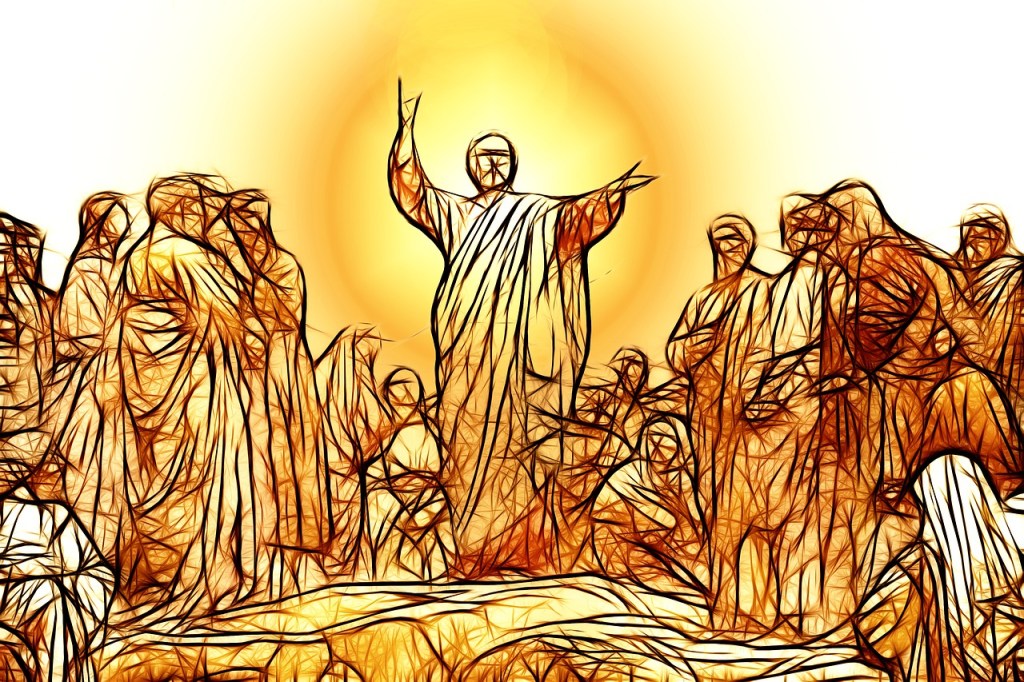
But he does say that to every one of us, and I think I know why. Remember the reaction Jesus got after the Sermon on the Mount; Matthew tells us the crowds were astonished at his teaching (Matthew 7:28). In both cases, astonishment. But at the Mount he was the new sensation; here in Nazareth, just the same, familiar Jesus. We must ask ourselves which Jesus we follow. Is his teaching still challenging us, or have his words become too familiar to us? Do we find new ways to apply them, or have they acquired a sameness? Are we continuing to grow in our knowledge and love of God, or do we think we know and love him as well as we need to?
Regardless how well we think we know him or his message, Jesus challenges us because he’s looking for a reaction. He wants us to challenge him and to challenge ourselves. Although the questions he got in Nazareth were tinged in irony, they lie at the heart of all the gospels and the heart of our faith: Is he not the carpenter’s son? Where did this man get all this? These are just another way of asking the question that also appears in every gospel, Who do you say that I am?
One final point. Matthew tells us that when Jesus heard these questions, he was in his native place (Matthew 13:54). We could say that the Church is our Lord’s native place, but it is also true that his native place is within each of us, where God has written his image. Certainly as we receive Jesus in Holy Communion he takes up residence in the most special way inside us. That is where he meets us, counsels us, urges us constantly to change our mind, to know him more deeply, and to contemplate that crucial question, Is he not the carpenter’s son? We do well to remember that every one of us, every day of our life, is challenged to answer those questions, and that everything we do from the time we wake up until the time we go to bed is our answer to them. Let us make it our most fervent hope and prayer that Christ is most truly honored there, in his native place.

 Mark 10:45