Daniel 1:1-6, 8-20; Luke 21:1-4
In biblical studies, as in life, things aren’t always what they seem. For example, some books of the bible seem like history; they mention real historical people and places and the situations they describe seem real enough. However, clues such as language and historical inaccuracies show that the author had another purpose in mind; he is speaking symbolically.
Thus it is with the book of Daniel. Scholars tell us that the symbolism running through its stories points to two particularly strong themes: The ability of the Jews to thrive in a Gentile world and the importance of remaining true to the traditions of the faith.
Both themes appear in Daniel and the gospel according to Luke. By successfully bargaining with the Gentile authorities about their diet, four young Hebrew men were able to remain true to their religious identity. Not only that, when the king discovered that their wisdom and understanding far surpassed that of his own people, these men, who it seemed were the conquered, were in fact conquerors.
These themes also run through the ministry of Blessed Miguel Pro. Born in Mexico, Pro was sent abroad as a seminarian and ordained a Jesuit priest in Belgium in 1925. Finding that he could not thrive abroad due to stomach ailments that nearly killed him, Father was returned to Mexico, despite the great persecution of Catholics currently underway.
This might seem like the worst thing for an ailing priest, but things aren’t always what they seem. In fact, his ministry to the people of Mexico restored Father’s health. Like Christ and the saints, his food was to do the will of the One who sent him, and he greatly delighted in doing God’s will right under the authorities’ noses. A master of disguise, Father was never what he seemed. He ministered in prisons posing as a policeman; in posh neighborhoods dressed as a rich man; in slums dressed as a beggar. Hiding in plain sight, he taught, gave Communion, said Mass, absolved sins, confirmed the faithful, and prayed over the dead. Father Miguel Pro, like the widow in the gospel, seemed to have almost nothing, but in reality had everything, and freely gave it. He who seemed to be conquered was the conqueror.
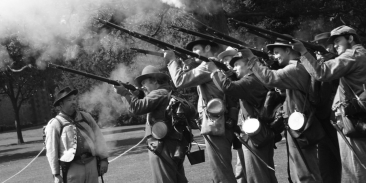 Eventually, Father was caught, imprisoned on a false charge and on the morning of November 23rd 1927 faced a firing squad. Even here, he was a conqueror. Before the cameras and all assembled, he forgave and blessed his persecutors, held out his arms in the shape of the cross and shouted “Viva, Cristo Rey (Long live Christ, the King)!” With that, Father Miguel Pro died.
The government published a photograph of his execution, believing that it would frighten Catholics into submission. Once again, things were not what they seemed. Father Pro, arms outstretched like a cross, displayed such Christ-like strength, such fearlessness in the face of unjust persecution, that the photograph and Father’s last words became the symbols around which Catholics rallied to resist the repression even more strongly. This was not a photograph of the conquered but of the conqueror. Ironically, the government quickly banned their own photograph.
Like the young men in the first chapter of Daniel, Blessed Miguel Pro thrived in a hostile environment because he remained faithful to his calling and his religious heritage. While our culture and our authorities are not as openly hostile as was Mexico in the early 20th century, there is constant and perhaps growing pressure to minimize the voice of Christ and his Church in the public arena. While the times may seem bleak, remember: Things are not always what they seem. Let us imitate Blessed Miguel Pro by being in the culture but not of it; by ministering in whatever way we can to preserve and build on the good that has come before. Finally, let us remember that, in the end, we bow to only one authority – that of the Triune God.
Viva Cristo Rey. Long live Christ the King.
Blessed Miguel Pro, pray for us.
 The two themes of fidelity and love are interwoven in the feast of the Presentation of the Blessed Virgin Mary. The presentation of oneself to God is an act of great faith and deep love. Whether Mary demonstrated her faith and love in a formal consecration to God in the Temple as described in the ancient non-biblical documents is irrelevant. Every day of Mary’s life was a presentation, a self-offering, an abandonment to the divine will made possible by the movement of grace within her. Long before he dwelled within her womb, indeed from the moment of her immaculate conception, our Lord dwelled within her soul and bestowed upon it the fullness of grace, his very life. By her response to that grace, Mary most truly defines what it means to be a Temple of the Holy Spirit.
 Persistence in prayer does not test God’s patience or change his mind; rather, it tests our faith and changes our attitude. Through his life and the Scriptures he has given the world, Jesus has told us that God loves each of us with a love beyond our understanding and knows our needs before we ask. That being so, God wants our prayer to consistently express the trust we have in him and his providence; that is the faith that Christ wants to find upon his return.
 Mark 10:45