Tag: Catholic

  • Better to be Better

    Saturday of the 1st Week in Lent

    Deuteronomy 26:16-19; Matthew 5:43-48

    A man once told me about something that happened to him at church. I know it may sound strange to some of you, but in his parish the people tend to sit in the same pew week after week. In his case, an older couple always sat in the pew right behind him and his family. He didn’t know their names, but they greeted each other at the sign of peace, and said goodbye when Mass was over. This went on for years; decades, even.

    One Sunday after Mass, the elderly woman lingered in her pew, weeping. When he asked if there was anything he could do, she said, “No. It’s just very near the anniversary of my husband’s death.” That struck the man deeply; he hadn’t even realized she’d been coming to Mass alone. After consoling her for awhile, he left, and resolved to never let that happen again. He kept his word; from then on, he and his family made it a point to talk with her, and became friends with her and other people near them at Mass.

    This is a great example of a principle our Lord alludes to in today’s gospel: the choice in life isn’t always between doing good and doing evil; sometimes, it’s between doing good and doing better. Loving those who love us is good; so is greeting our friends and family. But it’s better to love without regard to whether we’re loved in return, and to greet those who do not greet us.

    We talk a lot in the Church, especially during Lent, about living virtuously, and we do it in many ways: coming to church, volunteering in outreach to the poor, teaching children, beautifying the parish, etc. While these are all good and we must do them, Christ challenges us to think about what else we can do to better ourselves.

    In the spirit of the story I began with, one area might be recognizing the needs of those all around us. That isn’t always easy. We get stuck in such ruts – even with good things like going to Mass – that it can take a crisis, such as seeing someone in pain – to get us to see what’s better: looking beyond ourselves, even to the next pew.

    Of course, recognizing the need is good, but responding to it is better. It was good that the man consoled the widow behind him, and resolved to change his behavior. But the better thing was actually doing it, which he and his family did. For us, too, response can be the harder part; people may well need our help in ways we do not expect and that might cost us something. But that’s exactly the point; today and every day, Jesus challenges us to go beyond the good and seek the better. In so doing, we accomplish what he wants the most: The transformation not only of our parish and our community, but ourselves – one Christlike act of compassion at a time.

  • Becoming Who We Are

    Becoming Who We Are

    The Commemoration of All the Faithful Departed

    Wisdom 3:1-9; Romans 5:5-11; John 6:37-40

    Many years ago, on a train trip to Chicago from rural Michigan, I sat behind a family who had never been to a big city before. I tried not to listen, but their conversation was too interesting. The kids had no idea what skyscrapers were, so Dad tried to explain. It didn’t work; when we stopped in a small town, one kid said, “A skyscraper!” No, son, that’s a grain elevator. As we got to the city limits, Mom got tense. “Kids, when we stop, stay with me. Don’t wander off. They probably carry guns here. It doesn’t look like a very friendly place to me.” I wanted to say, “Ma’am, we’re going to Union Station, not Al Capone’s headquarters,” but kept my mouth shut. By the time we got downtown and they saw Chicago, it was clear that the actual reality was nothing like they imagined.

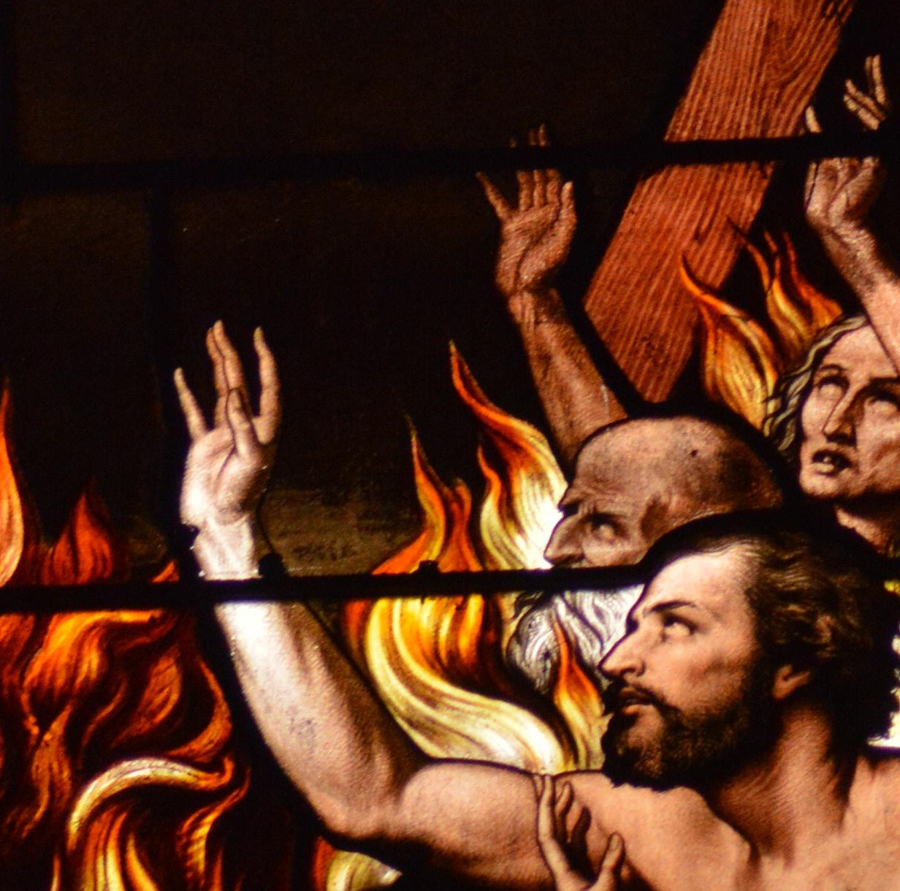
    This kind of thing happens in the Church, too. All Souls’ Day is a good time to see it, because purgatory takes center stage. Just hearing the word “purgatory” conjures up in many minds some of the imagery of the first reading: souls punished, chastised, tried, put in a furnace, burnt offerings (Wisdom 3:4-6). Not hard to see why in the popular imagination, purgatory is a fiery place where souls go to be purified – somehow – and for some length of time. (That’s all fuzzy. What isn’t fuzzy is the fire.)

    Let me do what my much younger self should have done for that young family on the way to Chicago: Clear up some misconceptions.

    1. Purgatory isn’t a place, it’s a process. For what? Well, although all of us would love to enter God’s presence immediately after we die, we have to deal with what John wrote in Revelation; namely, that nothing impure can enter heaven (21:27). So, if our soul has any venial sins or attachments to worldly things, all that must be eliminated first.
    2. There is, and there isn’t, a fire. There isn’t, in the sense that souls can’t “feel” the way bodies can, but there is, in the sense that souls can yearn (or burn, if you will) for a closer relationship with God, and know that growing closer to Him is only possible if we let go of our selfish desires.
    3. After we die, there is no time. The dead are beyond that. The better question is, how spiritually distant am I from God? Do I love God with an intense love that is willing to overcome any obstacle that keeps me from being with Him, or am I too attached to what I want? And how much do I really love others, especially those I’ve had the most difficulty with?

    With these misconceptions cleared up, we can better appreciate the balance of the imagery we heard in the book of Wisdom. Souls are punished, but also full of hope; chastised, but greatly blessed; tried, but found worthy of God; proven in a furnace, but like gold; sacrificed, but taken by God to Himself. So yes, there is suffering, but the battle is won, and they are not alone. This is why St. Paul said that hope does not disappoint (Romans 5:5); God is with us every step of the way, and the outcome is both known and glorious. Every soul being purified will be united with Him when all is said and done.

    What should we take away from this? Three things:

    1. The best way to deal with purgatory is by working to avoid it entirely! Our goal is sanctity; let us pray for the grace and strength to do what it takes to stay close to Christ, to remain in him, to do whatever he tells us.
    2. Pray for the souls in purgatory. This is a wonderful example of the love we are called to have – the love that seeks the good of others before the self. The witness of the saints testifies that souls undergoing purification are helped in the process by the prayers and sacrifices of others. Once in heaven, they can intercede for us.
    3. Remember that purgatory isn’t about who we were, or who we are, but who we are becoming, which is the most perfect version of ourselves. That is what Christ has called us from all eternity to be: perfect, as our heavenly Father is perfect (Matthew 5:48).

  • The Power of the Group

    The Power of the Group

    Wednesday of the 5th Week of Easter

    Acts 15:1-6; John 15:1-8

    Anyone who has ever been a parent or started a job knows that you can read all the books, take all the classes, and get all the training you want. No matter; once you start doing it on your own, things are going to come up that never occurred to you, and that you’re going to have to deal with.

    This was true for the Apostles, too. Jesus trained them well: day after day they followed him, talked with him, asked him questions, watched him work; he even sent them out two-by-two for on-the-job training. But now, here they are, facing a problem they never dreamed would happen, but one they have to deal with.

    We might not think that the Church growing is a problem, but that’s because we aren’t the Christian Pharisees. In their opinion, Gentiles could not be admitted to the Church until they accepted Mosaic law and practices, including circumcision. We don’t hear their rationale, but it’s probably the logical one: Jesus was a Jew. Of course, others disagree; St. Paul, for example, who would write that in Christ Jesus, neither circumcision nor uncircumcision counts for anything, but only faith working through love (Galatians 5:6). Clearly, there is stalemate; they need a way forward, and they’re going to have to do it on their own, because Jesus never said anything about this.

    Or did he? Perhaps there were signs in his words or actions.

    As for his actions, the Apostles probably remember that Jesus worked with them as a group; he called them in groups, taught them as a group, even sent them out in groups. For another, he made it a habit to include rather than exclude people; for the Apostles in particular, he even gave them authority to govern, baptize and teach in his name. Finally, Jesus prayed for unity, that they may all be one as he and the Father are one (John 17:21-23). How could it be surprising that, in response to the crisis facing the Church, the Apostles would come together as a group, include the presbyters to whom they had also given authority, and then work to make sure that the unity Jesus prayed for was preserved at all costs?

    As if that weren’t enough, consider what the Apostles heard him say in just the last few days: I will not leave you orphans; I will come to you (John 14:18); I am going away and I will come back to you (John 14:28); the Advocate, the Holy Spirit… will teach you everything and remind you of all that I told you (John 14:26); I am the vine, you are the branches. Whoever remains in me and I in him will bear much fruit, because without me you can do nothing (John 15:5).

    All this serves as a context to better understand why the Apostles would respond as they did. Our Lord had given ample evidence that he would be with them, as would the Holy Spirit. He knew very well that problems would crop up again and again, threatening to divide the Church, and that we wouldn’t know what to do. That’s why he went to such lengths to reassure us that when difficulties arise, we don’t have to know what to do; that’s his job, and there is no one better at it.

    So then, what’s our job? Do what the Apostles did: Remain in him; assemble in his name, and in his name ask for whatever we want. When we do that, we will find exactly what the Apostles and presbyters found: No matter what problem we might have, Jesus is the answer; he is the power of the group.