Tag: Apostles and Evangelists

  • Christ is Passing By

    Christ is Passing By

    Feast of St. Matthew, Apostle and Evangelist

    Ephesians 4:1-7, 11-13; Matthew 9:9-13

    The gospel story for the Feast of St. Matthew is a valuable lesson in discipleship.

    We know it well. Jesus passes by the customs post, looks at Matthew, and says: “Follow me.” Matthew gets up and follows him.

    The response is so sudden, so unreflective, it might look like he had no choice. What explains it? After working with many people coming to faith over the years, I think I know. Matthew was filled with that same restlessness Augustine spoke of later; he had everything the world could give, but not what his heart wanted most.

    That came when Christ passed by; the moment he realized he hadn’t been searching for something but someone, and that One was now standing right in front of him.

    In the joy of that discovery, what else would Matthew do but open himself to Christ? This he did: he opened his home, his table, his friends… his whole world.

    And that’s not all. Matthew also opened his mind to that creative energy of the Spirit – logging events of the ministry, ordering and arranging them as only someone used to keeping records could, ultimately painting such an eloquent, unforgettable portrait of Christ that it became the first book of the New Testament.

    In all this, we learn from Matthew that true discipleship doesn’t mean leaving our old life behind when Jesus calls, but bringing him into the life we already have.

    That may be difficult. Like Matthew, our corner of the world might be a place where others never read Scripture, step into a church, or even think about looking for God.

    So, how do we do it? Do we preach to people? Tell them about Christ?

    In a way, yes. We bring him, as St. Paul reminds us, according to the measure of Christ’s gifts to us. How is that? By the way we live our lives: with humility, gentleness, patience, forgiveness, striving to preserve the unity of the Spirit through the bond of peace.

    And we will have done well if people ask themselves, “What is it that makes that person different?”

    We know what it is. It’s Christ doing with us what he did with St. Matthew – walking with us, teaching us, transforming us, making our lives living examples of what it means to be the disciple he calls us to be. 

    Our life is our customs post. Every day Christ is passing by, asking us to follow.

    And every day the question is, where and to whom will we take him?

    St. Matthew, pray for us.

    —
  • I Saw You

    I Saw You

    Feast of St. Bartholomew (August 24)

    Revelation 21:9b-14; John 1:45-51

    There are many things to love about today’s Gospel, but let me mention three that caught my attention.

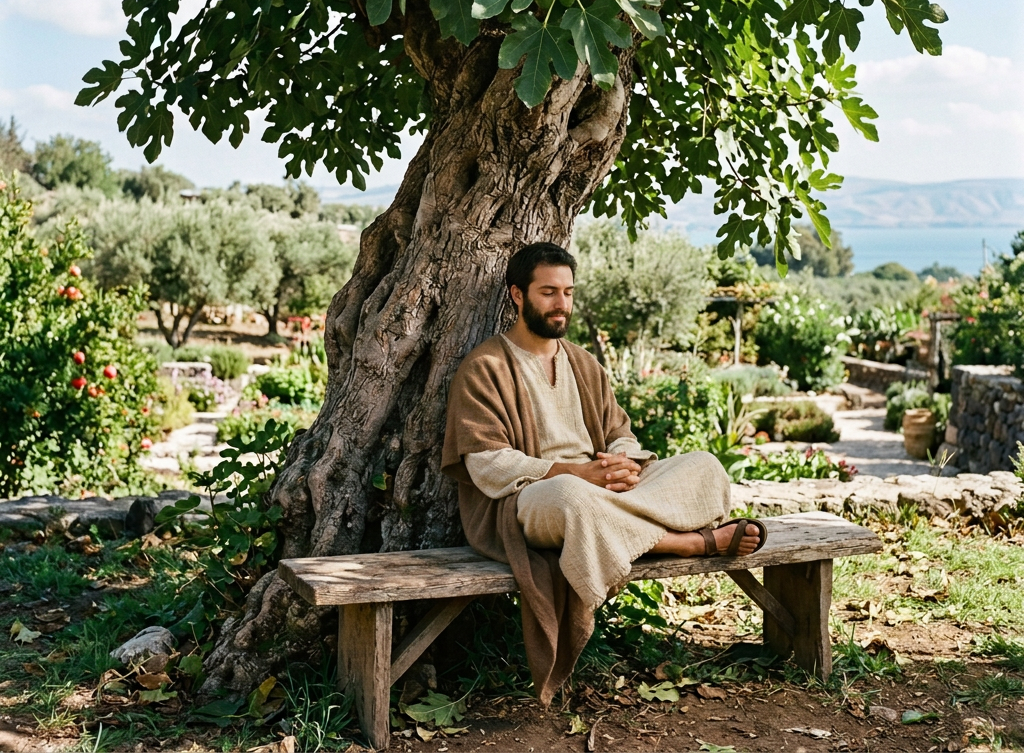
    First is the image of Nathanael under the fig tree. I can’t help but wonder what he was doing there. Guesses abound and we can’t know for sure, but as I see it, he was doing what I think we’ve all done and still do: sitting alone in a quiet place, thinking. And not just thinking, but asking questions, wrestling with God, and waiting for an answer – a clue, a light in the darkness, some revelation telling him that God is listening and will respond.

    Then come those great, consoling words of Jesus: “I saw you under the fig tree.” No wonder Nathanael was amazed! I wonder if we think about that enough. Even in our fig tree moments, we are never alone, never unseen. God is always there; watching, listening, and planning. We talk to Him, perhaps look at Him in the tabernacle or monstrance, but do we realize how close He is, and that as we are looking at Him, so He is looking at us? We may hear nothing, but silence doesn’t mean abandonment. “I saw you” is Christ’s great assurance that our waiting is never wasted if we remain grounded in faith.

    And that faith can be tested, for as the story shows, God’s answers can come in quite unexpected ways. I doubt that when Philip spoke of the one who Moses wrote about, Nathanael thought, “Ah, the answer to my prayers under the fig tree!” His reply shows it: “Can anything good come from Nazareth?”

    What makes this so intriguing is Nathanael’s response. When Philip said, “Come and see,” he could have easily replied, “No, thanks. I have other things to do.” He didn’t; instead, he opened himself to the possibility. He went and saw.

    This is a good time to stop and thank God for the “Philips” of the world. Ask yourself: Who has been Philip to me? Who ever invited me to “come and see” – maybe a parent, friend, priest, or teacher? And to whom am I Philip? Who do I invite? Do I live in such a way that people will want to know the source of my peace, joy, and hope?

    Finally, consider our Lord’s response to Nathanael’s amazement at being seen: “You will see greater things than these…”

    Of course, he did. And while he probably had many more “fig tree moments” in the days and years to come – times he wondered, was challenged, questioned, or suffered – these were nothing compared to what God had in store for him. Especially in the life to come, for as we heard in Revelation, “the holy city Jerusalem coming down out of heaven” has 12 foundation stones. One of them bears his name.

    St. Nathanael, or Bartholomew as today’s Feast calls him, is a wonderful model for us. He teaches us that our fig tree moments, and even our encounters with Jesus, aren’t the destination. They’re just the beginning of what God has ready for us, things far beyond our imagination. Like Nathanael, we may question, wonder, and not understand, but that’s not what ultimately matters. What matters is that we do what he did – keep asking, stay open to finding the answers, go where our Lord leads us, and keep faith that we, too, will see “greater things than these.”

    St. Bartholomew, pray for us.

    —

  • Most Likely To Succeed

    Most Likely To Succeed

    Solemnity of Sts. Peter and Paul, Apostles

    Acts 12:1-11; 2 Timothy 4:6-8, 17-18; Matthew 16:13-19

    When I was young, high school yearbooks had a page dedicated to students who other students called, “Most Likely to Succeed.”

    I did not appear there, and given what I know of them from Scripture, if ancient Palestine had yearbooks, Peter and Paul probably wouldn’t have, either.

    Peter, while certainly hardworking and full of heart, is also impulsive; in Scripture, he speaks before he thinks and frankly isn’t a very good judge of what he will do in any given situation… like when it comes to walking on water or speaking about Jesus around campfires.

    Paul I would probably describe as fiery and intense. On the plus side, that can lead to very deep convictions. On the negative side, there could be some anger issues and pretty heated confrontations. Again, all borne out in the New Testament.

    Yet, Christ wasn’t looking for the polished, popular, or predictable. He was looking for men who were broken but willing to be remade by grace. 

    So he chose them. He saw not simply who they were, but who they could become if they trusted his grace and allowed it to perfect their nature.

    And you could say they succeeded. Together, these two imperfect men established Christ’s Church and spread the Gospel throughout the known world.

    Sts. Peter and Paul are perfect examples of how God makes people “most likely to succeed.” How is that – by simply “fixing” their brokenness for them? No; as St. Augustine once said, “God made us without us, but will not save us without us.” God gave them every grace they needed so that their failures would never have the final word. But they still had to cooperate with that grace. In Acts, God saw to the release of Peter, but he had to follow and do what needed doing. Paul was given the education and the energy, but had to “compete well,” to “finish the race.”

    Even then he knew he didn’t “deserve” salvation. Rather, it would be “awarded” by the only “just Judge.” That is true for all of us. None of us are chosen because we deserve it. We’re chosen because God loves us. Only then is it clearest to everyone that God and God alone brings about every good result.

    So let us remember St. Peter the next time we feel bold in church but fearful and timid in the world, and St. Paul when we speak our love for Christ one minute and our anger with other people the next. But most of all, let us do what they did: confess our failings, turn from them, and continue to have faith that God’s grace is enough.

    That’s how ordinary people like us — people who fail, repent, and begin again — become, by the grace of God, the ones most likely to succeed.

    —

  • Seeking the Face of God

    Seeking the Face of God

    Feast of Sts. Philip and James

    1 Corinthians 15:1–8; John 14:6–14

    When Philip says, “Lord, show us the Father, and that will be enough for us,” it might sound as if Jesus was disappointed in him. “Have I been with you for so long a time and you still do not know me, Philip?”

    But over time, I’ve come to hear something different in that response — not rebuke, but compassion. Not frustration, but invitation.

    After all, when Jesus was a boy and Mary found him in the Temple, he asked her, “Did you not know that I must be in my Father’s house?” (Luke 2:49). Surely Jesus wasn’t disappointed in his mother. He knew that even she — Full of Grace — would need to ponder these things in her heart, to grow in her understanding of the divine mysteries. If the Blessed Mother had to wrestle with them, why wouldn’t Philip?

    So no, I don’t believe Jesus was scolding Philip. I believe he saw in his question not failure, but hunger: a longing to know God more deeply, to see Him more clearly.

    In that way, Philip stands for all of us. Don’t we all long to understand the faith better? Don’t we all wish God would just show Himself, and end the doubt, confusion, and struggle?

    But He doesn’t. Not all at once. Maybe that’s because the work of faith — the growth, the struggle, the contemplation — is part of the gift.

    So today, as we celebrate Saints Philip and James, Jesus teaches us two important lessons through Philip’s honest question.

    The first lesson is that God can be right in front of us — and we might not see Him. Again, consider Philip. He spent years walking with Jesus. He saw him heal the sick, feed multitudes, even raise the dead. Still, he didn’t understand that to see Jesus was to see the Father — to see the fullness of God’s love.

    That isn’t just Philip’s problem, it’s ours too. We may not walk with Christ on the roads as the Apostles did, but we have our own sacred encounters.

    • Do we recognize him in the Eucharist — truly present, Body and Blood, Soul and Divinity — or do we doubt?
    • Do we see his face in the people around us — especially those who are suffering, neglected, or difficult to love – or just inconvenience?
    • Do we trust that God truly hears and responds to our prayers, even when He seems silent? Or do we take silence as God’s refusal to answer?

    Jesus is always closer than we think. If we miss Him, it isn’t because He’s not there. It’s because we haven’t yet trained our hearts to see.

    The second lesson is that what we learn about Christ isn’t just for us — it’s meant to be shared. Notice that Jesus doesn’t end the conversation with Philip. He moves it forward by saying, “Whoever believes in me will do the works that I do — and will do greater ones than these.” Greater than healing the sick or feeding thousands? Yes! Because our Lord’s earthly ministry was never meant to end. It was meant to multiply — through the Church, through the apostles, through us.

    That’s exactly what Philip and James did. They didn’t understand everything perfectly, but they believed. They went out. They preached, taught, healed, and led the early Church. Ultimately, they gave their lives for Christ.

    What does this mean for us? At least three things:

    1. We don’t need to be perfect to be disciples. We need only be willing to keep trying.
    2. We don’t need to understand every mystery of the faith to be faithful. We need to keep learning — and keep growing in trust.
    3. We don’t need to have all the answers before we begin sharing the Gospel. We need to believe that God will give us the grace we need to be His witnesses — in word and deed — so that others may see Him in us.

    Today and every day, let us ask Christ for eyes of faith to see him in the Eucharist, in each other, in the Scriptures, and in the silence of prayer. Let us ask, too, for the courage of Philip and James; to take what we’ve seen and heard and carry it boldly into a world longing for the love of Christ. And like them — like all the saints — may we be faithful witnesses to every person God puts in our path. And may we never stop seeking the face of God — in Christ, in each other, and in everyone.

    —

  • The Power of One: Feast of St. Luke, Evangelist

    The next time you are tempted to think that one person cannot make much of a difference, consider:

    One man singlehandedly wrote a quarter of the New Testament. His is a two-volume work; the first a detailed gospel and the second the only account we have of how the Church developed in her earliest years.

    His gospel is packed with rich, unique characters: Zechariah and Elizabeth, parents of John the Baptist, Simeon and Anna in the Temple, the penitent woman who washes the feet of Jesus with her hair, the widow of Nain, the ten lepers, the good thief, and the travelers on the road to Emmaus. Women are accorded an unheard-of place of honor. First and foremost is his mother; told by the angel that she is to be mother of the Son of God, Mary is the only person to appear at his birth, his death, and the coming of the Spirit at Pentecost. Other prominent women featured include Mary Magdalene, Martha and Mary, and those who supported his ministry out of their own resources.

    He also uniquely portrays our Lord. Son of God and son of Adam, Jesus has a special compassion for the poor, the outcast, and the sick, and an equally special dislike of Herod. His Jesus is also kinder and more compassionate to his family and the Apostles than either Mark or Matthew; the family are those who hear the word of God and do it and the Apostles have his prayers, even at the Last Supper for Peter, who he knows will deny him. In his passion Jesus agonizes to the point of blood yet still has the presence of mind to heal a servant’s ear. Most movingly, on the cross he forgives his persecutors and promises the good thief Paradise. Finally, after his resurrection he appears on the road to Emmaus and stuns back to life the faithfulness of those two downhearted disciples who failed to recognize him until the breaking of the bread.

    Apart from these unique characters and perspective, the evangelist has a wonderful sense of story. He made sure to include some of our Lord’s most memorable parables: The lowly guest, the great banquet of the king, the lost sheep, the lost coin, the unjust steward, Lazarus and the rich man, the Good Samaritan, and of course the Prodigal Son. More than that, he crafted in beautiful prose the vignettes that form many mysteries of the holy Rosary (including much of the Hail Mary prayer itself): the Annunciation, the Visitation, the Presentation, the finding of Jesus in the Temple, and the descent of the Holy Spirit at Pentecost. His mastery of Greek, unparalleled in the Scriptures, is on full display in such prayers as the Benedictus of Zechariah, the Magnificat of Mary, and the Nunc Dimittis of Simeon. Every day around the world, millions of people recite these – probably from memory – as part of the Divine Office of the Church.

    As if all this weren’t enough, this same man then goes on to give us yet more of what no one else has: the story of the early Church. From Pentecost on he tells the amazing story of the spread of the gospel throughout Judea, Samaria, and to the ends of the earth – including Rome. In sometimes intimate detail he gives us both the beginning of St. Peter’s ministry and virtually all of St. Paul’s, writing the story at times as a fellow traveler, from Paul’s mystical encounter with Christ on the road to Damascus, through his victories and failures in ministry, all the way to his ultimate destination, the seat of the Empire – Rome.

    Overall, the span of his work is breathtaking; it is a complete narrative that stretches from before Christ’s birth, through his ministry, passion, death, resurrection, and ascension all the way into the development and growth of the early Church.

    italy-2472027_1920There is much more we could say on this, the day we remember him, but it would only belabor the point, which is that none of his work would have been possible unless this man had given himself completely over to the will of the Father, in devotion to our Lord Jesus Christ, through the power and inspiration of the Holy Spirit. But he did, and this masterpiece was the result.

    Remember the power of one; not one person alone but one who has conformed himself to being in union with the will of God. There is a plan and we all have a part to play in it. So let us each take the time to meditate on how God is calling us, then submit to his will and do it. This is what changes the world.

    St. Luke, pray for us.

  • The Artist: Feast of St. Matthew

    Ephesians 4:1-7, 11-13; Matthew 9:9-13

    Perhaps the most popular way to contemplate a bible story such as the call of St. Matthew is to imagine ourselves actually in the ancient setting as one of the characters. We see Jesus in that time and place and playing a role in the drama, say Matthew, we contemplate our own reaction to the call to follow Him.

    But there is another way, and that was the one chosen by the 16th century Italian artist Caravaggio. Commissioned to paint an interpretation of the call of St. Matthew, the young artist chose not to portray the scene in its biblical setting. Rather, he set the scene in his own time, moving it from a customs post to a Roman pub. If you’ve never seen the painting, imagine: A giant canvas, mostly dark; to the left, five men in modern clothing clustered around a table in a dimly lit, sparsely furnished room. They could be gamblers; it’s hard to tell. To the right, our Lord and St. Peter in ancient garb have just entered. The only light emanates from behind Christ and illuminates the men in the room. Christ beckons toward them with a gesture reminiscent of the famous Sistine Chapel image of God creating Adam. It’s difficult to tell exactly who He beckons toward. The two men closest to Him appear either annoyed or indifferent. The man in the middle, who may be Matthew, appears shocked and points perhaps at himself, perhaps at the man next to him as if to say, “Me or him?” Finally, the two men furthest away pay no attention either to the light or to Christ; their eyes are fixed on the money.

    The painting, which hangs in a chapel of the church of San Luigi dei Francesi in Rome, shocked the people of its time who were used to sacred art that showed Jesus in the places and with the people of biblical times. By bringing Him to the modern day, Caravaggio reminded them that Jesus is with all of us; He is not confined to any particular time. Gospel verses such as Jesus passed by (Matthew 9:9) are reminders that Jesus is always passing by: He is the child wasting away in a 3rd world country, the immigrant family at the border, the Alzheimer’s patient in the nursing home; the person next to us in the pew; the one looking at us in the mirror.

    Further, Jesus isn’t calling only Matthew. Where Caravaggio was ambiguous let us be clear; Jesus is calling all of us. No matter who we are or how deeply invested in Him we think we already are, Jesus is always calling us into a deeper, more intimate relationship. We speak of a ‘call’ but in reality it’s a challenge; we must ask ourselves if and how we are like those men in the painting. We may be annoyed, thinking that we’ve done enough; we may be indifferent, we’ve stopped caring. Like the man in the middle, we may be astonished, perhaps hoping that Jesus is asking someone else. Or we may be paying no attention at all, too occupied with what we think is important.

    A detail in Caravaggio’s painting should be pointed out. Although Jesus is beckoning toward the table, His feet are facing the exit. Jesus asks us to follow Him but He doesn’t wait. He is on a mission; there are places to go, people to see. The choice is ours. We can get up and follow as Matthew did or we can put it off, wait for a better time. Keep in mind though, that Jesus Himself chose that moment. He has a purpose, a plan, and it includes us. He may demand much but his generosity is never outdone.

    art-2755500_1920St. Paul reminds us of this when he says that grace is given to each according to the measure of Christ’s gift (Ephesians 4:11). His measure to Matthew was enough to transform him from a mere money-counter into an artist; indeed the artist who gave us the first portrait of Jesus in our New Testament. His medium wasn’t oil on canvas but words on paper, his subject not simply the man named Jesus but the Son of God and Son of Mary, the prophesied Emmanuel, “God is with us.” His palette held the many colors of Christ: teacher, healer, wonder-worker, Shepherd, Savior. He boldly painted all these images against a dark background for Jesus had come not into a roomful of Roman gamblers but into a land whose people were overshadowed by the darkness of sin and death. Where Caravaggio showed the light coming from behind Christ, Matthew knew that for all times and places Christ is the light – not the light who shines but the light who has arisen (Matthew 4:16). The long night of waiting, hoping, and wondering was over; the bright promise of salvation had dawned in Jesus, the Morning Star who never sets. This is why the great artist put the final brushstroke to his masterpiece in the words of our risen, ascending Master: And behold, I am with you always, until the end of the age (Matthew 28:20).

    St. Matthew, pray for us.

  • The Encounter That Changes Everything: St. Bartholomew, Apostle

    John 1:45-51

    If the Church were to have a patron saint for the cynical, St. Bartholomew just might qualify. Matthew, Mark, and Luke call him Bartholomew; John calls him Nathanael. We can call him cynical, for it was he who asked: “Can anything good come from Nazareth?” Yet the question and the cynicism behind it aren’t nearly as important as the answer, which touched Nathanael deeply and goes right to the heart what it means to evangelize.

    It looks like the first to answer his question was Philip, who invited Nathanael to meet Jesus, saying simply, “Come and see.” Inviting people to meet Jesus is an important step in evangelization. Years ago, Pope Paul VI taught us that it the mission of the entire Church to evangelize; that the full meaning of life in Christ is only found in becoming a witness for Christ by what we say and do. Those who make their entire life a witness radiate the self-giving love of Christ and tend to attract other people, for they make them feel special, appreciated, and valued.

    As important as the invitation is, deeper study of this scene in John’s gospel makes it clear that the first to answer Nathanael’s question was really Jesus himself. Note that Jesus said to him: Before Philip called you, I saw you under the fig tree. While no one knows exactly what happened under that tree, Nathanael’s reply, Rabbi, you are the Son of God; you are the King of Israel, betrays a mystical encounter so profound, so compelling, that it forever changed Nathanael’s life and the lives of all those he would touch.

    wild-fig-2760515_640Thus, the encounter with Christ is the key to evangelization. As Cardinal Francis George once said, evangelization consists of introducing people to Christ and allowing him to take over from there. No matter how eloquent, forceful or dramatic we are, the human word pales in comparison with the Eternal Word. Like Nathanael, every person has their own “fig tree” moments; at one time or another, everyone quietly contemplates the eternal, the divine, the transcendent. This is a mystical silence into which we dare not intrude; it is the stillness in which God speaks. The God who sees what we cannot – the heart and soul – speaks to whole person as we cannot. Again like Nathanael, the effect is all-encompassing and all-surpassing.

    As Christ went on to say, Nathanael would see much greater things, but he had already seen all he needed to see. Thanks to the invitation by Philip and his personal encounter with Jesus, the Apostle literally poured out his life evangelizing others.

    Can anything good come from Nazareth? Thanks to St. Bartholomew and all the Apostles, we who were invited and have been touched by Christ no longer need to come and see. At every Eucharist we can now taste and see the goodness of the Nazarene who hung the word Good on Friday. All that remains is that we, like all the saints, use the grace of Communion with Christ to make our lives an open invitation, that everyone may come and see Christ and taste his goodness for themselves.

    St. Bartholomew, pray for us.

  • Can We? The Feast of St. James the Apostle

    Readings: 2 Corinthians 4:7-15; Matthew 20:20-28

    As a young man I attended a classical guitar concert by an internationally recognized master. It was glorious; the music seemed to flow from him as effortlessly as breathing. Inspired, I thought, “I want to play like that,” but when I tried I realized that inspiration is one thing but performance something entirely different.

    Masters in any discipline make what they do look easy. Their work is inspiring and tempts us to believe that we can do it, too. We probably can, but to do so we first must realize that inspiration isn’t enough; commitment is what is needed.

    Perhaps this is what happened to the Apostle James who we remember today. He, his brother, and all of the Apostles watched Jesus teach, heal, and perform wondrous miracles to the adulation of the crowds. Maybe the glory of it all got to him; maybe he was fooled into thinking that such success comes easy, that whatever Jesus did he could do. This would explain why, when Jesus asked James and John if they could drink the chalice He was going to drink they replied, We can (Matthew 20:22). 

    good-friday-2264164_640Of course they could; the question was, did they know the cost? As Pope Francis once said, “I distrust a charity that costs nothing and does not hurt.” Jesus is Charity itself; God is love and there is no greater love than to die that others may live. Such a love virtually promises to hurt. Where James may have imagined sweet wine, a crown of leaves, and the cheers of a crowd, Jesus offered bitter gall, a crown of thorns, and a crowd cheering to see Him die.

    This kind of love asks much; it may ask everything. Still, remember that the Holy Father also said, “Genuine love is demanding, but its beauty lies precisely in the demands it makes.” If we cannot see beauty in the cross, thorns and rejection, consider St. Paul’s perspective in the first reading. Who was ever more afflicted than Christ? Who more persecuted or struck down? Yet He was not constrained, not abandoned, not destroyed. Nor are we; rather, we are raised to new and eternal life. This is why Paul exhorts us to carry in ourselves what James and the other Apostles carried: the body of the dying Jesus (2 Corinthians 4:10). He knew under the only inspiration that matters – the Holy Spirit – that the one who raised the Lord Jesus will raise us also… and place us with you in his presence (2 Corinthians 4:14).

    Although drinking from the chalice is not cheap, the reward is infinite. By so doing we commit ourselves to these life lessons of Christ, the Master: That true freedom is found only in obedience; that the greatest of leaders is the least of the servants; that the conqueror is the one who yields; and that the one who most truly loves life and lives it to the full is the one most willing to empty themselves even to death, that others may live.

    St. James, pray for us.

  • Apostle by Destiny: Feast of St. Matthias

    Acts 1:15-17, 20-26; John 15:9-17

    The list of the Apostles given in Matthew, Mark, and Luke do not agree in every detail; one or two of the less familiar names differ by evangelist and, just to complicate matters, Matthew’s list differs depending on which ancient manuscript of Matthew you’re looking at. Naturally these differences have led to confusion and disagreement about exactly who was who. Regardless, everyone agrees about one thing – the name Matthias does not appear in any gospel list of the Twelve.

    However, Peter makes two things clear in today’s reading from Acts. First, he recognizes that Christ chose twelve as a structural number; that is, it was the office that mattered, not the name of the man who filled it. This is why he says in reference to Judas, May another take his office (Psalm 109:8). Second, Peter understands that while men may not have foreseen the need for apostolic succession to that office, God did. By Peter’s reckoning two men, Justus and Matthias, were prepared; as he said, they had accompanied the Apostles the whole time the Lord Jesus came and went among us, beginning from the baptism of John until the day on which he was taken up (Acts 1:21-22).

    Therefore, although only one man was needed to fill the vacancy left by Judas, preparation for the call to apostleship for both men had begun long ago. The same is true for everyone called to any vocation that builds up the Kingdom of God. No man suddenly becomes a deacon, priest, or bishop on the day of ordination; no man or woman is instantly transformed into a spouse, whether of another person or of Christ, merely by speaking vows. Graces are given at those moments and at ordination a man’s state is changed and all the privileges of the office accorded; however, the call to follow that vocation and the discipline needed to prepare for it come well before the administration of any Sacrament (or Consecration prayer).

    What’s more, the whole process is initiated by Christ. We may be tempted to think that we choose a particular vocation and to a degree that is true for we have free will. However, remember the words of the prophet Isaiah: Before birth the LORD called me, from my mother’s womb he gave me my name (Isaiah 49:1) as well as those of Jesus in the gospel: It was not you who chose me, but I who chose you (John 15:16a). If we have truly committed ourselves to follow Christ then, although the steps toward our destiny are our own, the path is lighted by Christ, discerned in union with the Holy Spirit, and freely offered out of love for and in union with the will of the Father.

    fishing-164977_640With this in mind, we can say that Matthias freely chose to follow Christ who first chose him, called him from his mother’s womb, and gave him the name, “Apostle.” That Matthias was chosen for that office by lot was nothing more or less than confirmation that the journey begun from shore had now moved out into the deeper water that he had already been called to and prepared for.

    That we never hear about Matthias in Scripture again is neither surprising nor important. It is the same with most of the other Apostles. Remember why Christ chose Apostles to begin with: to go and bear fruit that will remain (John 15:16b). Somewhere, a line of bishops remains to this day that traces its origin to St. Matthias and continues to bear fruit for love of him who first called them to that glorious destiny – our Lord Jesus Christ.

    St. Matthias, pray for us.