Tag: Annunciation

  • Doing What the King Would Not

    Doing What the King Would Not

    Solemnity of the Annunciation of the Lord

    Isaiah 7:10-14,8:10; Psalm 40:8-9; Hebrews 10:4-10; Luke 1:26-38

    In her wisdom and guided by the Holy Spirit, the Church has chosen each day’s readings to make a certain point. Often, the central theme of the readings is found in the psalm. Today is a good example; the psalm is quoted by the author of the Letter to the Hebrews, who puts on the lips of Christ the words, I come to do your will, O God (Psalm 40:9). The Church puts them on our lips too, for they are much more than a mere literary theme; it is the goal of every Christian to imitate Christ.

    The first reading and the gospel are also intended to go together. Some days, like today, that might seem a little less clear, but we do find some points of contact when we look at their two prominent figures, Ahaz and the Blessed Virgin Mary.

    Ahaz was king of Judah; just 20 years old when he gained power. As we see him here, he is worried about Jerusalem being invaded by hostile kings from the north. Although God has already assured him this will not happen, Ahaz doesn’t trust God; he prefers to trust in himself and his own plans. Thus, when he refuses God’s invitation to ask for a sign, it isn’t a display of piety, but of his own arrogance and lack of faith.

    Mary stands in stark contrast to this, apart from also being young and receiving an invitation from God. The king is concerned purely with earthly power; the virgin, with powerlessness. He trusts in his own plans; she in God’s. Ahaz, in false piety, will not ask God for a sign; Mary, truly pious, asks, how can this be? The pretentious king will not respond to God’s invitation, even when the sign of a virgin with child is given; the humble maiden not only responds, but consents to be the virgin mother of that child.

    This brings us to the heart of the readings: The child. Ultimately, today isn’t about the refusal of Ahaz or the fiat of Mary; it’s about the Annunciation of the Lord. The Church has chosen these readings to remind us that all of us, no matter who, are invited to bring God to the world in some way. Sometimes, this comes as an invitation to joy, healing, and unity; others, an invitation to suffering, rejection, and loss. Either way, submission to God’s will requires us to be as Mary was: Living each day as part of the plan without knowing the plan, trusting God and not our own understanding, and placing no restrictions on what faith in Him makes possible, for as the angel said, nothing will be impossible for God (Luke 1:37).

    We may catch ourselves thinking that when the angel said that, he wasn’t thinking of us. As our Lord and his Blessed Mother lived it, discipleship is a total commitment, body and soul. Mary couldn’t be a little pregnant; Jesus couldn’t be partly divine, or almost die on the cross. When Jesus and Mary said, I come to do your will, they meant it to the death and beyond. Not that we don’t mean it, but we know how easy those words are to say and how very difficult to live. Given enough of even the little disappointments or failures of life, our resolve can be sorely tested. Which of us is never tempted to put the cross down, to think of ourselves, and to ask, “But what about me and what I want?”

    This isn’t meant as an indictment but an acknowledgment of reality. But so is this: There was only one perfect disciple: the Blessed Virgin Mary, perfected in grace from all eternity by her Son and Redeemer. The rest of us are works in progress; destined to be like her, perfected in grace, but not there yet. For us, growing as a disciple means examining ourselves, seeing where our weaknesses lie, and looking for the times, places, or events in our lives that trigger them. Even more importantly, we must remember that we don’t do this alone. Christ wants us to come to him; he has all the grace we will ever need. But we also must remember that when those who needed to be healed came to him, he still made them ask.

    So then, let us pray for the humility to do what the servant would do, but the king would not: Ask. And not only ask, but accept every invitation to announce the Lord by the witness of our lives. Only in this way, as today’s opening prayer said, can we, “who confess our Redeemer to be God and man… merit to become partakers even in his divine nature” (cf 2 Peter 1:4).
  • Mother and Baby: The Solemnity of the Annunciation of the Lord

    Isaiah 7:10-14; 8:10; Psalm 40:7-11; Hebrews 10:4-10; Luke 1:26-38

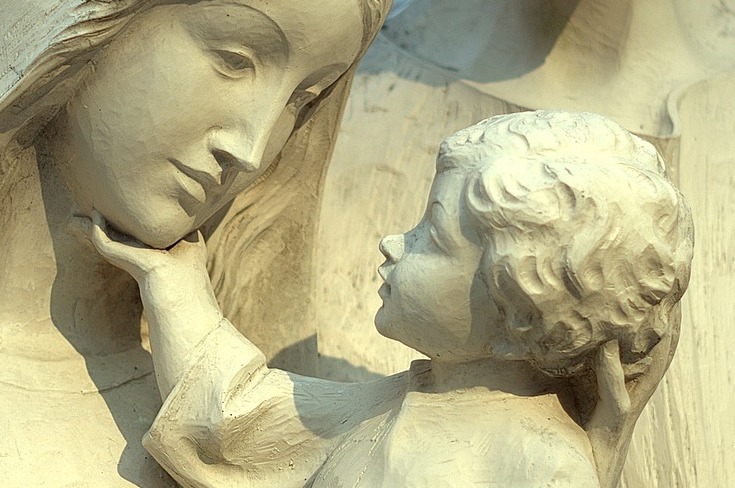
    Everyone knows the bond between a mother and her baby is special and that there is nothing in the world quite like it. But recently I came across some research that taught me things about it I didn’t know and that gave me new perspectives on the Blessed Mother.

    First, there is a physical basis to the phenomenon scientists call the “maternal instinct,” or others know as “Mommy brain.” Others like my older son who as a young child once inspected the back of his mother’s head, searching for the eyes hidden there. He wasn’t far wrong. During pregnancy a woman’s brain actually changes; areas related to the protection and nurturing of her baby develop as never before. This is nature’s way of attuning a mother to the needs and well-being of her children.

    It was no different for the Blessed Mother. From the moment the Holy Spirit came upon her and the power of the Most High overshadowed her (Luke 1:35), Mary began to develop the maternal instinct toward God himself. She alone among all women was to know the singular joy and tremendous responsibility of nurturing the Son of God; of protecting him from and preparing him for the world he came to save; of feeding him who thirsted for souls; and of providing a home for him who sought nowhere to lay his head except upon her breast, first as a helpless babe and then as a lifeless son taken down from the cross.

    It was from the cross that Christ raised Mary’s maternal instinct from the natural to the spiritual. With his words, Woman, behold your son (John 19:26) he gave her motherhood of his disciples, of all those like her who hear the word of God and do it (Luke 11:28). He made the bond complete when he told the Beloved Disciple, Behold, your mother (John 19:27), for in imitation of her Son we too have nowhere else to lay our heads. As her spiritual children we trust her, as he did, to see to our well-being and protection.

    The second thing I learned about the bond between mothers and babies is that children learn to recognize their mother’s voice in the womb and even prefer the language she speaks to any other they hear. By the time he was born, Mary’s voice was already very familiar to Jesus. And of course he prefers her language, for she speaks the language of total and selfless love. This is why we ask the Blessed Mother to speak to Jesus on our behalf; hers is the voice he heard from the time he was old enough to hear anything at all, the voice he could not refuse at Cana. Once again in imitation of him, Mary’s is the voice we too must not refuse, that says to us what it said to the servers at the wedding feast at Cana: Do whatever he tells you (John 2:5).

    Finally, I learned that perhaps the most important aspect of the bond between mother and baby is responsiveness. From the womb, mothers instinctively respond to the needs of their babies, giving from their own bodies whatever they have to give. This continues into childhood. Studies have shown that children thrive when their mothers respond to them in ways that foster growth and security; these especially include support and encouragement in difficult or stressful times. As Scripture makes clear, our Lord was no stranger to difficulty or stress, from his birth in a stable and flight into Egypt to his suffering and death on the cross. But Scripture also makes clear that Mary was with him at each of those times; in fact, she is the only one in all of Scripture to be present from his conception to his ascension. As such, Mary is the epitome of the supporting and encouraging mother.

    mother and baby

    One phrase in the readings perfectly summarizes the bond between Mary and her Son: I come to do your will (Psalm 40:8-9; Hebrews 10:7). For Mary this meant motherhood born of a love for God so deep that she, as Augustine once said, would conceive Christ in her heart before her womb. For Jesus it meant the Incarnation; a love so deep that he would take his own creation’s flesh and offer it back to his Father for the redemption of all who would accept him. Their obedience sets the pattern for us for we too are called to the same kind of obedience; to conceive Christ in our hearts; to offer to the Father the gift of ourselves in total dedication to Him; to love as Jesus and Mary loved. Without grace this is not possible, but this is the great hope of the Solemnity of the Annunciation, when the angel reminds us as he told the Fullness of Grace: nothing will be impossible for God (Luke 1:37).