Category: Reflections

Homilies and Reflections

  • Going Through the Motions: The Friday after Ash Wednesday

    Isaiah 58:1-9a; Psalm 51:19; Matthew 9:14-15

    After many years of playing the guitar I know that once I’ve learned a song, bad things can happen if I watch my fingers while I play. I make more mistakes, the music sounds too careful, too mechanical; I play without heart. When I forget what my hands are doing, I can focus on the music and everything feels and sounds better to me. I’d guess that many people in the performing arts would agree that at least on some level you just have to “go through the motions.”

    But while going through the motions may be fine in some contexts, it’s a real problem in the spiritual life. As we grow in our faith, we take on its rhythms; its prayers and practices become second-nature to the point that it’s almost as if we could do them in our sleep. But that’s just the problem; our tongues know them so well that our mind thinks that it isn’t needed. As a result, the practices that we learned specifically to grow closer to God can become the same practices that distance ourselves from him.

    Take for example the centuries-old practice of fasting; a good and pious practice that is supposed to remind us of the providence of God who is our only true and lasting nourishment. Yet, in the gospel reading today, the followers of John who were fasting seemed far less occupied with God and his providence and far more occupied with other people, particularly those who were not fasting. Of course, if their minds and hearts were fully engaged in the fast, the practices of Christ and his disciples would have been of little concern to them.

    This isn’t really about those disciples and it isn’t just about fasting. The dangers of routine in the spiritual life affect all of us, all the time. For me, it could be that I’m so used to fasting that I’ve forgotten why I ever began to do it; for you, it may be that your mind wanders during the rosary, the chaplet, the Stations, Adoration, or even Holy Mass. The point isn’t the practice, the point is where the mind and heart are directed while doing it. If we aren’t careful, even the most pious prayers and practices can be emptied of their meaning.

    Worse, our Lord reminds us through the prophet Isaiah that these devotions will not remain empty long; they will be filled with evil. Listen again as Isaiah says: Lo, on your fast day you carry out your own pursuits, and drive all your laborers. Yes, your fast ends in quarreling and fighting (Isaiah 58:3-4). No one who takes up a fast out of love for God wants to see their devotion end like that, but these are the logical conclusion when spiritual practices become a matter of merely going through the motions.
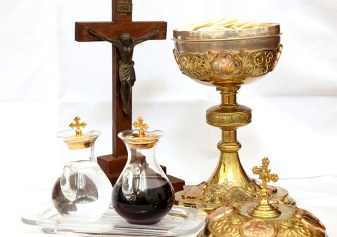
    cross-699617_640This is why our Lord counsels us through Isaiah to break from our routine, to find new ways to express our devotion and recover their original intent. That may mean learning new prayers; becoming active in a ministry that we haven’t done in awhile or ever; coming early to Mass for some quiet time with our Lord or staying after to make thanksgiving; paying greater attention at Mass especially at the Consecration; and taking special care to receive our Lord gratefully in Holy Communion. Whatever we do, God urges us to remember that these actions aren’t mere habits; they are tokens of the love and longing for God borne in our hearts, planted there by him and always drawn to him in whom alone we find rest and true union.

    Let us remember today the importance of vigilance in the spiritual life. It’s good to memorize our prayers and say them every day; it’s better to pray earnestly and from the heart. It’s good to attend daily Mass out of love for God and unity with one another; it’s better to use the healing power of the Mass to let go of the animosity, hatred, or enmity that separates us from others and from God. This takes effort; it takes sacrifice, but it is a sacrifice done from a heart like that of King David, who sang in today’s psalm:

    My sacrifice, O God, is a contrite spirit; a heart contrite and humbled, O God, you will not spurn.

  • Happiness: Tuesday of the Seventh Week in Ordinary Time

    Readings: Sirach 2:1-11; Mark 9:30-37

    Are people who practice their faith happier than people who don’t? It would seem so, if the results of a recent survey on religious practice can be trusted. Data collected from people around the world showed that those who are actively religious tended to describe themselves as very happy more often than people who are not. Here in the United States the difference is remarkable; actively religious people were over 40% more likely to describe themselves as very happy.1

    We might wonder what the non-religious would make of this in light of today’s readings. First they hear Sirach say, “When you come to serve the LORD… prepare yourself for trials… in crushing misfortune be patient… For in fire gold and silver are tested, and worthy people in the crucible of humiliation” (Sirach 2:1-5). This is followed by Jesus predicting his passion and death and then telling his power-hungry disciples that those who wish to be first “shall be the last of all and the servant of all” (Mark 9:35). So, the non-religious person asks, happiness comes to those who endure trials, misfortune, and humiliation; who carry crosses, finish last, and act as everyone’s servant? Sounds like a recipe for making myself unhappier than I already am!

    If we define happiness as feelings of contentment, well-being, or pleasant experiences, then they have a point; trials, humiliation, crosses, and servitude are the furthest thing from pleasant. But this is a misunderstanding. Happiness is not a feeling, it is a state of being; specifically, it is the state of being in union with God.

    Look at it this way: Both religious and non-religious people have good times and bad; they undergo trials, are humiliated from time to time, suffer misfortunes, and know what it means to sacrifice. The difference is that religious people see these times not only as something to endure or to learn from but as opportunities to unite themselves to God and to others and in so doing come closer and closer to loving as God loves.

    hospice-1793998_640Divine love is the key to happiness. Again, although religious and non-religious people know what it means to love, there are at least two important differences. First, the religious person knows that we can only be happy to the degree that we love as God loves and that no one showed greater love than Christ. None endured more trials, suffered more humiliation, was crushed by more infirmity, carried a cross weighed down by more sin, or was more of a suffering servant than he who did it that we his beloved may be spared. With this depth of love as the standard, we are called to imitate Christ in the love we bear toward each other, even and perhaps especially those we think least worthy of it. We can never be happy without doing so.

    Yet even our best effort to show this kind of love is in vain without the second aspect – hope. As the Catechism reminds us, “hope is the theological virtue by which we desire the kingdom of heaven and eternal life as our happiness, placing our trust in Christ’s promises and relying not on our own strength, but on the help of the grace of the Holy Spirit” (CCC §1817). The non-religious may love and will find some contentment in it but without God, there is no happiness; with God, the hope of happiness springs eternal.

    We should not be surprised that those who have received the gift of faith are happy. Christ promised it to the mourning, the meek, and the merciful; to the peacemakers and the persecuted; the humble and hungry; to all those who would imitate the love he showed by offering himself for the life of the world: “Rejoice and be glad, for your reward will be great in heaven” (Matthew 5:12).

    1 Marshall, J. (2019). Are religious people happier, healthier? Our new global study explores this question. Available online as of 02/19/19 at https://pewrsr.ch/2MEWOYx.

  • Come Away By Yourselves – Saturday of the Fourth Week in Ordinary Time

    Hebrews 13:15-17, 20-21; Psalm 23:1-6; Mark 6:30-34

    Some of the best advice I ever got about working in the Church came from a spiritual advisor who encouraged me to “look for ways to unwind” with other clergy and parishioners. He said that part of our job is to teach people by example that we’re not meant to spend all of our time together exclusively at Mass or in meetings; we should make time to talk, relax, laugh, get to know each other, and enjoy each other’s company.

    Jesus models this in today’s gospel. Recall that the Twelve had been sent out on a mission to preach, exorcise demons, and heal the sick. Now they have returned, reassembled, and just recounted to their Master all that happened to them on their journeys.

    I know from personal experience that there is joy both in the mission and the return. In the mission we use the gifts we have been given in the way best suited for the situation; this is the time to plant seeds as best we can and to pray for their growth. During the mission time we experience all that it has to offer – good and bad – and these affect us for the better and the worse. Our return is the opportunity to share these experiences with each other and in so doing relive the triumphs, laugh at the mistakes or foibles in ourselves, but also to relieve the stress of the problems and see that we are not alone; others along the way have seen many of the same things.

    By inviting the Twelve to “come away by yourselves to a deserted place and rest a while” (Mark 6:31), Christ modeled the virtue of temperance. Mission and return, as fulfilling as they are, aren’t enough. We also need leisure; not so much a time to play as a time to unwind, to share quiet, personal time with each other and most importantly with Him. There will be no advance in our spiritual life without such a retreat.

    Take a moment to picture in your mind what this time with Jesus might look like. Choose your own deserted place – just you, a small group of friends, and Christ. He wants nothing more than to be with you and spend the afternoon. He has no agenda other than you; to listen to you, laugh and/or cry with you, and to enjoy the peace of the moment together with you.

    We all know that on this side of eternity that kind of time won’t last forever. The mission must begin anew. In the gospel at that very moment the crowds were searching for them and did find them. In his infinitely merciful love, Christ fed them and will soon teach his Apostles how to do so by the thousand.

    But the lesson today is that the mission best begins anew once its ministers are renewed. Our bodies and spirits grow weary and need recharging. Without renewal we risk burning out instead of burning with the Spirit; the same fields that shine for the harvest come to resemble the dark valley of the psalm (Psalm 23:4).

    jesus-3499151_1280Nevertheless, the letter to the Hebrews assures us that the God of peace furnishes us with all that is good, that we may do his will and carry out what is pleasing to him through Jesus Christ (Hebrews 13:20-21). The greatest good is Christ, the Good Shepherd who remains at our side and invites us to come away by ourselves and rest awhile. Only there, beside the restful waters where he restores our soul, can we the sheep once again become the shepherds he has called us to be.

  • The True Reward – Tuesday of the 4th Week in Ordinary Time

    Hebrews 12:1-4; Mark 5:21-43

    Today we are presented with two characters who are among the easiest in the entire gospel of Mark to sympathize with. The first is Jairus, the father of a dying twelve year-old girl; the second, an unnamed woman plagued with continuous menstrual bleeding. Who cannot sympathize with a man helplessly watching as life ebbs from the body of his daughter, or a woman left broke from futile medical treatments whose perpetual state of uncleanness condemns her to live out her life suffering and isolated from her family, friends, and society at large?

    Yet for all that the evangelist doesn’t want to evoke sympathy; rather, his intention is to draw us into the action, to see ourselves in the stories and characters. This is an effective technique not only for contemplating and better understanding the actions of Christ and those around him but ourselves as well.

    These characters make this easier because their stories resonate across time. We’ve all known people whose children have suffered life-threatening illnesses or who have gone from doctor to doctor with no relief of their suffering. We may be those people! What did we do? Being believers we prayed, asking God for relief. Certainly Jairus and the woman prayed; however, neither had gotten the answer they wanted. The question is, what would our reaction be to that?

    If we’re honest with ourselves we must admit that sometimes when our prayers are not answered as we want, we’re tempted to stop praying; to be angry at or resentful toward God. While this is perfectly normal the honesty works both ways; that is, if we’re going to question God’s motives then we must question our own by asking if our image of God is as a Father or as an instrument to be used (CCC §2734)? That is, are we praying “Thy will be done” or “My will be done”?

    Consider Jairus. Mark calls him a “synagogue official” and in his gospel they are no friends of Christ. Even if he was a disciple, the scandal of association might have kept him away. No matter; his love for his daughter eclipsed everything. Even if his prayer at the feet of our Lord was tinged with ambivalence or fear, Jesus rewarded him for overcoming it and trusting in God’s providence rather than his own understanding.

    Next, consider the woman by the side of the road. She was afraid to approach our Lord, perhaps because of her impurity. Nevertheless, her desperation and frustration drove her to find Jesus, if only to touch his garment. While her immediate healing implied faith on her part, Jesus wanted her faith expressed.church-753815_1920 Even so, he doesn’t demand, only asks, “Who touched me?” Now think about her response. She could have hidden or run away; instead, she approached him and confessed all. Only then did he say that her faith cured her.

    The letter to the Hebrews exhorts us to “rid ourselves of every burden and sin that clings to us and persevere in running the race that lies before us” (Hebrews 12:1-2). This is much easier said than done when we are suffering but the key lies in the next phrase of that verse: “while keeping our eyes fixed on Jesus, the leader and perfecter of faith” (Hebrews 12:2). The important thing is not that Jairus and the woman understood or were unafraid; they may have understood nothing and been completely afraid. The important thing is that they persevered, they kept their eyes fixed on Jesus. They allowed faith to be their guide and in so doing went beyond their understanding, beyond their fear.

    That is the boldness of faith, founded on divine love and rewarded with transformation of the heart (CCC §2739). It is true that both women in today’s gospel story were healed, and that is a reward in itself, but the true reward given to Jairus and the woman was transformation of the heart. This transformation causes us to seek only what pleases the Father, and it’s why St. Josemaria Escriva urged us to begin our prayers of petition with the words, If it pleases you, Lord…. He knew, as the Catechism teaches, that “If our prayer is resolutely united with that of Jesus, in trust and boldness as children, we obtain all that we ask in his name, even more than any particular thing: the Holy Spirit himself, who contains all gifts” (CCC §2741).


  • From Little Seeds – Friday, the 3rd Week in Ordinary Time

    Psalm 37:5; Mark 4:26-34

    Tradition dating from the second century tells us that St. Mark was writing to a Christian community in Rome that had experienced its share of persecution and failure. This was a community where it seems that people were leaving the faith under the threat of torture or death, leaders were more interested in preserving their own well-being than in leading the community, and evangelization was met with indifference or at times hostile rejection. Under these conditions, it would be hard not to lose hope.

    Given that, it might be hard to understand how such a community would benefit from grasses-1939673_1280hearing parables about farmers and seeds. For that matter, it may be hard for us in the modern age to see the point. Jesus teaches us that seeds grow in the ground of their own accord and mustard seeds are small but grow into bushes large enough for birds to nest in. OK, but what is the point of this?

    Simply put, Jesus is giving both them and us very good reason to hope.

    Earlier this week, we heard him explain that the seed is the word of God. Once, those seeds were sowed within us. We heard them and over time they took root and grew. Now we are called to sow the same seeds in the hearts and minds of other people.

    Here though we must remember one important point. Jesus teaches that those who sow the word do not control the growth. Just as a farmer can cultivate the soil, plant at the right time, and rotate the crops, but cannot control the elements, so it is with us. We sow the word in whatever ways our talents lead us, but we cannot worry about how to control its growth. That must be left to God. We are asked only to have faith that God will bring forth abundance in his own time according to his own design.

    The second point concerns the seed itself. Namely, the seed is not only the word; it is also the person in whom the word has taken root. Jesus reminds us that from something as tiny and insignificant as a mustard seed comes a bush that can flower and grow several feet high. Imagine that one little seed as one seemingly insignificant person. Isn’t that how God has always worked? In the Old Testament, think of Joseph with the coat of many colors; Moses; David. In the New Testament, think of Mary, the mother of our Savior. It’s always the little people, the human mustard seeds, in whom the word of God flourishes and through whom mighty things are accomplished.

    Taken together, these parables told St. Mark’s community exactly what they needed to hear, and they do the same for us. First, the seed is the word of God. It has been sown in us and we are to sow it in others. It will flourish, but it will do so according to a design over which God alone has control. Second, no person, no community is too small or insignificant to serve as an instrument for God. There is great hope, for all that is needed is openness to hear the word of God and do it.

    As Psalm 37 reminds us: Commit to the LORD your way; trust in him, and he will act (Psalm 37:5).