John 1:45-51
If the Church were to have a patron saint for the cynical, St. Bartholomew just might qualify. Matthew, Mark, and Luke call him Bartholomew; John calls him Nathanael. We can call him cynical, for it was he who asked: “Can anything good come from Nazareth?” Yet the question and the cynicism behind it aren’t nearly as important as the answer, which touched Nathanael deeply and goes right to the heart what it means to evangelize.
It looks like the first to answer his question was Philip, who invited Nathanael to meet Jesus, saying simply, “Come and see.” Inviting people to meet Jesus is an important step in evangelization. Years ago, Pope Paul VI taught us that it the mission of the entire Church to evangelize; that the full meaning of life in Christ is only found in becoming a witness for Christ by what we say and do. Those who make their entire life a witness radiate the self-giving love of Christ and tend to attract other people, for they make them feel special, appreciated, and valued.
As important as the invitation is, deeper study of this scene in John’s gospel makes it clear that the first to answer Nathanael’s question was really Jesus himself. Note that Jesus said to him: Before Philip called you, I saw you under the fig tree. While no one knows exactly what happened under that tree, Nathanael’s reply, Rabbi, you are the Son of God; you are the King of Israel, betrays a mystical encounter so profound, so compelling, that it forever changed Nathanael’s life and the lives of all those he would touch.
 Thus, the encounter with Christ is the key to evangelization. As Cardinal Francis George once said, evangelization consists of introducing people to Christ and allowing him to take over from there. No matter how eloquent, forceful or dramatic we are, the human word pales in comparison with the Eternal Word. Like Nathanael, every person has their own “fig tree” moments; at one time or another, everyone quietly contemplates the eternal, the divine, the transcendent. This is a mystical silence into which we dare not intrude; it is the stillness in which God speaks. The God who sees what we cannot – the heart and soul – speaks to whole person as we cannot. Again like Nathanael, the effect is all-encompassing and all-surpassing.
As Christ went on to say, Nathanael would see much greater things, but he had already seen all he needed to see. Thanks to the invitation by Philip and his personal encounter with Jesus, the Apostle literally poured out his life evangelizing others.
Can anything good come from Nazareth? Thanks to St. Bartholomew and all the Apostles, we who were invited and have been touched by Christ no longer need to come and see. At every Eucharist we can now taste and see the goodness of the Nazarene who hung the word Good on Friday. All that remains is that we, like all the saints, use the grace of Communion with Christ to make our lives an open invitation, that everyone may come and see Christ and taste his goodness for themselves.
St. Bartholomew, pray for us.
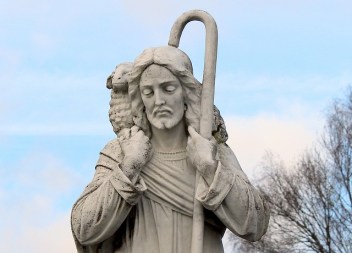 The answer can be read between the lines of our Lord’s question in today’s gospel: He doesn’t want any to be lost. He wants the shepherd to go out and find them. Even one.
 The answer to all of this is given by Jesus in the gospel and can be boiled down to one word – vigilance. If you sense that you are distracted in prayer, then let that become your prayer. Say, “Lord, see how weak I am. I can’t even focus on you now when I need you the most!” In your weakness Christ will be your strength. If you feel like God is far away, remember: God doesn’t move, we do. Weak faith causes us to drift. We strengthen it with exercise, so pray more, not less; attend Mass more often; see him in Adoration. If you find yourself putting off prayer, remember Christ’s words: At an hour you do not expect, the Son of Man will come (Luke 12:40). Also, remember his reaction to finding people not doing what he asked; it did not go well for them. Finally, when you’re discouraged remember Abraham and everything he went through. In faith he left his native land, wandered homeless, and nearly lost his only son. As if that wasn’t enough, he was never allowed to actually live in the land he was promised. Those are pretty good reasons to be discouraged! Still, no matter where he was, he always built an altar and sacrificed to God. He could lose his home, his son, and the land of his inheritance, but he never lost heart; he remained faithful, prayerful, and vigilant to the end. So can we.
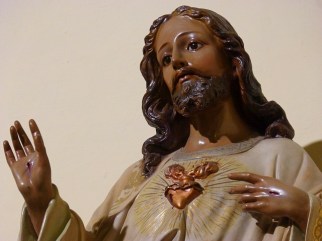 Jesus spent his life and ministry showing us what it means to love as God loves: He made himself vulnerable in the sight of others, exposed his deepest longings, deepest fears, deepest joys, his deepest self. Of course, he risked rejection and it cost him his life, but that is what love does; it was in the nature of his perfect divinity that from the depths of his infinite love and mercy, he glorified what mankind so quickly crucified.
 What is unique to Luke in the Transfiguration is the dimension of prayer. Only he tells us that Jesus ascended the mountain to pray. Luke properly understands it as a tale of two mountains: On the one, the unnamed mount of Transfiguration, the prayer of Jesus results in a glorious vision, he dazzling white, his face shining, his Father speaking to the apostles awakened. On the other, the mount of Gethsemane, the prayer of Jesus will end in the passion, his face sweating blood, his Father silent, and these same apostles sleeping. Luke is clear: We cannot have the glory of the Transfiguration without the suffering of the cross. In Christ, the two are inextricably bound. What’s more, this is the cost of discipleship; later in Luke Jesus will say, Whoever does not carry his own cross and come after me cannot be my disciple (Luke 14:27)
 Jesus could; Jesus did. He “took” the loaves and fish, “looked” to heaven, “said” the blessing, “broke” the loaves, and “gave” them to the disciples. If that sounds a lot like the actions of Jesus instituting the Eucharist, that’s because it is. In feeding the multitudes, Jesus showed that only God could carry the world; only God could unite a house divided. The Eucharist foreshadowed by Christ in the gospel is the sacrament of unity; it is the antidote to the enemy within that seeks to divide.
 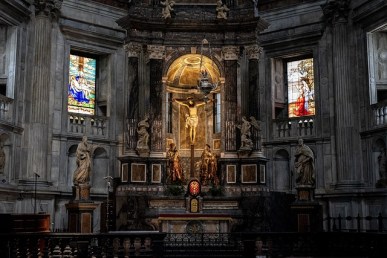 The complication is that our senses can actually keep us from seeing the spiritual reality. We become so preoccupied with what they’re telling us that we miss what lies beyond them. When I walked through St. Mary Major I saw every artistic and architectural wonder she could reveal but missed the revelation that all of it pointed to, the greatest one possible – Christ in the most holy Eucharist. As for the people at Mass, they were also at risk of preoccupation, not with works of art but with their own thoughts or problems. In either case, the task before us is to concentrate on the glory being revealed to us, for it alone is the more lasting and soul-satisfying.
 Today we honor Saints Joachim and Anne, the parents of Mary, for many reasons related to salvation in memory and reality. Most especially we honor them as husband and wife, for it was their marriage, their union that produced the Immaculate Conception, which transformed the dim, distant memory of salvation into a living, breathing, crystal clear reality. We also honor them because, as the last of that long line of generations who patiently waited through the long night for the first rays of salvation’s dawn, doing so honors all the faithful who lived through and, in whatever ways they could, passed on the events of salvation history to those who came after. Finally, we honor them as parents, for they raised their daughter in the faith, taught her the love and goodness of God, and instilled in her the devotion He preferred for the mother of His Only Son.
 Of course they could; the question was, did they know the cost? As Pope Francis once said, “I distrust a charity that costs nothing and does not hurt.” Jesus is Charity itself; God is love and there is no greater love than to die that others may live. Such a love virtually promises to hurt. Where James may have imagined sweet wine, a crown of leaves, and the cheers of a crowd, Jesus offered bitter gall, a crown of thorns, and a crowd cheering to see Him die.
 If the Pharisees had been thinking from this perspective they would have realized that the disciples were not just walking through a field wantonly plucking heads of grain in supposed violation of the sabbath; they were following Christ, giving their lives every day of the week, including the sabbath, to the Lord of the Sabbath.
 Mark 10:45