Category: Reflections

Homilies and Reflections

  • No Trumpets

    No Trumpets

    Monday of the 1st Week in Ordinary Time

    1 Samuel 1:1-8; Mark 1:14-20

    Dancer and author Agnes de Mille once said, “No trumpets sound when the important decisions of our life are made. Destiny is made known silently.”

    That line captures the quiet power of today’s Scriptures.

    In the first reading, there are no trumpets for Hannah—nothing dramatic at all. No angels, no voices from heaven, no sudden change in her circumstances. She must have wished there were! We can sense her anguish, her misunderstood suffering, and the frustration of a pain that returns year after year. The real question is whether she will remain faithful in her suffering, despite the seeming silence of God.

    The Gospel is just as understated. Jesus simply walks along the shore and says to four fishermen, “Come after me.” No fanfare. No crowds. No explanation of where this will lead or what it will cost. Like Hannah, their decision rests on whether they will trust God and act without understanding what lies ahead.

    Of course, we know how these stories unfold. Because of Hannah’s faithfulness, God blesses her with a son—Samuel—who becomes prophet, judge, and king-maker. The Apostles, despite their repeated confusion and fear, ultimately remain faithful to Christ and become the first pillars of the Church.

    But that’s hindsight. What about now? What about us?

    For most of us, God’s call sounds far more ordinary. It may be when someone asks us to serve in the parish in a way we don’t feel qualified for, when a neighbor needs help at an inconvenient time, or when prayer begins to feel dry but we know we should keep going anyway. Nothing dramatic happens. No one applauds. And we may wonder whether any of it makes a difference.

    The point of the readings is that the so-called “ordinariness” of life is precisely where faith is lived. And it’s actually far from ordinary.

    Like Hannah and the Apostles, there are no trumpets or clear signs. Even when we do sense God’s call, we can’t see clearly down the road. All we know is that God comes quietly into our lives, asking us to follow Him without recognition, without certainty, and without any guarantee that our suffering will be quickly resolved. But Scripture also teaches us that God is always with us, and if we remain faithful, He will work through us in extraordinary ways.

    Some years ago, Thomas Merton summarized this in a beautiful prayer which I ask you to pray with me:

    “My Lord God, I have no idea where I am going. I do not see the road ahead of me. I cannot know for certain where it will end. Nor do I really know myself, And the fact that I think I am following your will does not mean that I am actually doing so. But I believe that the desire to please you does in fact please you. And I hope I have that desire in all that I am doing. I hope that I will never do anything apart from that desire. And I know that if I do this, you will lead me by the right road though I may know nothing about it. Therefore I will trust you always though I may seem to be lost and in the shadow of death. I will not fear, for you are ever with me, And you will never leave me to face my perils alone.” 1

    1From Thoughts In Solitude by Thomas Merton, first published in 1956.

  • Holy Families, Not Perfect Ones

    Holy Families, Not Perfect Ones

    Sirach 3:2-6, 12-14; Colossians 3:12-21; Matthew 2:13-15, 19-23

    The Scriptures for the Feast of the Holy Family speak honestly about family life; not as perfect, but as a place where faith is tested and love is learned.

    Sirach tells us, “Take care of your father when he is old… even if his mind fails, be considerate of him.” He does not limit this call to ideal relationships. It is a summons to faithful love, even when family bonds are complicated or strained.

    That passage reminds me of a time when, as a teenager, I traveled with my father to New York to be with his own father, who was alone and dying of cancer. I didn’t know the details, but I knew there had been difficulties between them. Yet during those few days, I didn’t see that. All I saw was a patient, gentle, attentive son. No speeches, no attempts to fix the past… just the silence of Dad’s presence, care, and compassion.

    Those images have never left me. More importantly, they helped me see Dad in a new and illuminating light. Just like he had struggles with his father, I had struggles with him. Despite all that, watching him live out that kind of reverent love went a long way toward healing our relationship. That mattered, because Dad died young. Had I waited, that healing might never have come.

    St. Paul urges us to “put on compassion, kindness, humility, gentleness, and patience.” In the Gospel, Joseph does just that: he silently rises, protects those entrusted to him, and trusts God with his family’s future. Watching Dad live that way has challenged me to do the same.

    And it’s about challenge, after all. While the Feast of the Holy Family rightly draws our eyes to Jesus, Mary, and Joseph, it’s not about comparing the Holy Family’s perfection to ours. Rather, the Feast invites us to challenge ourselves; that the love in our family be stronger than our resentment, our presence stronger than our history, and our faith strong enough to act — quietly, faithfully, and one day at a time— so that God’s love and peace may work through us to bring healing and wholeness.

  • The Stone and Love

    The Stone and Love

    As I’ve said before, one way to try and make sense of the gospels is to put yourself into them, to be at the scene. John’s gospel account today lends itself well to that: Not finding Jesus, Mary wonders what happened; Peter, hearing from her that Jesus isn’t there, runs to the tomb and rushes in to see for himself; John, breathless, peers into the empty tomb and believes.

    Yet, everything that happened after Mary arrived at the tomb depended on the one thing I couldn’t understand: Why was the stone rolled away?

    Being God, Jesus certainly didn’t need it moved. His glorified body will soon be passing through locked doors as if they aren’t there, suddenly appearing or disappearing, and ascending into the heavens. The stone was no obstacle to him.

    Then it occurred to me… it was an obstacle to us. If the stone hadn’t been rolled back, Mary wouldn’t have searched for an answer, Peter wouldn’t have rushed in, and John wouldn’t have believed. The stone wasn’t rolled away for the Lord’s sake; it was rolled away for ours.

    Still, the people in the story didn’t have to respond as they did. Mary needn’t have gone to the tomb at all, let alone wondered where the body of Jesus had been taken. Peter and John could’ve stayed where they were and kept doing whatever they were doing.

    But they didn’t. Why? Love.

    Mary Magdalene loved Jesus because he had healed her and turned her life around. Love doesn’t settle; it keeps searching, even when hope seems lost. For his part, Peter might never live down denying Jesus three times, but he had also confessed him as Messiah, the only one to Whom they could go. His is a love that may be imperfect and impetuous, but it moves; it doesn’t hesitate in the face of mystery. And John, so often called the Disciple Whom Jesus Loved, shows us by seeing and believing, that the eyes of love recognize truth, even when they don’t fully understand it.

    Thus, while Mary, Peter, and John each responded differently, love is the common denominator. The empty tomb evokes not just curiosity; it evokes love’s response.

    As for us, this is the time to measure our own love for Christ, and our own willingness to respond. The Resurrection isn’t a mere historical event; it’s a personal invitation. The stone is still rolled back today – not because Jesus needs help getting out, but because we need help getting in: into faith, into hope, into the new life he offers.

    Love searches. Love rushes in. Love believes.

  • Savoring Scripture: Engaging with the Word of God

    Savoring Scripture: Engaging with the Word of God

    St. Jerome once said that if we believe that Christ is contained in both the Eucharist and the Bible, we should give them equal reverence. When a consecrated host falls on the floor, we carefully pick it up and thoroughly clean the area so nothing is lost. But if we don’t listen to the Word of God, it’s like allowing Christ to remain on the floor; that encounter is lost forever. With that in mind, on the Feast of St. Jerome in 2019, Pope Francis declared the 3rd Sunday in Ordinary Time as Word of God Sunday. His goal was to enable the Church to “experience anew how the risen Lord opens up for us the treasury of his word and… proclaim its unfathomable riches before the world.”1

    Two basic problems challenge our experience reading the Bible. First, over-familiarity; we know a passage so well that we “tune it out,” assuming we know everything we need to. Second, ignorance; a passage is difficult (think, “St. Paul”) so we let it go, intending to, but never getting back to it. Instead, our goal should be to experience the Word of God the way some people experience fine wine – or, if you’re like me, fine Belgian chocolate – by savoring it. For example, rather than taking on all of today’s first reading, let’s “savor” just two verses: Ezra read plainly from the book of the law of God, interpreting it so that all could understand… ‘Today is holy to the LORD your God. Do not be sad, and do not weep’— for all the people were weeping as they heard the words of the law (Nehemiah 8:8-9).

    Step 1: Understanding. Nehemiah may be unfamiliar, but look it up and you’ll see that this book and its twin, Ezra, were written to tell us what happened when the Jews exiled in Babylon were allowed to return to Jerusalem, rebuild the Temple, and recover their way of life. To set the scene, we’re at the point when everyone is at the Temple celebrating the Feast of Booths (also known as Tabernacles). This may be the first time doing so for some of them in over 70 years.

    Step 2: Put yourself in the story. Imagine you were very young, maybe 6 or 7 at the time of the exile, and for decades, all you had were memories of home. Now, here you are, standing where you and your family stood years ago, doing what they did. Or, imagine you’re one of the Jews not sent into exile; you were left behind with a ruined Temple and no priests. Now, the Temple and city walls have been rebuilt, the priests and people have returned, and the Law is heard again. Maybe God is finally making His people whole! Each person will have their own story, but for so many of them, young and old, this is a profound and emotional moment. And this is just one way to look at these verses; there are many more.

    Step 3: Relevance. So, what does all this have to do with us? A lot! For one thing, it’s a moment to stop and reflect on all those who passed on the faith to us: Parents, teachers, friends – without them, we wouldn’t be here. They are God’s gift to us. For another thing, it prompts us to ask, to whom are we God’s gift? How do we pass on the faith? Can we do more? Also, this is a reminder that every verse of Scripture has a depth, beauty, and power that are just waiting to be revealed.

    Step 4: Prayer. We end our time with the Word of God in prayer, like: “Lord God, thank you for the gift of faith; for all the people you put in my life who passed it on at whatever cost to themselves. Give me the grace to pass on the faith and to proclaim it by the example of my life, that Your Name may be more greatly known, honored, and loved, in my own life and in the lives of all those I meet.”

    There are over 31,000 verses in the Bible. It’s overwhelming to imagine savoring each of them this way. But we don’t have to. What matters isn’t that we do everything, but that we do something. So, try this: Regularly, or every day if you can, choose a verse or two that jump out at you in the day’s Bible readings (at https://bible.usccb.org/), or from your Bible, and go through the steps above. The Word of God, Jesus Christ, is waiting for you there. Savor every encounter.

    1https://www.vatican.va/content/francesco/en/motu_proprio/documents/papa-francesco-motu-proprio-20190930_aperuit-illis.html

  • The Only Lasting Joy

    The Only Lasting Joy

    Saturday of the 3rd Week of Advent

    Zephaniah 3:14-18a; Luke 1:39-45

    This is the time of year when the whole world seems to focus on joy. Everything from songs to decorations to napkins urges us to be joyful. We hear it in the readings today: Shout for joy, O daughter Zion! Sing joyfully, O Israel (Zephaniah 3:14), and … the infant in my womb leaped for joy (Luke 1:44). But, if you’re anything like me, you might find that, while you do feel joy sometimes, other times you don’t. Call it the stresses and strains of life, the rush of so many places to go and people to see during the season, or just being under the weather – whatever it is, we don’t always feel joyful.

    Should we? We might be tempted to think so, but if we pause and reflect a little more deeply on the readings, a fuller picture emerges.

    First, we heard Zephaniah speak of joy to daughter Zion. At that time, “daughter” was used to refer to the suburbs of a city, the area just outside its walls or gates. In this case, that was the Israelites who had returned to Jerusalem from exile and now faced the daunting task of rebuilding the Temple and their whole way of life. While there was some short-term happiness in the return, the long term was full of fear and uncertainty. Thus, when the prophet spoke of joy, he wasn’t asking the people to feel joyful, but to rejoice in the assurance that God had not only not abandoned them, but would actually be in their midst as their Savior! This was a joy that nothing and no one could take away.

    Then in the gospel, we heard that John leapt in the womb of his mother. Although he was certainly joyful in that moment, we cannot help but think forward to his ministry years later: Regardless the outcome – acceptance or rejection, challenge or even threat to his life – his vibrant and unshakable proclamation of the coming of Christ reflected a joy that also could not be taken away.

    From these two examples, we see that what matters isn’t whether we feel joyful, but whether we are joyful. Feelings, even joyful ones, come and go like any emotion. On the other hand, spiritual gifts such as joy are meant to last, because they come from God. This gift, as Holy Father Francis says, is “the fullness of consolation, the fullness of the presence of the Lord… The great strength that we have to transform, to preach the Gospel, to go forward as witnesses of life is the joy of the Lord, which is a fruit of the Holy Spirit, and today we ask him to grant us this fruit.”1

    So, if we want lasting joy, the Holy Father has told us what we need to do: Go forward as witnesses of life, resting in the assurance that, as with the daughter of Zion, God will always be our consolation, and as with the Baptist, will give us the continual joy of His presence. No matter what we do, be it mourning or laughing, if we are His witnesses as we do it, the fruit of that love will always be joy.

    What better time to ask the Holy Spirit for this Christmas gift? That we, like the Blessed Mother, Elizabeth, John the Baptist, and all the Saints, be the best witnesses of life; that we may know and be able to share with everyone the deep and lasting joy that comes only from loving God and daring to go wherever that love takes us.

    1https://www.catholicnewsagency.com/news/44217/joy-is-more-than-emotion-it-is-a-gift-of-the-holy-spirit-pope-francis-says

  • Mother and Queen

    Mother and Queen

    The Queenship of Mary (August 22)

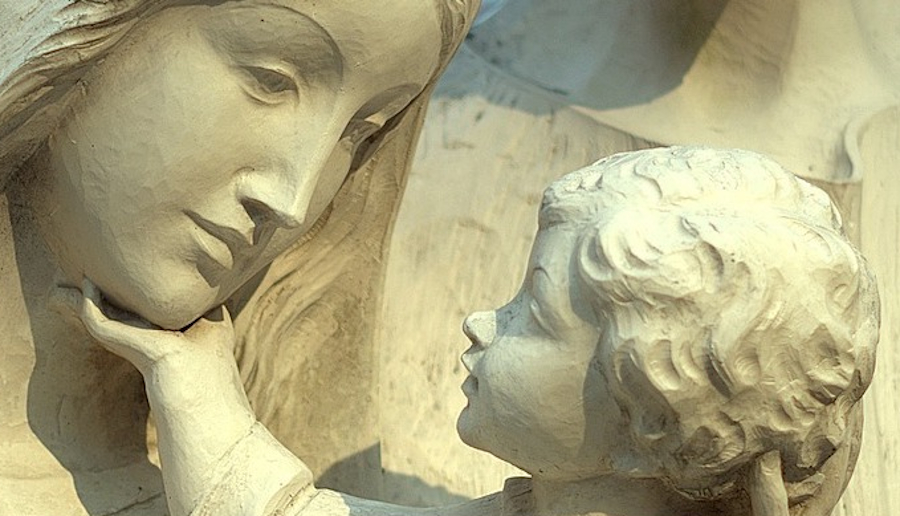
    When my son was very little, he asked my wife to turn her head so he could inspect the back of it. He was convinced she had an extra set of eyes back there somewhere.

    I sympathize. It was the same with my own mom; she always seemed to know what was going on with me. Even after I grew up and would call home, just one “Hello” out of my mouth and she would say, “OK, Richard, what’s wrong?”

    Who knows a boy better than his mother?

    I’m a father myself, and I can sense some things in my children, but nothing like their mother. Call it women’s intuition, call it what you will, I think there’s a certain grace poured upon a mother that binds her to her child like no other. Maybe it’s because a mother’s womb is our exclusive home for the first 9 months of our lives; Mom is all we know and all we can know. Everything we need for life comes through her and depends on her.

    Consider that in the context of Christ and his mother. Who has ever known Christ better than she, and who would love her more than he?

    Ask yourself: How would he, who wrote the commandments, including, “Honor your father and mother,” honor his mother? She who was his exclusive home for the first 9 months of life, who cradled him in her arms, fed him, dressed him, taught him to walk, helped him learn the Scriptures he gave the world, sang to him, shared a home with him for 30 years, and ultimately laid him in the tomb – all the while pondering these mysteries in her heart and loving him as only a mother can.

    The answer can only be that he would honor her perfectly.

    As the First Book of Kings shows, the king’s mother was queen; the only person for whom he would stand when she entered the room. In Heaven, the King of kings would do no less, and giving her to us from the Cross asks that we do no less.

    Mary, our Mother and Queen, pray for us.

  • When the Going Gets Tough

    When the Going Gets Tough

    Wednesday of the 18th Week in Ordinary Time

    Jeremiah 31:1-7; Matthew 15:21-28

    Today’s readings are a reminder that throughout salvation history, there have been times when the going has gotten tough. Consider the Israelites to whom Jeremiah was sent: Their world crumbling around them, dark times were getting darker. Didn’t God see this? Couldn’t He hear their prayers? Where was He? And the Canaanite woman in the gospel: Helplessly watching her child suffer, in desperation she sought out Christ, only to be turned away by the disciples and then even by Christ himself. Things don’t get much tougher than that.

    The question is, when times get tough, how do we respond? We’d like to think we wouldn’t give up hope, but that’s a tall order. Even when Jeremiah assured the people that God hadn’t forgotten them, better times were coming, and He would restore them, the frustration of waiting was too much for many, who gave up and fell away. Nevertheless, the prophet closes hopefully, speaking of a remnant, a faithful few, who would persevere. For her part, the Canaanite woman is a model of perseverance, showing dramatically the extent to which true love is willing to go. What parent cannot sympathize? With her child suffering, no disciple, no apostle, no man, nothing and no one could keep her from Christ. Not only that, even when Christ himself challenged her by using her as an example in a parable, she refused to give up, even if that meant doing what no one else ever did in all the gospels: re-write the ending to one of his parables to make herself – and her daughter – the winner.

    Remember the old saying: “When the going gets tough, the tough get going.” Well, that’s clearly what God wants, for He abundantly rewards it. As we hear in Jeremiah tomorrow, He will promise a new Covenant with His people, one written not on stone but in our hearts. And in the gospel, our Lord’s reply, O woman, great is your faith, and his healing of the woman’s daughter, shows that when he is approached in patient yet persistent prayer, his response is absolute delight.

    So, today and every day, let God delight in us. Let us be that remnant – resilient, our eyes fixed on Him who will deliver us – and the faithful one who perseveres patiently in prayer, all for the sake of the same love Almighty God has for each one of us.

  • Truth or Consequences

    Truth or Consequences

    Saturday of the 17th Week in Ordinary Time

    Jeremiah 26:11-16, 24; Matthew 14:1-12

    Long ago, in a parish far, far away, I attended a meeting between some parishioners and our pastor. I don’t recall the circumstances, but there was some dispute between him and them. During the meeting, Father said, “I’m sorry you don’t like what I had to say, but first, stop and ask yourself if what I said is true. Maybe I could have said it more nicely, but the real question is: Even though you don’t like it, is it the truth?”

    I thought about that while reading today’s Scriptures. The prophet’s job was not to be nice, but to speak the truth to whomever God wanted, whether they wanted to hear it or not. Sometimes it was soft and comforting; others, hard and unsettling. Either way, it wasn’t the prophet’s word, it was God’s – the plain, unvarnished truth – and meant to be taken as such.

    As the readings show, the stakes for the prophet were the highest possible – his life – and that depended on the reaction of his judges. Jeremiah was spared because the people took their time and debated his case in light of previous prophets. John was not so lucky; his judge was Herod. As Matthew depicted him, we see how ignorance, lust for power, and pride blinded him to justice.

    First, he tells us that Herod knew nothing about Jesus and didn’t care to learn. We know many things about him, but are we ever tempted to think we’ve learned enough, or to avoid learning things that challenge us to change our life? Remember, one of the spiritual works of mercy is to instruct the ignorant, and that includes ourselves; we are obliged to learn whatever we can about the faith, for Christ has entrusted it to us to live and bring to the world. How can we do that if we don’t know it?

    Second, Matthew says that Herod feared not John but the people. As a tetrarch (“fourth-of-a-king”), he had little power compared to real kings like his father, and was desperate to hold onto what little he had. As for us, what are we desperate to hold onto? Maybe we’ve given everything to Christ except that one little thing, that one part of us, we dearly want to keep for ourselves. Committing to Christ means letting go of our desire for control and submitting entirely to him, as he committed himself entirely to us.

    Third, human pride. Herod may have felt some distress at the idea of killing John, but that didn’t outweigh the distress of losing face to his guests. We haven’t killed people to preserve our pride, but maybe we have hurt someone’s reputation to save our own, or wounded others who have injured our pride. What can counteract this but the humility of Christ, who came to serve and not be served?

    The readings today are a call to look for any trace of these warning signs lurking within us when our Lord challenges us to listen and respond to his Word. It is a daily battle, so let us pray for the strength to continue learning as much as we can about Christ and his Church, to let go of every attachment that keeps us from giving ourselves totally to him, and for the humility, not only to see the truth about ourselves, but to love it, for truth isn’t a thing, it’s a person – Jesus Christ.

  • The Harvest is Coming

    The Harvest is Coming

    Saturday of the 16th Week in Ordinary Time

    Jeremiah 7:1-11; Psalm 84:2; James 1:21; Matthew 13:24-30

    Like all parables, the intriguing parable we hear today contains a twist or surprise that is designed by our Lord to make us think. The twist is that the sower decided to leave the weeds in the field. Very few gardeners or farmers, then or now, would expect that. Why not let the servants pull them, so the wheat can more easily flourish?

    I think there are a couple of reasons. First, as the wheat and the weed (here, darnel) begin to grow, they look very much alike; the servants could easily mistake one for the other. Second, as they mature, the roots get entangled; pulling one will almost certainly take the other along with it. Clearly, the sower doesn’t want to do anything that would risk losing even a single grain of wheat.

    This is like the infinite, merciful love of God for us. He has given us Christ, sent us into the world, made available all the graces we need, and is with us always. As Christ said earlier in this same gospel when he invited us to take his yoke upon our shoulders, he is even willing to bear most of the load.

    Even with all that, it’s still not easy. The sower knows that letting the wheat and weed grow together makes it harder for the wheat to grow. Then why do it? Because anything worth having is worth working for. In the spiritual life, virtues only develop when they have something to work against. How do we grow in courage without facing fear, or in patience without being pushed, or in charity without the temptation to be selfish? By allowing the presence of evil, God challenges goodness to become greatness.

    Of course, repentance is a process. It’s not going to happen overnight. Fortunately, as the parable also implies, God gives us time. But we must use it to full advantage. Recall how Jeremiah pictured the people standing in the Temple, unrepentant yet saying, “We are safe.” God’s response probably sounds familiar; Jesus will use it later against the Temple authorities: den of thieves (Jeremiah 7:11). The worst thing we can be is complacent, satisfied with where we are in our relationship with God and each other. There is always more to do. Thus, the parable invites us to see not only that we are wheat in the field of the world, but that the wheat and weeds exist inside each of us as well. How can the Church, God’s dwelling place, be lovely if His dwelling place within us is not?

    Finally, the parable reminds us that, while God is patient and merciful, He is also just. Both the wheat and weed faced a reckoning – the harvest – and the sower has definite plans for each: Burn or barn. For us, too, the harvest is coming, and God will make a similar decision about us. We know which one we want, so let’s not put it off; the time is now to do what the Gospel acclamation urged: Humbly welcome the word that has been planted in you and is able to save your souls (James 1:21).

  • The Most Surpassing Gift

    The Most Surpassing Gift

    Memorial of St. Anthony of Padua, Priest and Doctor of the Church

    1 Kings 18:41-46; Psalm 65:10, 11, 12-13; Matthew 5:20-26

    Today is the Memorial of St. Anthony of Padua. Although time doesn’t permit us to look very deeply into his life, this man is such a great saint that even a summary can help us understand something important about God and ourselves.

    Born in Lisbon in 1195, Fernando Martins de Bulhões became an Augustinian priest near his home in Portugal, but spent most of his life as a Franciscan named Anthony. He wanted to be a missionary to the Muslims in Africa; he became a theologian. He wanted to be a martyr; he became a teacher. He wanted a quiet life of menial labor; he became a renowned preacher against heresy and the first theology instructor of the new Franciscan order. He wanted to die in Padua; he died on his way there.

    In the gospel, Jesus said that unless your righteousness surpasses that of the scribes and Pharisees, you will not enter into the Kingdom of heaven (Matthew 5:20). It isn’t that the scribes and Pharisees have no righteousness, it’s that ours must be surpassing. In life, there is good and there is better; we may be in good health, but we can be healthier. This also applies to the spiritual life; we may have a good understanding of the bible or the Church, but we can always learn more, and, in so doing, grow closer to God.

    Everything Anthony wanted was good. Being an Augustinian, a missionary, a martyr, living an ascetic life, serving in the lowest place, are all very good. Nevertheless, God had something better, something surpassing, in mind for him. All people, good and evil alike, are called to conversion. Everyone can grow in holiness.

    While growth in holiness sounds great, in practice it means that sometimes we will find ourselves in places we don’t expect, doing things we didn’t plan on doing. If we are ever tempted to see these as mistakes, deviations from the plan, the life of St. Anthony shows the opposite; they may be the plan. We may be exactly where God wants us.

    How do we know? By looking at the fruit of our labor. Again, consider St. Anthony. All his desires – to be an Augustinian, a martyr, a servant in a monastery – would have had wonderful effects, touching many lives for the better. For most of us, any of these would be a surpassing gift. But God had given Fernando a brilliant mind, capable not only of understanding deep theological concepts, but of being able to express them simply, clearly, and profoundly. These, along with his passion and humility, would sway the hearts of thousands otherwise lost to the heresy sweeping across western Europe. Thus, Anthony of Padua had gifts that could change the course of the Church herself forever.

    He couldn’t know that at the time, any more than we know how our choices will affect others. But therein lies his true greatness; like Elijah’s servant who kept looking for God in the storm, St. Anthony looked for God always and everywhere in the events of his life until he found Him, and then listened to and obeyed Him. We are called to do the same. Like that servant, all we may see at first is the “storm” – the illness, the suffering, the things we’d rather not do. But, if we’re vigilant, if we keep looking with the eyes of faith, God will give us the grace to see ourselves as the psalm does; that through these storms, our Lord prepares us to receive Him. There is pain in breaking into the soil to do that, but how else can the seed grow into a rich harvest? This is how God loves us, and love is His most surpassing gift; He gives it to us every day, at every Mass, in every Eucharist. As St. Anthony and all the saints show us, with the grace of this gift, there is nothing we cannot do.

    St. Anthony of Padua, pray for us.