Category: Reflection

  • Ready or Not: Sunday of the 32nd Week in Ordinary Time

    Ready or Not: Sunday of the 32nd Week in Ordinary Time

    Wisdom 6:12-16; Thessalonians 4:13-18; Matthew 25:1-13

    My father died when he was 55 years old. He went out golfing with one of my brothers and had a massive coronary on the golf course. According to the coroner, Dad died from a total blockage of the left anterior descending artery of his heart – known as the “widowmaker.” He died in less than a minute.

    Awhile after his funeral, my Mom told me something I hadn’t known. Over the last year or so Dad had been going to Confession every two weeks like clockwork. That wasn’t typical of my Dad; he was a practicing Catholic and no stranger to Confession, but when I was a kid he didn’t go every two weeks. Now he was. It got me to wondering whether he had a sense that he going to die soon.

    It also got me wondering about my own life. For example, if I knew that today was my last day on Earth, what would I change? What would I do? I think, like the foolish virgins, I would be calling out, “Lord, Lord!”

    But even more to the point, I wondered what Christ would say in reply. Today and the next two Sundays are the time the Church gives us to contemplate that question and we must ask it now because Jesus makes it clear that there comes a time when it’s too late.

    As we saw in the parable, that is the fate of the foolish. Desperate, they seek help from those around them: Give us some of your oil (Matthew 25:8). It seems like a reasonable request. Why can’t the others share? Isn’t their refusal cruel or selfish? No; not when we understand what the oil represents. The oil in the parable is everything we have done to build up the Kingdom of Heaven. So even if they wanted to, the wise couldn’t give away their good works to someone else; each person has to go out and earn their own.

    That’s why it’s so important to seek wisdom like the first reading recommends, for when we seek wisdom it will be given to us. In fact, the reading says, she will make herself known in anticipation of our desire; will wait for us, will seek us, will graciously appear to us. It sounds simple. So then, why isn’t everyone wise? Because wisdom tends to come slowly, through trial and error; those who are wise most often got that way by learning from their mistakes, suffering some loss, making some real sacrifices.

    It’s human nature to avoid that but ask yourself, when I’ve wanted something in life, really wanted it, haven’t I been willing to sacrifice time, money, comfort, or whatever I needed to, to get it? As Venerable Fulton Sheen once said, love is the soul of sacrifice. In the parable our Lord isn’t really talking about young women and a wedding; he’s talking about loving him and being his disciple. Well, what are we willing to sacrifice to get that oil of service in our lamps? Are we willing to give up even the sins that are dearest to us?

    As we know, this takes work. It’s far easier to put it off, to let ourselves drift into that deadly sin of sloth, the spiritual laziness that rationalizes sin away. The problem is that sins don’t just go away; they build silently within us like a blockage to our heart that, if we let it go long enough, becomes our own spiritual widowmaker. By then, it’s too late.

    But again there is the lesson of my father. He didn’t make any drastic, sudden changes in his life; he simply started spending a little more time every month examining his conscience and cleansing himself of sin. One small step, but regularly made. Like the first reading said, taking thought of wisdom is the perfection of prudence, and whoever for her sake keeps vigil shall quickly be free from care (Wisdom 6:15).

    It’s not that we have to be that vigilant in this pursuit. Notice that both the foolish and the wise virgins fell asleep waiting for the bridegroom. In the second reading, St. Paul was dealing with people in Thessalonika whose loved ones had died while waiting for Christ’s return. But our Lord did not emphasize vigilance as much as he emphasized being prepared. When our flask is full of the oil of doing justly, loving mercy, and walking humbly with our God, it won’t matter if we have fallen asleep while waiting for Him to return. All that will matter is that we are ready.

    So then, take the time given to you and ask yourself before it’s too late: “Am I ready?”

  • Minute Meditation: St. Martin de Porres

    Minute Meditation: St. Martin de Porres

    Philippians 2:5-11

    Among the most important things we ever say, our last words probably rank pretty high. That is certainly the time to say the one thing that is closest to our heart; the thing we want others to hear and perhaps even remember us by.

    The last words of the man we remember today, St. Martin de Porres, are a perfect case in point. Brief yet the height of eloquence, they capture him as no other words could. As he lay near death, Martin continued to do what he so often did in life – he prayed. As he and his Dominican community recited the Creed, St. Martin breathed his last at the words of the Incarnation: “et homo factus est” (“And became man”).

    It is fortuitous that the first reading today gives us those beautiful words of Philippians that sing of our Lord, Jesus Christ: though he was in the form of God, (he) did not regard equality with God something to be grasped. Rather, he emptied himself, taking the form of a slave… (Philippians 2:6-7). Since those words were first written, humanity has struggled to understand this depth of humility; how the all-powerful, indivisible, unseen God could so humble himself as to take up the fragile flesh of his own creation and, through the perfect oblation of his passion, death, and resurrection lift, redeem and exalt it to the glory of God the Father.

    Imagine the mercy; imagine the kind of love that would do this.

    This was the love that St. Martin de Porres poured himself out to imitate: To be himself that same model of charity; to plumb the depths of humility that would bring him closer and closer to Christ. Driven by this, Martin spent his life doing the things that Christ did – praying constantly, working incessantly, serving the servants, offering himself whenever and wherever he could. All this made his last words not only an affirmation of the Incarnation but the most eloquent and fitting summary of his life: Humility born of love, given completely to service, that others may live.

    St. Martin de Porres, pray for us.

  • The Slave of the Slaves: Memorial of St. Peter Claver

    Although I am free in regard to all, I have made myself a slave to all so as to win over as many as possible.

    1 Corinthians 9:19

    Imagine being dragged aboard a ship, naked and chained in the darkness below deck, lying helpless for several weeks, through rough seas and stifling heat. There are over 500 of you; males here, females there. You are fed just enough to keep you alive. Starvation, disease, and death are rampant. No one knows where you’re going or what awaits you when the hatch finally opens. Over the centuries of the slave trade, millions of people saw that hatch open only to a lifetime of slavery in a strange New World.

    Yet, like a drop of mercy from heaven, hundreds of thousands of these same people saw that hatch open to reveal the caring, concerned face of a gentle Spanish Jesuit. He would come below and find the newborns who were still alive, pour water over them, make the sign of the Cross and pray. He then ministered to the dying, and the dead he had respectfully removed. To the sick he brought medicine and bandaged their wounds. Those too sick to leave the ship on their own he helped carry above. When he got to you, he would clean you, give you food, clothing, and fresh water. He would speak warmly and gently through an interpreter, although no translation was needed for his touch. This was a man fluent in the language of love and by the time he had finished, he had restored a measure of the dignity so shamefully taken away. Every moment, this man acted as if he was your slave and happy to be nothing more.

    That’s because he was.

    The man was Peter Claver, a 17th century priest and Jesuit who devoted his life to ministering however he could to every slave shackled in the darkness aboard the hundreds of ships landing in the port city of Cartagena. Fr. Claver took to heart the words of St. Paul, who said, Although I am free in regard to all, I have made myself a slave to all so as to win over as many as possible (1 Corinthians 9:19).

    Father’s devotion to the service of slaves sprang from his desire to imitate the service of his model, the Blessed Mother, to whom he was devoted. As a young novice he was so moved by a pilgrimage to one her shrines that he wrote, “I must dedicate myself to the service of God until death, on the understanding that I am like a slave, wholly occupied in the service of his master.” He traveled to the New World after hearing that millions of enslaved people died there knowing nothing of Christ. After his first few years serving them, Father signed the document of his final profession to the Society of Jesus with the words, “Peter Claver, slave of the slaves, forever.”

    Before the slaves were sent on, Father took whatever time was given him to teach them about Christ. He used pictures, rosaries, crucifixes, anything he could find. He concluded every session by teaching them to say, “Lord Jesus Christ, Son of God, You are my Father. I am sorry for having offended You. I love You very much. I love You very much.” It is said that he personally baptized over 300,000 slaves.

    Fr. Claver continued his ministry for 40 years. Finally, sick, frail and exhausted, he knelt and kissed the feet of his young Jesuit successor and on the day he predicted – the Feast of the Nativity of the Blessed Virgin Mary, September 8th, 1654 – he died at the age of 73.

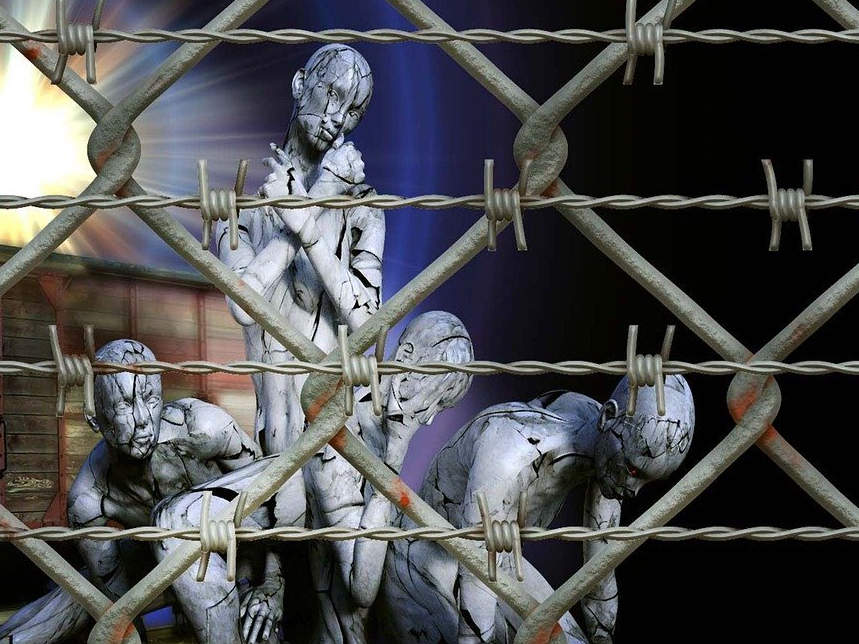
    portsoy-1244572_640Although the slave trade of that era is thankfully no more, slavery still abounds. Who are the people in our own lives, chained in the darkness of sin, feeling helpless, uncertain and fearful of their destiny? Who are those with wounded or even dying spirits, on the brink of losing hope? Who are those starving for affection, for shelter, for safety, for dignity? Will you be the one to open the hatch to descend into their suffering and restore what dignity you can?

    Let us pray that we, like St. Peter Claver, may be the slave of the slaves, forever.

    St. Peter Claver, pray for us.

  • Happy Shall You Be, and Favored: Wednesday of the 21st Week in Ordinary Time

    Happy Shall You Be, and Favored: Wednesday of the 21st Week in Ordinary Time

    2 Thessalonians 3:6-10,16-18; Psalm 128:1-2; Matthew 23:27-32

    When I was a child, learning came quickly and easily to me. I was the type of student who excelled without much effort. I expected that to continue when I got to graduate school but it didn’t; I quickly found myself struggling. Although the other students seemed to have no trouble, the nebulous concepts and abstract theories baffled me. I was lost.

    All that changed one semester when I took a class from a professor who had turned to teaching after a long career in the business world. He taught concepts and theories too but not as vague abstractions; he applied them to real-life situations that he had actually experienced. Under that kind of teaching I again excelled and this taught me something about myself: I did much better when concepts were modeled for me than when I was left to figure them out on my own.

    Perhaps that’s why the first reading resonates with me. It is taken from St. Paul’s second letter to the Thessalonians. His first letter years earlier talked at some length about the end times and it may be that over time these people had focused on that and not on the gospel. In any event St. Paul and his companions visited them, as he says, to present ourselves as a model for you, so that you might imitate us (2 Thessalonians 3:9). In so doing, he must have thought that modeling would serve as a concrete, practical example of how to more fully live out the gospel as Christ intended.

    Of course, no matter how well the Thessalonians learned about the Christian life, their imitation of it had to come from a sincere and genuine faith. Otherwise it was merely an act, an outward show, and they were no more than hypocrites, the name Jesus called the scribes and Pharisees in the gospel. In those days the Greek word “hypocrite” referred to actors on stage who hid behind large masks and in exaggerated motions pretended to be who they were not.

    Although we have long since lost that particular meaning, we all know that hypocrisy is hardly limited to the ancient world and that the words of Christ indict us as well. In our own ways each of us knows what it means to hide behind a mask, pretend to be who we are not, and speaks from a divided heart. We may have many reasons – the pain of rejection, reluctance to stand out from the crowd, etc. – nevertheless we know deep down that these are rationalizations based on fear.

    But like the Thessalonians we have spent too much time on the wrong thing. We should not be focused on servile fear – a fear of punishment – but on holy fear, the fear of the Lord as in today’s psalm. Pope Francis has reminded us that holy fear is “the joyful awareness of God’s grandeur and a grateful realization that only in him do our hearts find true peace.”1

    That is the peace prayed for by St. Paul at all times and in every way (2 Thessalonians 3:16) who knew that true peace only comes when we have conquered our servile fear and live in imitation of Christ as the people we were created to be. We can only do this by the Spirit’s gift of holy fear which, again to quote Pope Francis, “allows us to imitate the Lord in humility and obedience, not with a resigned and passive attitude, but with courage and joy.”2

    Therefore, let us pray for the virtues that help us overcome hypocrisy: humility, obedience and fortitude, and especially for an outpouring of the Holy Spirit’s gift of fear of the Lord, that we may taste the wonderful fruits of his handiwork: Love, joy, and peace. As the psalmist has so beautifully sung, Happy shall you be, and favored (Psalm 128:2).

    1https://www.catholicnewsagency.com/news/pope-fear-of-the-lord-an-alarm-reminding-us-of-whats-right-48609

    2 Ibid.

  • Love Worthy of Suffering: Friday of the 18th Week of Ordinary Time

    Love Worthy of Suffering: Friday of the 18th Week of Ordinary Time

    Matthew 16:24-28

    I recently came across a profoundly moving book entitled Man’s Search for Meaning by the Austrian psychiatrist and Holocaust survivor Dr. Viktor Frankl. In it he recounts many of the horrors of his internment in the Nazi death camps. What sets this book apart from other such accounts is that his perspective as a physician and psychiatrist imbues that experience with some remarkable insights that everyone can profit from.

    His greatest insight, hinted at in the title of the book stems from his observation that the prison camps held two distinct types of prisoner. The first and by far the majority were those who competed and struggled against each other to gain even the smallest amount of power, control, or possessions. They did so regardless of the cost to others or to their own dignity because they saw it as the way alleviate as much of their own suffering as they could. The second group was different; these prisoners befriended and looked out for others, comforted or consoled them, gave them hope. These people, Frankl realized, did so because they were searching for meaning in their suffering; they recognized in themselves and in others a freedom and dignity that no Nazi could beat, starve, or gas out of them. He went on to write: “The way in which a man accepts his fate and all the suffering it entails, the way in which he takes up his cross, gives him ample opportunity – even under the most difficult circumstances – to add a deeper meaning to his life.”

    This is exactly why Christ so challenged his disciples with the difficult words in today’s gospel; why he said, Whoever wishes to come after me must deny himself, take up his cross, and follow me (Matthew 16:24). Denying ourselves, bearing the weight of suffering, and following Christ can hurt physically, emotionally, and spiritually. But it hurts more not to, for then we become like the first group of prisoners: Grasping and fighting to reserve power, control, and comfort to ourselves. So often Frankl found that their strategy backfired; prisoners worked hard to preserve their lives but lost them anyway.

    When Christ said whoever wishes to save his life will lose it, but whoever loses his life for my sake will find it (Matthew 16:25) we rightly wonder how we can lose our life by saving it or save our life by losing it. However, the translation of “save our life” in this context is “protect” or “keep safe.” Thus, Jesus is counseling us not to keep safe but to risk being hurt, for only when we do that can we enjoy eternal life with God in heaven.

    Although that might help us understand his words, it doesn’t make living it out any easier. It seems as if Jesus is teaching that the way to avoid suffering in the afterlife is to endure suffering in this life. That seems cruel! Does Jesus really want us to suffer? What does suffering gain us?

    If we take the attitude of the first group of prisoners, the answer is “nothing.” Suffering exists only to be eliminated; it is not something to endure – for its own sake or anyone else’s.

    That is the attitude of love turned inward and as Frankl saw, the result was little gain and much futility. Love turned outward is in the image of God who is Love itself, and no one modeled that image better than Jesus, who is the image of the invisible God (Colossians 1:15). By his Incarnation Jesus taught that true love seeks neither isolation nor safety but entanglement and risk. God could have chosen to save fallen humanity from the safety of pure divinity. He didn’t; he chose to dwell among us, to take on the nature he created and raise it from within; to bind himself to the human condition beyond any untying and restore it to its original capacity for the deepest love possible: Eternal union with him. Jesus spent his life and ministry showing us what it means to love as God loves: He made himself vulnerable in the sight of others, exposed his deepest longings, deepest fears, deepest joys, his deepest self. Of course, he risked rejection and it cost him his life, but that is what love does; it was in the nature of his perfect divinity that from the depths of his infinite love and mercy, he glorified what mankind so quickly crucified.

    This tells us that Jesus doesn’t want us to suffer, he wants us to love; by its very nature, love risks suffering and when perfected will endure any amount of suffering for the sake of the beloved. Like the prisoners in the death camp we are perfectly free to refuse, but refusing to love means that we give nothing, share nothing, resist the promptings of the Holy Spirit, and remain isolated even from God himself. Some may call that safety but Christ calls it loss, for he knows that the only thing we bring to heaven is the love that we have given away.

  • Fed to the Dogs: Wednesday of the 18th Week in Ordinary Time

    Fed to the Dogs: Wednesday of the 18th Week in Ordinary Time

    Matthew 15:21-28

    There are times in the gospel when Jesus says something that makes us ask, “Did he really just say that?” For example, his mother came to see him and what does he do but turn to his disciples and say, Who is my mother? (Matthew 12:48). Then there is the time he said, If your right eye causes you to sin, tear it out and throw it away (Matthew 5:29). Today is yet another, as he says to a woman pleading for help, It is not right to take the food of the children and throw it to the dogs (Matthew 15:26).

    Did he really just say that?

    Well, yes. The question is, what did he mean? To answer that, we have to know more about the context.

    To begin with, Jesus withdrew to the region of Tyre and Sidon (Matthew 15:21), pagan lands. We might wonder why he went there but I think it was for two reasons: First, as the Catechism tells us, Christ comes to meet every human being (CCC 2560); he wants none lost but all brought to knowledge of him. Second, he has just sparred with the Pharisees about what truly defiles a person, teaching them that it is not what goes into the mouth that matters but what comes out of it (Matthew 15:1-20); that is, vice or virtue. Where better to demonstrate that than pagan territory for, by implication, the Gentiles are not defiled (as the Hebrews assumed) because of who they are; to the contrary, there may be great virtue among them. He has come to see.

    The Canaanite woman does not disappoint. She too has come to see – to see Him – and on finding him shows the faith to call him Lord and the love to pray on behalf of her child: Have pity on me, Lord, Son of David! My daughter is tormented by a demon (Matthew 15:22). She doesn’t know it but the Holy Spirit is moving within her, making her as St. Augustine once said, “a beggar before God” (CCC 2559).

    And a persistent beggar! Three times she is rebuffed. First when Jesus does not answer her (Matthew 15:23), again when he says, I was sent only to the lost sheep of the house of Israel (Matthew 15:24). Anyone less persevering might have gone away but the Holy Spirit prompts her to move closer, now to the piety of doing him homage and pleading, Lord, help me.(Matthew 15:25). If it is help that comes it is of a mysterious sort, coming in the third rebuff, the now brief but infamous parable, It is not right to take the food of the children and throw it to the dogs (Matthew 15:26).

    Before we get to the term “dogs,” consider the word “food.” Its literal translation is “bread.” In reality, Jesus is the Living Bread; in the parable, he is referring to himself. As for “dogs,” it is true that Hebrews compared people to dogs or called them dogs to imply they were either of very low status (e.g., 2 Kings 8:13; Exodus 22:31; Deuteronomy 23:18; 2 Samuel 3:8; Proverbs 26:11; Ecclesiastes 9:4; 2 Samuel 9:8; 1 Samuel 24:14) or evil (Philemon 3:2; Revelation 22:15). And although Christ softened the term by changing it to puppy or house dog, it was still in no way complimentary. However, taken as a whole, Christ is challenging her by way of parable to ask herself, “Jesus is the bread, Israel are the children; where do I belong? How am I fed?”

    Her answer is inspired: Please, Lord, for even the dogs eat the scraps that fall from the table of their masters (Matthew 15:27). Not only does she say nothing about the term ‘puppies,’ she humbly puts herself in the dog’s place yet proposes an ending to his parable that allows everyone to partake in Christ, Jew or Gentile, each in their own place. The Holy Spirit has enlightened her mind with the gift of understanding; she has begun to see that the answer to her prayer, to all prayer, means uniting her will with the will of Christ, which as we said above is that none be lost but all come to knowledge of God, who is love.

    Thus, through this faithful woman’s inspired reply to his challenge, Christ has vindicated his argument to the Pharisees that the things that come out of the mouth come from the heart (Matthew 15:18), in her case humility, perseverance, love, and understanding. These are as he said the key to “great faith” (Matthew 15:28) and they only happen when we allow the Holy Spirit to work within us, slowly but surely uniting our will to the perfect will of God.

  • Walking on the Water: Monday of the 18th Week in Ordinary Time

    Walking on the Water: Monday of the 18th Week in Ordinary Time

    Jeremiah 28:1-17; Matthew 14:13-21

    Each evangelist has a particular view of the Apostles in his gospel. In Mark, the Apostles never seem to get it right; they constantly misunderstand or respond inappropriately. In Luke the Apostles also misunderstand and make mistakes but there is always an excuse; they were tired or stressed. Matthew is perhaps more realistic. He shows the Apostles struggling; there is tension between faith and doubt. This comes through in his telling of the storm at sea and I think it reflects things true not only of them but all of us.

    Let me point out two things about how Matthew sets the scene. First, Jesus sends the Apostles across the sea without him while he prays to his Father on the mountain. As he remains serenely at prayer a storm rages on the sea, tossing the Apostles’ boat in every direction. Second, Jesus does not come across the sea until the 4th watch of the night – some time between 3 and 6 am. In other words, he lets the Apostles get tossed around in the storm for several hours before going to them.

    We can all identify with this in our own way. Think of a time when you were under great stress, when life seemed to toss you about, when every minute seemed like an hour and the stress was more than you thought you could bear. You prayed and prayed for relief, and… nothing. How did you feel? As for myself, I would say that I felt alone; doubtful that God was ever going to help; vulnerable; tense; above all, afraid.

    Fear is perhaps what we have most in common with the Apostles. It can be paralyzing; we don’t know what to do, who to listen to, how to respond. We want to run away but we’re trapped; we can’t.

    At such times we are most susceptible to the kind of false prophet we hear about in the first reading, in our case someone who either tells us what we most want to hear or what confirms our worst suspicions and deepens our darkest fears: We’re alone; being punished; God has abandoned us, will not help us, or worst of all, is not there. It isn’t surprising that in fear the Apostles chose the worldly explanation on seeing Jesus: It is a ghost (Matthew 13:26).

    But God is truth and as Matthew has made clear from beginning to end in his gospel, Jesus is Emmanuel, God-With-Us (1:23), and will be with us always until the end of the age (28:20). So he comes, but notice how: From within the storm itself. In this we learn that God is with us not above and beyond the storms of life but deep in the midst of them. However we suffer, however we feel, we are not alone; Christ is compassion and speaks to us in that suffering. It may be the grace of long-suffering, patience, or fortitude; he does not tell us but as the Divine Physician he comes, gives us grace, and strengthens us for whatever journey he has in mind.

    Moreover, Christ does not simply appear in the storm – he calls from it:“Take courage, it is I; do not be afraid” (Matthew 14:27). He does this not to criticize or overpower but to give courage and to encourage; not necessarily to calm the storm raging around us but to bring calm and inner peace to the storm that rages within.

    Those who love Jesus as Peter did will do what true love does – cast aside fear and risk everything to be with the Beloved. This is one of Peter’s most endearing qualities – the recklessness of his love for Christ – and we do well to imitate it. Our Lord rewards such love; he bids Peter,“Come” (Matthew 14:29).

    Yet as St. Augustine said in his Confessions, “My weight is my love, and this it is that bears me in whatever direction I am borne” (Confessions XIII 9, 10). Although Peter did love our Lord, fear got the better of him: when he saw how strong the wind was he became frightened (Matthew 14:30) and began to sink. The question is, in what direction are we borne? Let us bring that to prayer today, asking for the grace that does not allow fear to bring us down amid the storms of our life but to keep our eyes fixed on Christ, our feet on firmly with his, facing those storms from the top of the water.

  • The Wounds of Love: St. Birgitta of Sweden

    The Wounds of Love: St. Birgitta of Sweden

    Galatians 2:19-20; John 15:1-8

    I once instructed a woman in the RCIA program who excelled in her studies of the faith. After receiving the sacraments she moved away and I lost track of her. Years later, I learned that she had stopped practicing the faith. She was now “spiritual but not religious.” I think that means she believes that while there is a spiritual dimension to the world, it isn’t what we understand as the faith most fully revealed to us in Christ.

    The sticking point for her, as for many, may well have been the passion and death of our Lord. Indeed, the crucifixion was called by St. Paul a stumbling block to Jews and foolishness to Gentiles (1 Corinthians 1:23). But to one of the saints, St. Birgitta of Sweden, the crucifixion held a special place; it was the nexus of the physical and spiritual worlds.

    Birgitta lived a life full of the joys and sorrows of family. Born in Sweden around the year 1303, the daughter of a governor, by age 42 she had already been a wife for 28 years and a widow for one. She had a wide and deep experience of motherhood; as mother of 4 boys and 4 girls, she saw one daughter run off to marry a troublemaker, one son die as a boy, one as a man, and another daughter grow up to become St. Catherine of Sweden.

    She also knew the life of the working world. While raising her own children she served as lady-in-waiting to the queen of Sweden. Her kind, motherly way drew her into the confidence of the king and queen, both of whom tended to enjoy worldly life too much for their own good. Birgitta worked as hard as she could to keep their religious concerns before them; this became a frustrating and unfortunately futile struggle.

    Finally, Birgitta knew the religious life as well. After becoming a widow and devoting herself to care of the poor, who greatly loved her, she dedicated buildings and land on family property to a new contemplative order. She wrote the rule for her order which became known as the Order of the Most Holy Savior.

    At the same time, Birgitta lived a full life in the spiritual world. She was a mystic. At age seven, she had a vision of being crowned by the Blessed Mother. Three years later came her most profound mystical experience: The crucified Christ appeared to her and bid her gaze upon him. When she asked who had so cruelly treated him, he replied, “Those who despise me and spurn my love for them.” This was her own Damascus road moment; although she had many visions, dreams, and locutions afterwards, she devoted the rest of her life to the contemplation of Christ’s suffering.

    After wisely consulting her spiritual advisor and obtaining his approval, Birgitta began to share her visions with the world. She met with Magnus, the king of Sweden, and advised him that Christ would visit a plague on the land if he and the queen did not change their ways. As usual, he laughed off her vision. The Black Death came two years later, wiping out half the population. Needless to say, the king stopped laughing.

    Birgitta next focused her attention on the popes, who had long since deserted Rome in fear for their lives. Leaving Sweden with her daughter Catherine, she moved to Rome. In the midst of its crumbling churches and society, Birgitta ministered to the sick, fed the poor, housed pilgrims, and called on the pope to return. Her call took on a special intensity due to her dislike of pope Clement VI, who she called “a murderer of souls, more unjust than Pilate and more cruel than Judas.” During a thunderstorm on the night of December 3rd 1350, lightning struck the bells of St. Peter’s, melting them. Birgitta prophesied this as a sign that Clement’s life was coming to an end. He died a few days later. When the next pope fled to get away from her Birgitta literally chased him down, begged him to approve her order, which he did, and to return to Rome, which he did not do. After her death in 1373, her call for the popes to return was taken up by St. Catherine of Siena. Not long after, the papacy returned to Rome to stay. Birgitta was vindicated.

    In the first reading, St. Paul wrote:

    I have been crucified with Christ; yet I live, no longer I, but Christ lives in me; insofar as I now live in the flesh, I live by faith in the Son of God who has loved me and given himself up for me (Galatians 2:19-20).

    jesus-753063_640

    Birgitta’s life is a testament to the triumph of St. Paul’s words. From the moment of that first overwhelming spiritual encounter with the suffering, crucified Christ when she was 10 years old, she began to internalize them; to sense as we all must, not only the pain of Christ’s passion but the passion behind his pain. The ultimate reality of the cross is love, a love so great it unites heaven and earth, the physical and spiritual. What else could it be but love that would cause God himself to take on our humanity, our sinfulness, and in the face of humanity’s rejection, nail it to the cross? Birgitta spent her life contemplating not the pain of futility but the pain which Oscar Wilde called the wounds of love. In her own way, St. Birgitta spent her life showing her family, her king, her people, and her pope that this is not only a love worth dying for; it is a love worth living for – eternally.

    St. Birgitta, pray for us.

  • Minute Meditation: Feast of Mary Magdalene

    Minute Meditation: Feast of Mary Magdalene

    Today we celebrate the Feast of St. Mary Magdalene. We know little about her and over the years the little we know has been tainted with confusion and misunderstanding.

    Let’s put all that aside and consider just two lines from Morning Prayer of the universal Church. They tell us everything we need to know:

    • When Jesus had risen from the dead on the morning after the sabbath, he appeared first to Mary Magdalene, from whom he had cast out seven devils.

    and

    • Father, your Son first entrusted to Mary Magdalene the joyful news of his resurrection.

    Those two lines give us more than enough to think about the entire day. Consider: Whoever she was, wherever she was from, whatever her tormented past, she was transformed into the person Christ first appeared to and entrusted with the news of his resurrection.

    Thanks be to God, that same kind of transformation is available to you and to me. Whoever we are, wherever we are, whatever our past, while we live we are never beyond the healing transformation of Christ’s redeeming love. It is as far away as our next breath if that’s what we want.

    In the words of St. Augustine, every saint has a past; every sinner has a future.

    St. Mary Magdalene, pray for us.

  • No Reluctant Prophet: Monday of the 16th Week in Ordinary Time

    No Reluctant Prophet: Monday of the 16th Week in Ordinary Time

    Micah 6:1-4, 6-8; Psalm 50:23; Matthew 12:38-42

    So far in this chapter of Matthew we have seen Jesus being treated by the Pharisees like a man on trial. They have twice accused him of violating the sabbath, once of being in league with demons, and now, joined by the scribes, they confront him with the demand for a sign from God (Matthew 12:38).

    Given their lack of faith in Jesus this may seem reasonable but it betrays at least two problems they have in their relationship with God. First, no scribe or Pharisee, no human being is ever in a position to put God on trial or make Him prove anything. If anyone is on trial it’s us, as the prophet Micah said in the first reading: the LORD has a plea against his people, and he enters into trial with Israel (6:2). What’s more, we don’t get to tell God who He works through or how He does things. As He also said through Micah, I brought you up from the land of Egypt… I released you… I sent before you Moses, Aaron, and Miriam (6:4). God calls the people, God determines the path. Second, notice how Christ responds to the demand of the scribes and Pharisees by speaking of an “unfaithful” – or “adulterous” – generation (Matthew 12:39). This nuptial language goes to the heart of the real problem, which is the failure of these men to understand that our relationship with God is not a contract, or something we negotiate. It is a covenant, a mutual giving of our entire selves one to the other; a commitment that is total and unto death.

    Jesus drives this point home with true irony by bringing up Jonah for as everyone knew, Jonah was a prophet who was “total” only in his defiance of God’s will and “unto death” only in his effort to avoid doing it. The so-called “reluctant” prophet, Jonah sailed the other way when God called him to preach to pagan Nineveh, tried to drown himself in the sea when he got caught, spoke as little prophecy as possible, angrily complained when Nineveh repented, and worried more about losing the shade from a plant than about the possibility of over a hundred thousand Ninevites dying. Jonah was the perfect example of how not to commit yourself to God.

    Yet Christ took that prophet and made a sign out of him: Just as Jonah was in the belly of the whale… so will the Son of Man be in the heart of the earth (Matthew 12:40). Out of that one point of deep darkness – the disobedient man’s descent into the belly of the beast – Christ brings one point of brilliant light – the obedient Son of Man’s descent into the heart of the earth, or, as we say in the Apostles’ Creed, his descent to the dead. There of course he would preach as Jonah could only wish to, and release those repentant souls who had been awaiting the redemption only He could bring.

    Had the scribes and Pharisees recognized the prophetic truth that Christ had just spoken, they would have known that all they had left was the question from Micah: With what shall I come before the LORD, and bow before God most high (6:6)? Since they did not, we turn to ourselves, for we too are on trial. In our own ways, we are all guilty of being a reluctant prophet: Avoiding various calls to serve, stubbornly resisting God’s will, doing the minimum possible, complaining to God about people whose repentance only He can know, and worrying more about our own comfort than about the suffering of many around us.

    So, with what shall we come? Scripture makes it clear: Prayer and sacrifice. As Micah urges us to do right, love goodness, and walk humbly with God (6:8), we pray for the virtues: Prudence, to know what is right; fortitude, to do it; wisdom, to see and love God’s goodness in all people; humility, to walk with God where He leads; and faith, to trust and praise Him at all times. This is a sacrifice, for like Jonah we are inclined to do what we want, love what we want, and walk where we please. But through the psalmist God reassures us: He that offers praise as a sacrifice glorifies me; and to him that goes the right way I will show the salvation of God (Psalm 50:23). The Salvation of God is Christ, who does only right, is love and goodness itself, and who walked in perfect humility all the way from the heart of his Father to the womb of his Mother, from the height of the cross to the heart of the earth, and from the Sacraments he has given the Church into the hearts of all believers.