Matthew 13:54-58
As part of a pilgrimage to Italy, we were privileged to visit all of the major cathedrals in Rome. It was very easy to be bowled over by their beauty. They were truly a feast for the eyes; majestic and overwhelming. I remember visiting St. Mary Major while daily Mass was going on. As all the tourists walked around admiring the magnificence, the local people went to Mass and, when it was over, simply got up and left. To me, this was a wonder to explore; to them, it was just “their church.”
It reminded me of the old saying that “familiarity breeds contempt.” Not that the people were in any way contemptuous of their church; they weren’t. I just mean that to them St. Mary’s was “home,” a familiar place, one many of them had known all their lives.
However, there does seem to be some contempt for Jesus in the questions and attitude of the people in his home town. They had known Jesus most of his life and seem somewhat bemused as they ask one of the most crucial and ironic questions in the gospel: Is he not the carpenter’s son? (Matthew 13:55). From our perspective we might wonder at their wonderment; this is the Son of God, announced by the angel to the Blessed Virgin Mary. But those asking the question weren’t reading the gospel; to them, this was Jesus, who grew up among them. They knew his mother, they knew his family, they knew him.
Or did they?
It’s human nature to want to know things, and to think that we do. We’re used to learning; we’ve done it from birth. But our intellect is limited; no matter how much we know about anything, certain aspects remain hidden from us. We see this in our own relationships. If you’re married, think of your spouse; if not, perhaps brothers, sisters, or other family. Think even of places, like this church. We know them, right?
Yes and no. Although we do know a lot, there are limits, things we can never know. Take even the most familiar person. No matter how well we know them, they will ultimately remain a mystery simply because we cannot know their inmost being – their soul. At church we can see the pews, the walls, the statues, the tabernacle, the hosts inside it, but the supernatural realities also remain a mystery: the substance of the bread and wine, the outpouring of the Holy Spirit, the Real Presence of Christ. Hidden from our senses, these are revealed only to the eyes of faith.
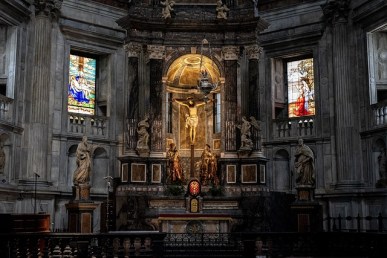 The complication is that our senses can actually keep us from seeing the spiritual reality. We become so preoccupied with what they’re telling us that we miss what lies beyond them. When I walked through St. Mary Major I saw every artistic and architectural wonder she could reveal but missed the revelation that all of it pointed to, the greatest one possible – Christ in the most holy Eucharist. As for the people at Mass, they were also at risk of preoccupation, not with works of art but with their own thoughts or problems. In either case, the task before us is to concentrate on the glory being revealed to us, for it alone is the more lasting and soul-satisfying.
The key to success is faith; the free assent of our mind and submission of our will to divine revelation. When faith guides where senses fail we find that familiarity breeds not contempt but love, that familiarity is not a barrier to a deeper experience of God but actually the road by which we enter more and more deeply into it.
 Today we honor Saints Joachim and Anne, the parents of Mary, for many reasons related to salvation in memory and reality. Most especially we honor them as husband and wife, for it was their marriage, their union that produced the Immaculate Conception, which transformed the dim, distant memory of salvation into a living, breathing, crystal clear reality. We also honor them because, as the last of that long line of generations who patiently waited through the long night for the first rays of salvation’s dawn, doing so honors all the faithful who lived through and, in whatever ways they could, passed on the events of salvation history to those who came after. Finally, we honor them as parents, for they raised their daughter in the faith, taught her the love and goodness of God, and instilled in her the devotion He preferred for the mother of His Only Son.
 Of course they could; the question was, did they know the cost? As Pope Francis once said, “I distrust a charity that costs nothing and does not hurt.” Jesus is Charity itself; God is love and there is no greater love than to die that others may live. Such a love virtually promises to hurt. Where James may have imagined sweet wine, a crown of leaves, and the cheers of a crowd, Jesus offered bitter gall, a crown of thorns, and a crowd cheering to see Him die.
 If the Pharisees had been thinking from this perspective they would have realized that the disciples were not just walking through a field wantonly plucking heads of grain in supposed violation of the sabbath; they were following Christ, giving their lives every day of the week, including the sabbath, to the Lord of the Sabbath.
 Like Dickens’ specters, ignorance and want still haunt us today. Modern culture has forgotten God, and this ignorance moves it to see family, life and love as things that can re-defined. Our scriptures today remind us that no Pharaoh, no judge, no culture can re-define what they could never define to begin with. And where our society wants us to believe that we are lost until we find ourselves, let us remember that Scripture teaches us exactly the opposite; we are found when we lose ourselves for the sake of Christ.
 The abbot reminded the king and he reminds us that the church is not a place we run to that we may lose ourselves; it is the place we come to that we may find ourselves. Over the course of his life and reign Henry spent hours on his knees in front of the Tabernacle. He may have meant to empty himself of his problems but Christ had a different plan; He desired to fill him with the grace that would enable him to face and overcome his problems.
 One night, eight years into a 30-year sentence for the murder of a young girl who had refused his advances, Alessandro Serenelli fell asleep. Suddenly, where his prison cell had been he now saw a beautiful, sunny garden and a girl approaching. As she drew near, he recognized her as Marietta, the girl he had slain. Fearful and wanting to flee but unable to, he watched as she bent down, picked several lilies, and offered them to him. As he took them, they changed into flaming lights. He counted fourteen of them; one for each knife wound he had once inflicted on her. She then smiled at him and said, “Alessandro, as I have promised, your soul shall someday reach me in heaven.”
 This is the freedom that changes not only our own life but the lives of others as well. Consider how Elisha’s freedom to follow Elijah affected the lives of others. What would have become of all the people Elisha touched in his ministry had he refused the call and simply kept on plowing? In our own time, think about how the choices we make affect the lives of others. Where would the moral development of our children be if we chose to ignore what God has taught us? What would our relationships look like if we ignored St. Paul’s exhortation to serve one another through love (Galatians 5:13)? God’s call changes all of us no matter how we choose. If we accept it we grow closer to Him and bring others closer to Him as well; if we refuse or ignore it we distance ourselves and may well keep others from Him. The choice is ours.
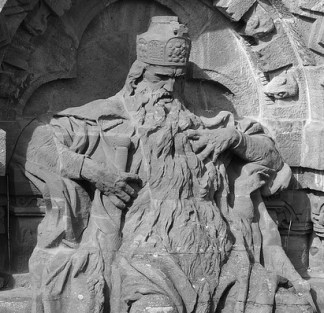 Although he was as willing to follow Jesus as the scribe in the gospel, Cyril did not lose his personality in the process. By all accounts, he was imposing, impetuous, impatient, perhaps even infuriating. He wasn’t always the perfect picture of sanctity or the epitome of virtue. Very few saints are. Sinners and saints fight the same battles, share the same temptations, and struggle with the same demons. They differ only in their response to them. The sinner looks to himself or to the world for strength; the saint looks to Christ alone. This is what Cyril knew and what St. Paul meant when he told the Corinthians:
 Mark 10:45