Thursday of the 24th Week in Ordinary Time
1 Corinthians 15:1-11; Luke 7:36-50
I have a confession to make: At times, my past haunts me. I re-live mistakes I’ve made, moments in my life I’ve let someone down, or when I could’ve done something to make a bad situation better, but didn’t.
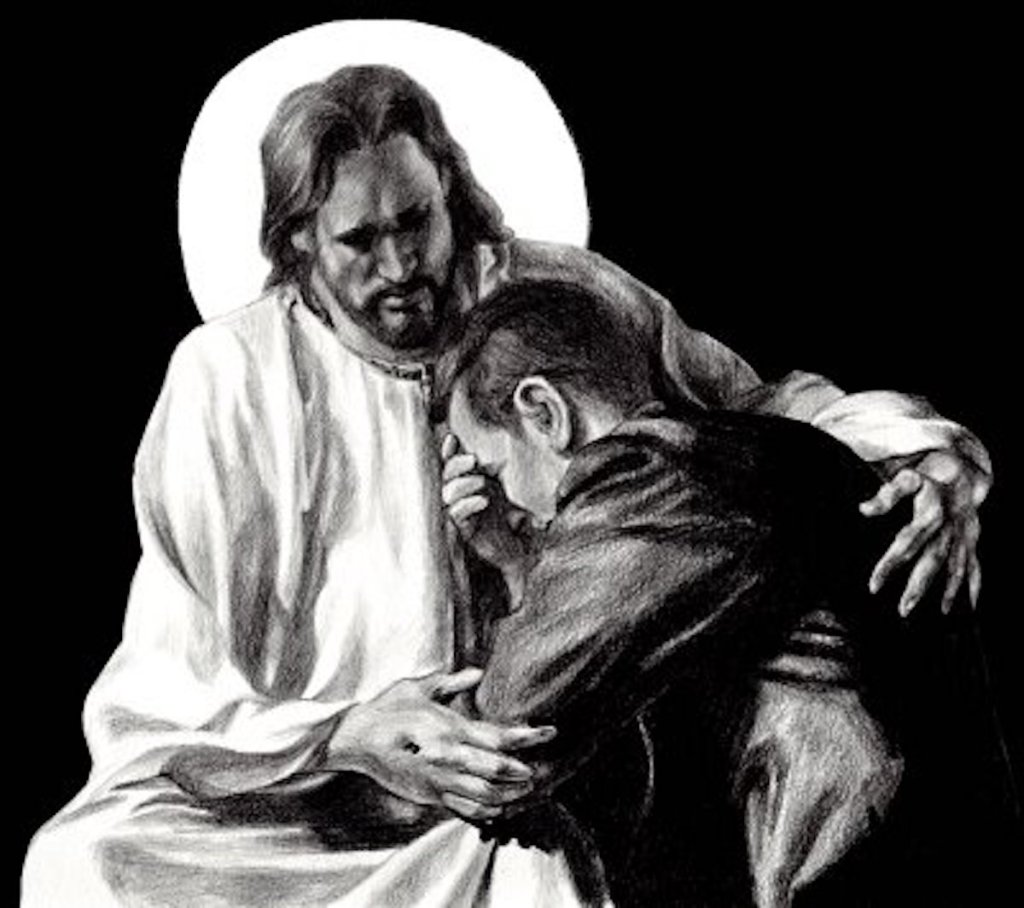
I know I’m not alone. We see it in the readings today. First, St. Paul says, I am the least of the Apostles, not fit to be called an Apostle, because I persecuted the Church of God (1 Corinthians 15:9). Sounds like the past is on his mind, most likely when he stood watching as St. Stephen was stoned to death. Then in the gospel, the sinful woman wept at the feet of Jesus and began to bathe his feet with her tears (Luke 7:38). Clearly, the past was on her mind. Indeed, it drove here there!
Perhaps to one degree or another, it’s true for all of us. Even if we’ve confessed our sins, those moments continue to haunt us. If it happens to you, here are some “do’s” and “don’ts” that I hope help you deal with it.
We can summarize the “do’s” in the old saying, “Let go and let God.”
- Do let go of resentments. We may resent other people, we may resent something about ourselves. Regardless, resentments hurt only us; they keep us focused on what has already happened at the expense of what is happening right now.
- Do let go of the need to control. Some of us want to be in control of every situation, or at least appear that way. That’s not possible; things happen every day that are simply beyond our (or anyone’s) control. Like the sinful woman, let that go at the feet of Christ. Remember that God is bigger than anything we encounter, loves us infinitely, and has our welfare in mind. He is in control; give him the unknowns.
- Do let go of the past. Key here is to remember what St. Paul said next: But by the grace of God I am what I am,and his grace to me has not been ineffective (1 Corinthians 15:10). Christ meets us with his grace only in the present moment, not the past or the future. Remain with Christ in the present; that’s the only place we can make a difference to ourselves or anyone else.
As for the “don’ts”:
- Don’t ignore the pain of the past. Find ways to deal with it. The sinful woman dared to enter a roomful of men to get to Christ; St. Paul talked openly about how he persecuted the Church. If you’re struggling to let something go, find someone, be it friend, clergyman, or therapist, to talk to. They can help you focus on what matters.
- Don’t forget empathy. As the gospel showed, Simon the Pharisee was pretty short on it. As our Lord noted, he failed to welcome him with due respect and was certainly judgmental toward the sinful woman. Christ was right in front of him, in person and in the person of the woman, but he couldn’t see him. Christian love is empathetic; our goal is to see in each other the face of Christ, do the best we can to see things through their point of view, and respond accordingly.
- Don’t stop. It’s easy to allow failure to stop us. Don’t! If even in little ways, keep moving forward. As we heard, St. Paul pushed himself to work harder than the others. As for the sinful woman, we don’t have to imagine her resolve after being forgiven by Christ; we know the feeling of forgiveness after a good Confession; it is as if a 16-ton weight has been lifted off our shoulders. As the only Son of God once taught, when the son frees us, we are truly free (John 8:36).
St. Therese of Lisieux once prayed, “O my God, you know that to love You I only have today.” Perhaps one step toward doing (and not doing) all these things is to make her prayer our own, so to live in the grace of the present moment. For that is the place we come to Christ and rest in him, that we may never let him go.
—
 Mark 10:45
Leave a comment